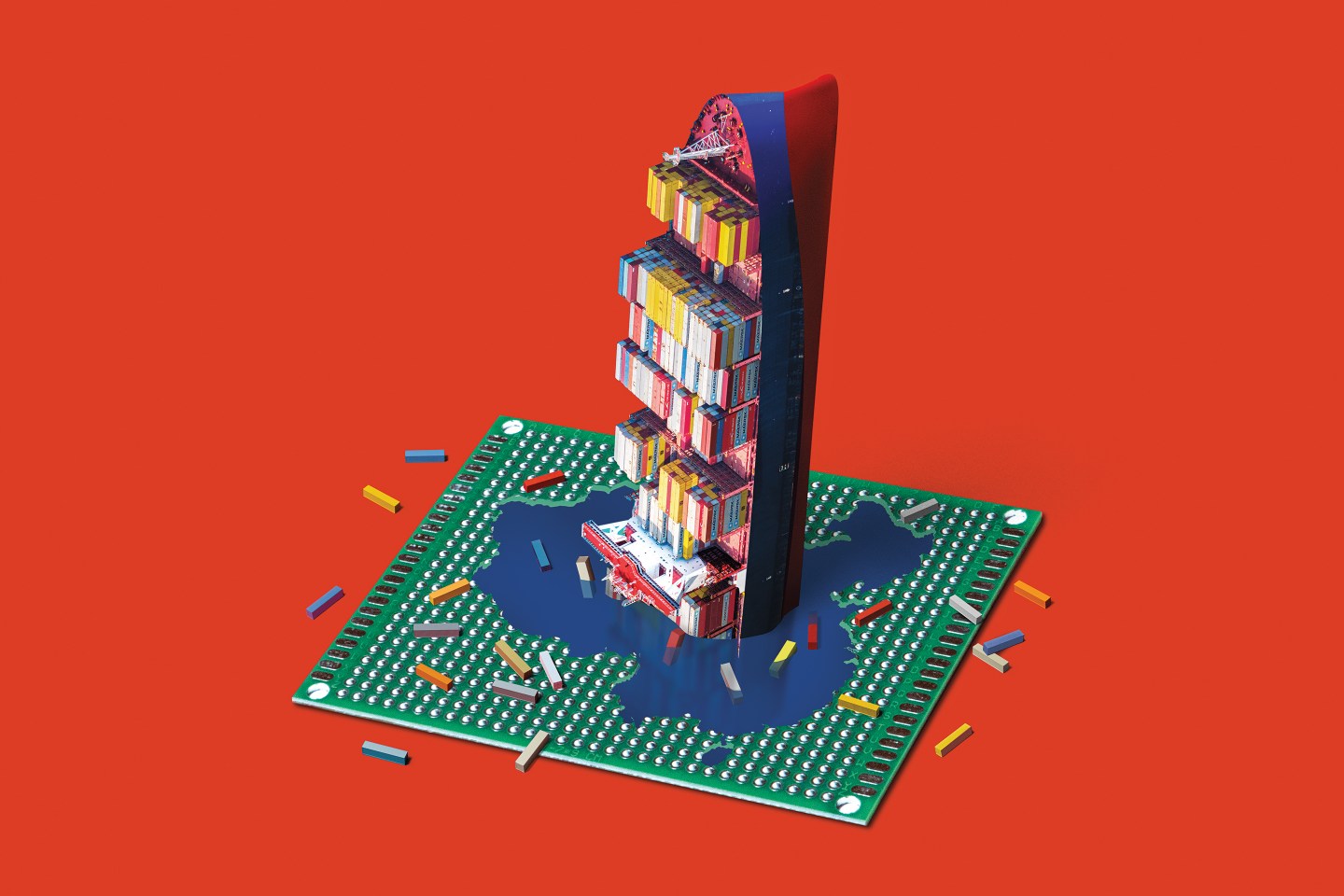
During his first term as president, Donald Trump shook up global trade by imposing new tariffs on China, the world’s epicenter for manufacturing. Companies importing Chinese-made goods into the U.S. suddenly found themselves having to pay extra duties—sometimes 30% more—if they continued using that country as a supplier.
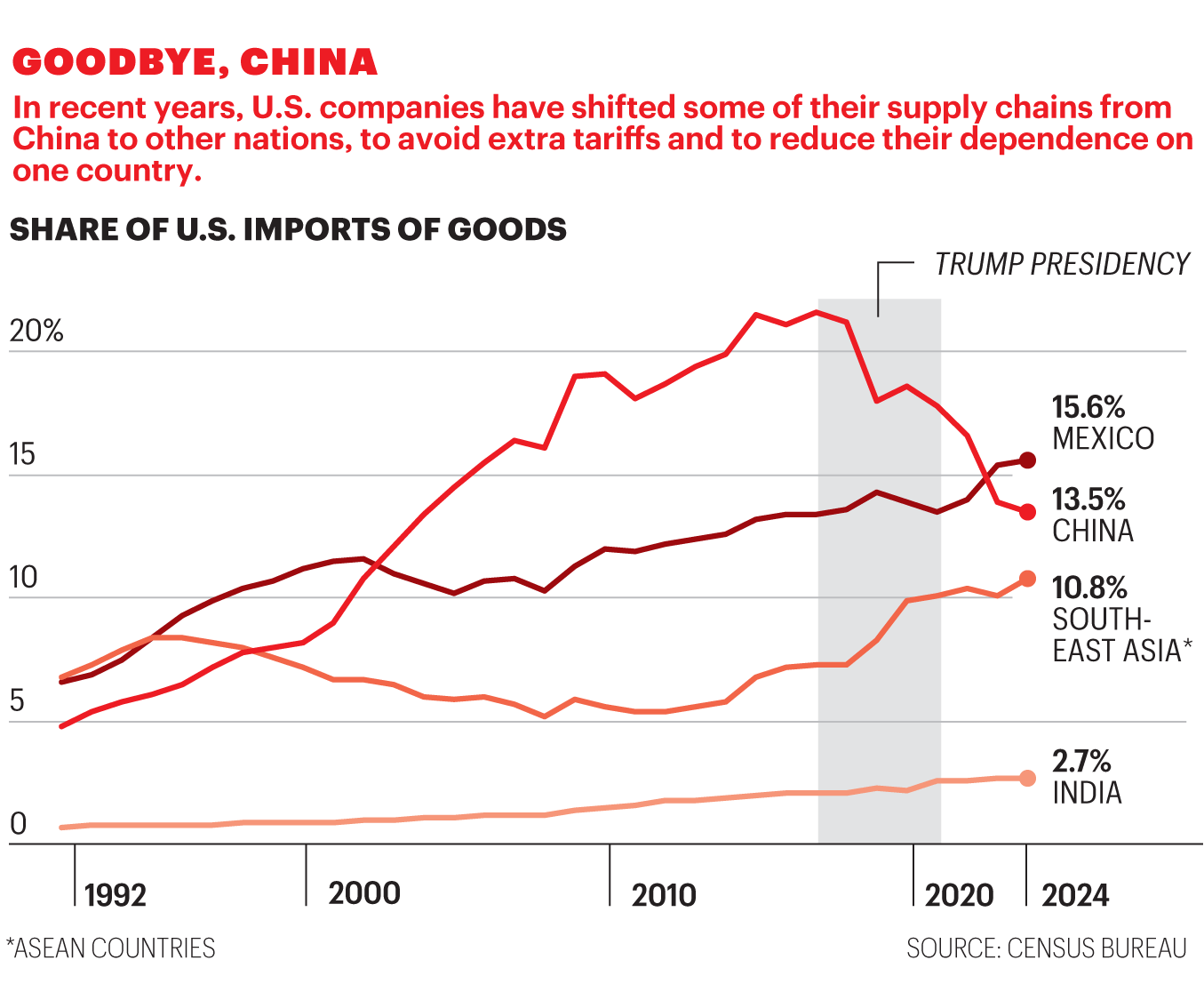
The response by U.S. businesses was swift: Many relocated at least some of their production from China to countries like Vietnam, India, and Mexico, which weren’t in Trump’s economic crosshairs.
Now, with Trump’s second term underway, the tariffs plan is again on the table. But this time, he’s promised an expanded version that, if implemented, would create even more corporate upheaval and turn some previously winning countries in his trade war into big losers.
“Trump Two is not Trump One,” warns Deborah Elms, head of trade policy at the Hinrich Foundation, a Singapore-based think tank that advocates for sustainable global trade. “I’m not convinced that everyone recognizes the extent of the danger. It’s going to catch a number of folks in the region really off guard.”
Trump’s specific road map for reshuffling global trade will emerge in the months and years ahead—or perhaps there will never be a map, leaving business leaders in the dark on a critical issue impacting their all-important planning. What is clear from his previous dance with tariffs is this: Even after nearly a decade of tensions with China, U.S. companies still haven’t been able to find a replacement for Chinese manufacturing.
In reality, Trump’s tariffs—largely unchanged under President Joe Biden—accelerated a transition from China that was already underway. Companies had already started to move lower-value manufacturing, like textiles, to other countries as labor there became more expensive. “A lot of this diversification was the Chinese factories themselves, picking up their equipment and moving the whole thing to Vietnam and Cambodia,” says Joe Ngai, chairman for the Greater China region at consulting firm McKinsey.
Beijing’s harsh COVID-era lockdowns, which closed factories nationwide and snarled the country’s well oiled supply chain, added even more urgency to the shift. U.S. companies realized that they didn’t want to depend too much on a single country.
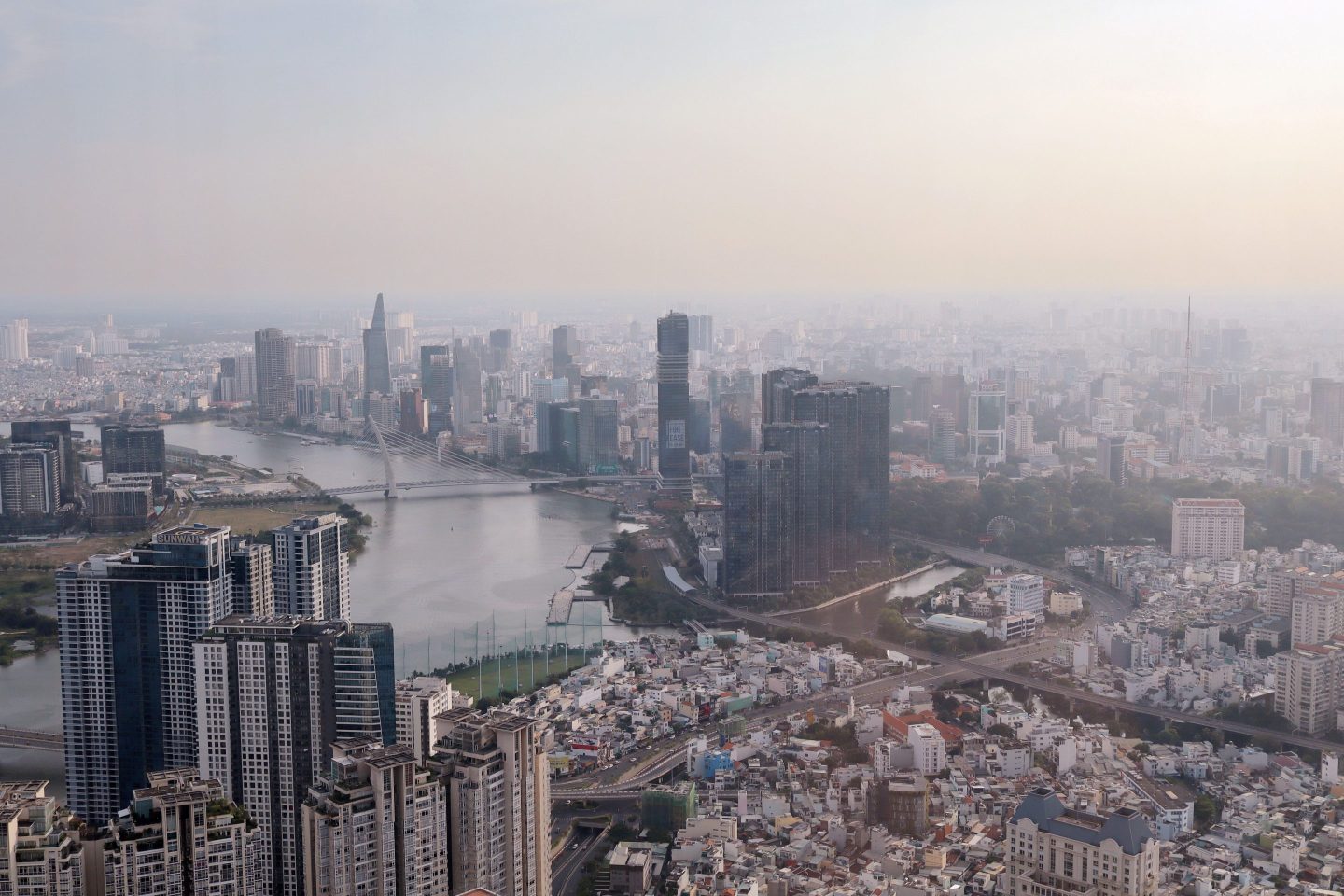
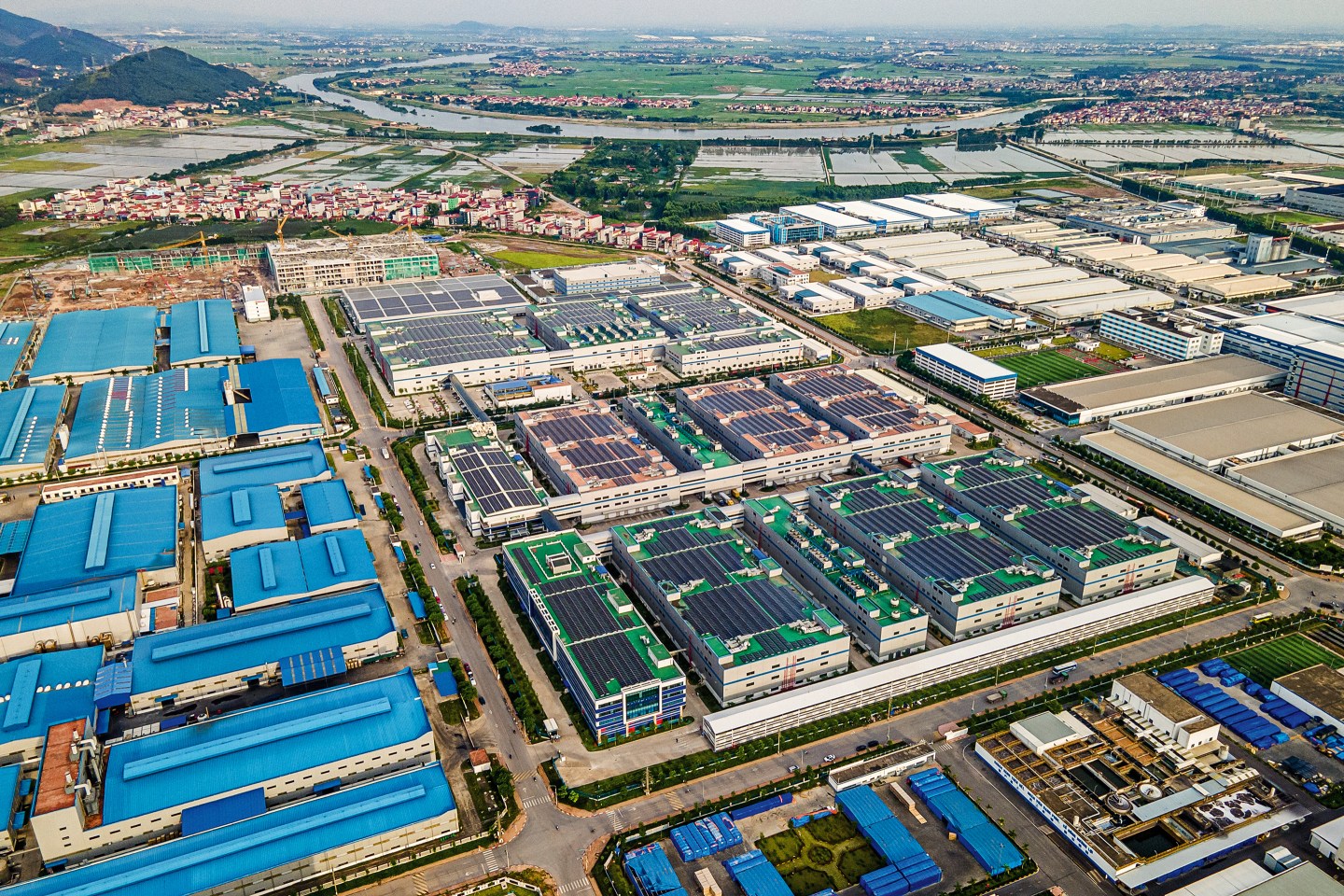
Vietnam’s status as a manufacturing hub in particular soared from the new push to diversify and avoid tariffs. Apple, HP, and Dell are among the major companies that have moved manufacturing to the Southeast Asian country, part of the $290 billion in foreign investment there since 2016—or more than during the entire two decades prior. “From an Asian perspective, Trump One was disruptive but not, on balance, that dreadful,” Elms says.
Biden-era laws related to China add another complication to the supply-chain story. The Inflation Reduction Act, partly aimed at increasing domestic manufacturing, made China less attractive as a supplier to the clean energy and automotive industries. Electric-vehicle makers, for example, can’t collect subsidies offered by the legislation if they use components from countries of concern—namely, China.
Additionally, Biden has banned exports of U.S. advanced semiconductors and chipmaking equipment to China. The crackdown has made it more complicated for chipmakers like TSMC, Samsung, and Intel that have existing factories there. The bans, combined with the impact of higher tariffs, have pushed some chip producers to add plants in other countries.
As a result of the long list of obstacles, China’s share of all U.S. imported goods has dropped sharply in recent years. After peaking at 21.6% of all imports in 2017, China’s share had fallen to 13.5% in November, according to the U.S. Census Bureau.
One reason China has retained a substantial footing after Trump’s broadsides during his first term, as well as Biden’s more surgical strikes, is its strength in high-end manufacturing. Not only is China’s labor cheap, relatively speaking, but it’s also skilled. “For stuff that’s very intricate, there’s just no country that can match the scale that China has,” says Keith Hartley, CEO of LevaData, a platform that gives companies insights into their supply chain.
In reaction, many companies have pursued a “China plus one” strategy—or more accurately, a “China plus one plus one” strategy, according to Hartley. It involves establishing a manufacturing base in China, a second elsewhere in Asia, and a third on yet another continent.
That strategy is also being pursued, ironically, by Chinese companies, some of which are now exploring opening new factories closer to markets in Europe, Southeast Asia, and Latin America. China electric vehicle giant BYD, for example, has committed to building new plants in Thailand, Brazil, Hungary, Turkey, and Pakistan, and is reportedly considering one in Mexico.
So as a second round of Trump tariffs looms, where might companies reshore next? One option is India, already home to a small but growing share of Apple’s iPhone manufacturing. Smartphones are now India’s largest export to the U.S., thanks partly to Apple and its suppliers’ investments there. India “is seen as an ally of the U.S. and is also eager to limit its own exposure to trade with China,” says Eswar Prasad, a Cornell University economist.
But India still hasn’t quite caught up to China’s well-developed supply chain, with Indian factories reportedly struggling to match the low defect rates of Chinese counterparts. “Indian manufacturing is not stepping in to be a regional manufacturing hub, let alone a global manufacturing one,” Hartley says. “It befuddles me.”
But will Trump Two present the same opportunities as Trump One? It’s unclear.
The first Trump administration was largely willing to limit tariffs on products made with Chinese components but assembled in South Korea or Vietnam. Now the U.S. seems determined to cut China off entirely.
The problem, many experts say, is that it’s nearly impossible to manufacture products without at least some Chinese-made components. No other country—in Asia or elsewhere—offers the breadth of production at a similar cost. “We are still incredibly addicted to the China supply chain in the global sense—not just the U.S.,” Hartley says.
In his second term, Trump is expected to aim his tariffs more broadly, in terms of the number of countries targeted, than he did previously. One strategy may be to slap tariffs on all U.S. imports or on goods from countries that have a trade surplus with the U.S.
Nominations are now open:
Fortune is now accepting nominations for the 2025 Southeast Asia 500—the definitive ranking of the region’s largest companies. Start your nomination here.
Several Asian countries, for example, export more to the U.S. than they import. The most dangerously exposed may be Vietnam, which has the third-largest trade surplus with the U.S., after China and Mexico. In 2019, Trump went as far as blasting Vietnam as “the single worst abuser” on trade. As a result, Sheana Yue, an economist with Oxford Economics, told Fortune in December, “We expect Vietnam to be the only Southeast Asian economy the Trump administration will implement higher tariffs on when he gets into office.
That’s bad news for Vietnam, which smashed expectations in 2024 with a 7.1% GDP growth rate thanks to strong exports. This year, its government expects an even faster 8% in economic growth, despite Trump.
New tariffs on Vietnam and other countries, if implemented, would be a major hit to companies that have spent millions of dollars to shift production there. Years of planning are usually involved, making it impossible to hopscotch between countries for lower tariffs. “Creating a factory is a big capital expense. You can’t move these things,” McKinsey’s Ngai says.
Meanwhile, after almost a decade of worsening tensions between Washington and Beijing, Chinese companies are increasingly giving up on ever breaking into the U.S. market. Instead, many are focusing on growing in Indonesia, Africa, and the rest of what’s now known as the Global South. “If, at the end, I don’t sell to the U.S., it’s not the end of the world,” Ngai says, wearing the hat of Chinese CEOs.
U.S. companies, too, are planning for a world without the Chinese market—partly because Chinese products are increasingly high-enough quality to compete against them. Apple, Nike, and Starbucks, for example, now face fierce competition from local Chinese brands that offer good products at cheaper prices.
Instead, Ngai thinks, tariffs will complicate life for Western companies that still rely on low-cost Chinese goods: “The nightmare is not for Chinese companies. The nightmare is for Walmart and Costco if they can’t import from China.”
Both Costco and Walmart have warned that broad tariffs on U.S. imports translate into higher prices for U.S. consumers. “Tariffs raise costs,” Costco chief financial officer Gary Millerchip said during a recent earnings call. “When it rains, it rains on everybody.”
Walmart’s dependence on Chinese imports to stock its store shelves has declined, however, as it seeks to diversify its suppliers. During the past five years, Chinese imports to the U.S. have declined to 60% of the company’s total merchandise from 80%, according to Reuters, while imports from India have soared to 25% from just 2% overall.
Many U.S. consumers would feel the financial impact of higher tariffs from the countless small and medium-size manufacturers in China that send cheap goods to the U.S. Online retailers that facilitate crossborder commerce and are increasingly popular with U.S. shoppers would also be impacted. “The days of Chinese companies like Shein and Temu sending low-value packages to the United States that are not subject to taxes are numbered,” says Prasad, referring to two of the biggest Chinese e-commerce sites in the U.S.
Just as some U.S.-based companies haven’t quite kicked their addiction to Chinese supply chains, some Chinese manufacturers haven’t been able to quit the U.S. consumer. Says Elms, of the Hinrich Foundation: “It’s not so easy to find a replacement market for the U.S.”
This article appears in the February/March 2025 Asia issue of Fortune with the headline “Trump’s first trade war caused U.S. firms to flee China. Now comes round 2.”