Cases of HN51 bird flu in mammals like those reported recently must be “monitored closely,” the head of the World Health Organization said Wednesday, as the organization’s experts called on public health officials to prepare for human outbreaks of the disease.
H5N1 avian flu has existed for a quarter century. Only rarely have human cases occurred, with no sustained transmission reported. But “we cannot assume that will remain the case,” WHO Director General Tedros Adhanom Ghebreyesus said at a news conference. New, frequent reports that the disease has crossed into small mammals like minks, otters, foxes, and sea lions are cause for alarm, given the species’ similarities with humans, he noted.
While the risk to people remains low, public health officials must prepare “to face outbreaks in humans, and be ready also to control them as soon as possible,” Dr. Sylvie Briand, director of Global Infectious Hazard Preparedness and Emergency Preparedness at the WHO, told Fortune.
Ghebreyesus cautioned against touching or collecting sick or dead animals, and encouraged those who encounter such to report them to local authorities. Countries must strengthen their avian flu surveillance in areas where humans and wild animals interact, he insisted. And public health officials must work with manufacturers to ensure that vaccines and antivirals are available for global use, he said.
‘Only the tip of the iceberg’
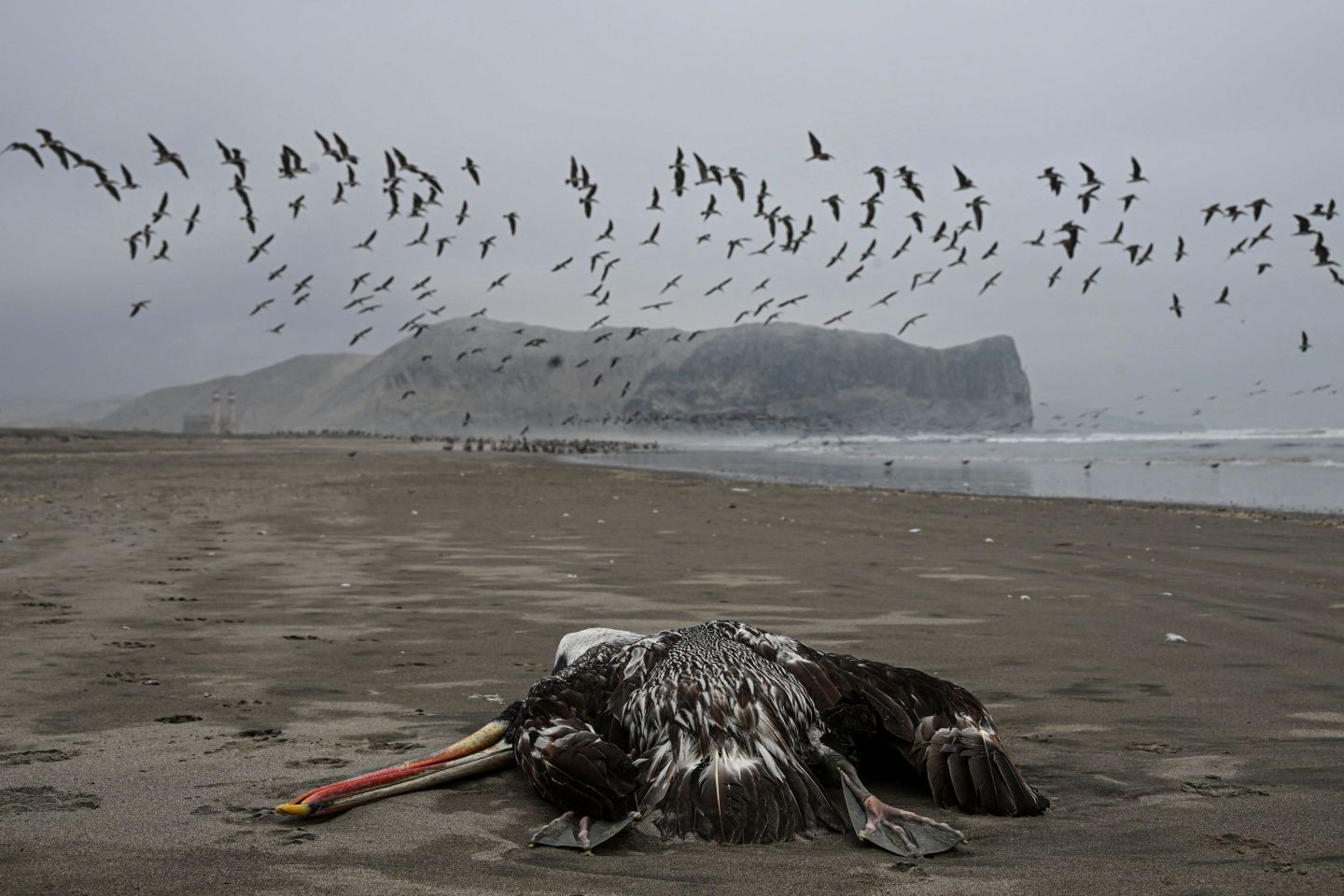
Tests on several sea lions and a dolphin found dead in Peru in November have returned positive for the concerning strain of bird flu, Peruvian veterinary authorities said Tuesday, the Center for Infectious Disease Research and Policy (CIDRAP) at the University of Minnesota reported. At least 585 sea lions and 55,000 birds have been found dead in the country, their deaths likely due to H5N1, a federal agency reported Monday.
What’s more, a lion held in a Peruvian zoo recently died of the virus, CIDRAP recently reported, citing media reports. Foxes, dolphins, opossums, skunks, raccoons, and other types of bears are among other species that have been infected since last year, according to the U.S. Department of Agriculture. A “mass mortality event” among seals on Russia’s Caspian Sea coast in December was caused by avian flu, though the strain was not named, CIDRAP recently reported, citing Dagestan State University.
In late January, the first grizzlies to be documented with the highly pathogenic avian flu were euthanized in Montana after they were found partially blind and disoriented, with other neurologic issues. And surviving infected harbor and gray seals identified in New England last summer by a team led by Jonathan Runstadler, professor and chair of the Department of Infectious Disease and Global Health at Tufts University’s Cummings School of Veterinary Medicine, were unable to orient themselves and swim properly, he told the Journal of the American Medical Association in a recent article.
These instances are just a few of numerous recent reports of outbreaks among mammals, including at a worrying outbreak at a mink farm in Spain. It’s trend that should worry public health officials, Mike Ryan, executive director of the WHO’s health emergencies program, told Fortune on Wednesday.
“Small mammals may not look like us,” but they share many physical similarities with humans, he said.
The H5N1 virus could win the lottery, so to speak, by quickly and ably adapting to humans and starting an epidemic somewhere—then, possibly, a pandemic. Most viruses don’t get that lucky. But the more opportunity the virus has to spread, the better the chance that it will succeed, Ryan added.
While there have been identified instances of H5N1 in mammals since the virus was first detected in the late 1990s, never have there been so many, Dr. Jay Varma, chief medical adviser at the New York-based think tank Kroll Institute, told Fortune.
Recently discovered H5N1 mass fatality events among mammals “are probably only the tip of the iceberg,” he cautioned.
“We only know about these events when there are very large die-offs that are recognized by people and somebody actually does the testing and reports the results,” he said. “There may be smaller die-offs, larger die-offs, people afraid that no one will buy their chickens if they report a die-off. We know there are many instances where lab testing isn’t done.”
Worst outbreak in U.S. history for birds
The H5N1 strain of avian flu has been responsible for the deaths of tens of millions of birds in the U.S. in recent months, and countless millions worldwide. The strain—first identified in domestic waterfowl in China in 1996—is behind more than 58 million U.S. bird deaths in the past year. These deaths have occurred both directly due to the virus and indirectly, when flocks are culled to curb further exposure, according to the U.S. Centers for Disease Control and Prevention. The virus has a near 100% fatality rate among birds, killing most infected within 48 hours.
This season’s bird flu outbreak is the worst in U.S. history, having surpassed a 2015 outbreak the CDC once called “arguably the most significant animal health event in U.S. history.” That year, nearly 51 million birds died nationally due to H5N1 and related avian flu viruses. This season’s outbreak is also the worst in U.K. history, with farmers in England ordered to keep their birds indoors as of Nov. 7 in a poultry “lock down” of sorts.
The so-called “R naught” value—or the number of people infected by a single infected person, on average—for COVID initially ranged from 1.5 to 7, and now sits upwards of 12. The R naught value of H5N1 among birds: “around 100,” Rajiv Chowdhury, senior epidemiologist and professor of global health at Florida International University, recently told Fortune.
Trend of ‘low’ risk to humans may not hold
Economic and food-supply issues aside, the strain poses a threat to humans because it can severely sicken them, though it has only done so in relatively small numbers so far. Hundreds of human cases were identified in Egypt earlier this century, though there were no confirmed reports of sustained human-to-human transmission.
But that trend may not hold, experts warn. In January the WHO reported that a previously healthy Ecuadorian girl had been hospitalized with the virus, and was under sedation and on a ventilator. Just how she contracted the virus was uncertain and under investigation, but poultry her family had recently purchased died without apparent cause.
The world appears to have dodged a proverbial bullet, with the girl’s condition improving and no additional human cases reported since, WHO officials said Wednesday. They also confirmed that the girl contracted the virus from poultry, not from another human.
The likelihood of human-to-human transmission of H5N1 is “very low,” Chowdhury recently told Fortune. But if it were to occur in a sustained manner, it could rock the globe in a way not seen since the 1918 Spanish Flu.
If H5N1 indeed makes a sustained crossover to humans, “the potential impact could be significant,” he said, signifying the start of a “new global influenza pandemic.”
The risk for sustained transmission among humans could be anything from one in 10 to one in 100,000, Varma said, adding that the uncertainty necessitates the conveyance of a mixed risk message. The average person shouldn’t be alarmed by H5N1 at the moment. But governments must take actions like “investing more heavily in programs that detect and characterize these viruses,” in addition to funding lab testing among animals.
Governments must also ensure there’s a safe and effective vaccine ready to go for humans, and that supplies are adequate. If a vaccine were developed and approved for animals like chickens, turkeys, and pigs, it could reduce spread among livestock, as well as the risk of spillover to humans who work with them, he added.
“We know from COVID that you can’t just vaccinate your own country,” Varma said. “Everywhere around the world needs to be protected. There needs to be more investment in this.”
The Spanish Flu as a cautionary tale
The 1918 flu pandemic serves as a cautionary tale as the world faces a potential H5N1 pandemic, Chowdhury said. Like the H5N1 flu, the Spanish Flu is thought to have avian origins. And both viruses contain genes that allow them to replicate efficiently in human bronchial cells, according to a 2006 report from the Washington, D.C.-based Population Reference Bureau.
When H5N1 infects humans, the inflammation it causes can lead to lung cells becoming “intensely inflamed”—to an extent not seen in a usual flu. A similar effect was noted in Spanish Flu victims, autopsies of which revealed “lungs choked with debris from the excessive inflammation,” resulting in drowning, the report noted.
While seasonal flu symptoms include fever, cough, sore throat, runny nose, aches, and fatigue, according to the CDC, symptoms of H5N1 in humans are typically much more severe. They include an often high fever, weakness, cough, sore throat, muscle aches, abdominal pain, chest pain, and diarrhea, according to the WHO. These symptoms can quickly give way to difficulty breathing, pneumonia, and/or Acute Respiratory Distress Syndrome, which is often deadly, as well as neurologic effects like seizures.
Because the virus hasn’t crossed over to humans in a sustained manner, it’s uncertain what an easily transmissible human version of H5N1 might look like, Varma said. “But we can guess, based on prior flu epidemics, that it would be very deadly to humans.”
COVID has been “somewhat manageable” because younger individuals are typically less likely to suffer severe disease, he said. The same was not true of the Spanish Flu, which killed more young than old. If human-to-human transmission of H5N1 begins to occur, “we shouldn’t automatically assume that young people or even children will be better protected,” he said. “They may very well be at higher risk.”
New zoonotic diseases, or diseases that transmit from animals to people, tend to result in high mortality rates among the people they infect. They’re not well adapted to humans and tend to cause copious amounts of damage in the lungs, though they’re not usually very transmissible, Briand said.
Once such viruses adapt to human transmission—if they do—the fatality rate may drop. While the Spanish Flu killed a whopping 50 million—around seven times greater than COVID’s official global death toll of just under 7 million—it killed no more than 4% of those it infected, according to Briand—a fatality rate much lower than that of H5N1 in birds.
“In 1918, we didn’t have antibiotics,” she said. “We didn’t have antivirals either. We didn’t have vaccines. And we didn’t have any of the tools we have now to control flu outbreaks. We’re in a much better place, of course, now than we were a century ago.”
While the risks to humans posed by H5N1 are weighty, they can be mitigated, Ryan emphasized.
The point is “not to be scared of viruses,” he said, adding that “they’re out there and always will be.”
“We need to focus on our game plan, what we need to do to make sure we keep everybody safe,” he said. “Don’t just spend time thinking of the risk. Act upon those risks and they can be significantly reduced, in terms of impact.”