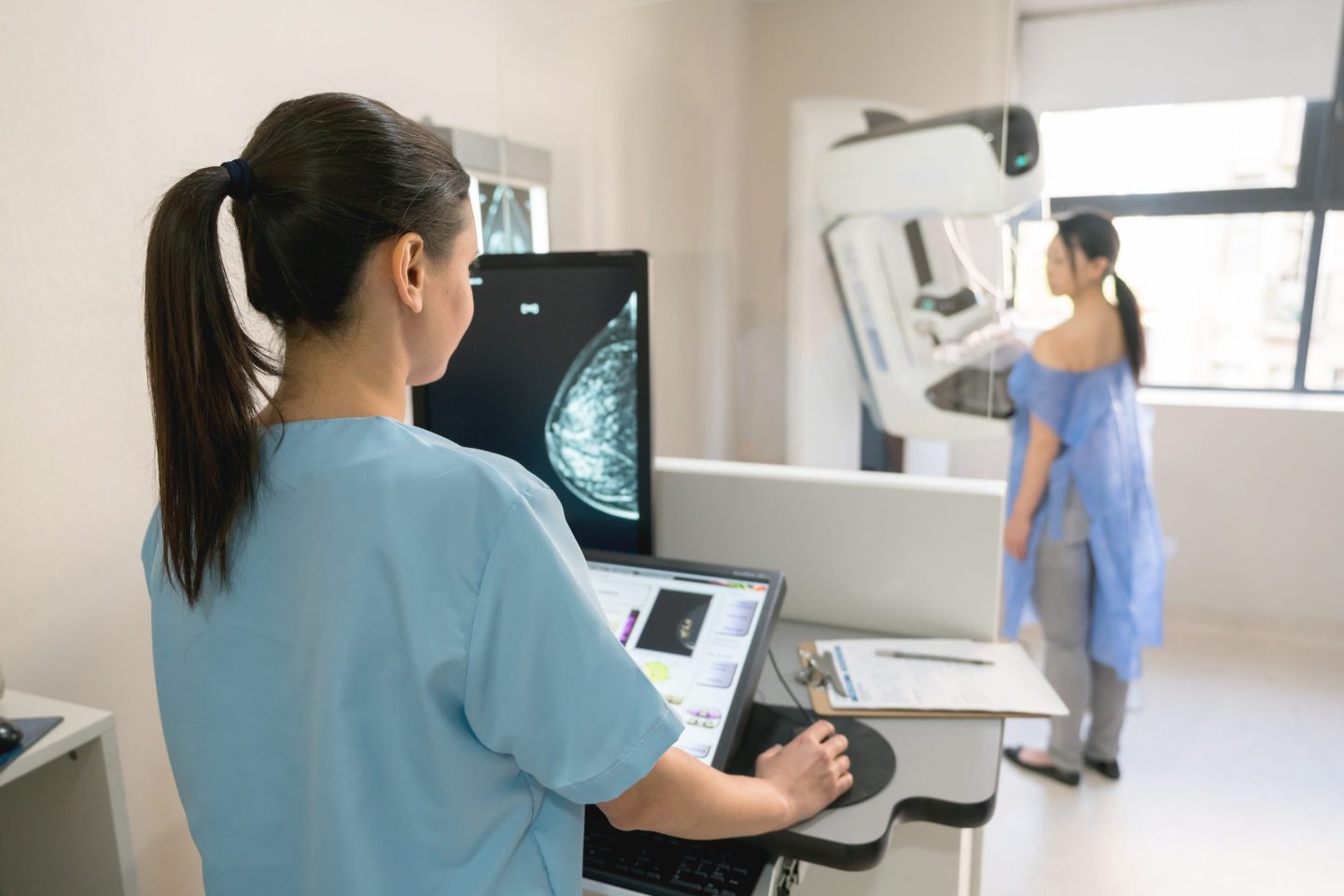
When JoAnn Pushkin was 45 years old, she felt a lump in her right breast—which struck her as odd, considering it had only been eight weeks since her annual mammogram, which she’d been getting dutifully since the age of 40, and which had produced a result of “normal.”
Pushkin went to her doctor, who felt the lump and sent her for another mammogram plus ultrasound. She was surprised when the technician told her, offhandedly, “You have dense breasts. This is going to be a very hard find for us.”
And she was stunned when the lump she felt—invisible on the mammogram—showed up as cancer on her ultrasound, “clear as a bell.” That led to a double mastectomy, chemotherapy, radiation, follow-up surgeries, and the complication of chronic lymphedema.
But it also spurred Pushkin into action, pushing, as part of a movement, for a new federal rule that requires mammogram facilities to notify patients about the density of their breasts.
That new rule, part of the U.S. Food and Drug Administration’s updated mammography regulations, went into effect on Tuesday.
Pushkin wrote to the FDA back in 2010, after her treatments were finished, with the notification request, subsequently testifying as part of the process.
She did so after learning that nearly half of women over 40 have dense breasts, which bring an elevated risk of breast cancer and also tend to mask the cancer on mammograms, making detection more difficult.
It also led her to co-found an educational nonprofit, Dense Breast Info, and to fight for the New York State Breast Density Inform bill that went into effect in 2013—one of a patchwork of state laws that require sharing information about dense breasts, but not, in every case, about whether or not a patient has dense breasts. That’s just part of what makes the new rule important.
“At least there’ll be a uniform standard across all women in the United States, where they will be told that their breasts are either dense or not dense,” says Dr. Wendie Berg, professor of radiology at the University of Pittsburgh School of Medicine and Dense Breast Info chief scientific advisor.
But what does “dense breasts” really mean? And what are you supposed to do once you know you’ve got them? Below, find answers to all your questions about breast density and cancer screenings.
What does it mean to have dense breasts?
Breasts are made up of fat and milk glands that are held together by fibrous tissue. The more glands and fibrous tissue than fatty tissue a woman has, the “denser” her breasts.
Among women in their 40s, about 50% have some level of dense breasts. That means that a staggering half of all women getting their first mammogram—which the U.S. Preventive Services Task Force recommends happen at 40 and then every two years thereafter—will risk having breast cancer go undetected by that mammography.
Density exists on a spectrum, says Berg, and can change over time, with some breasts becoming less dense after menopause.
And while there are actually four categories used by physicians to categorize breasts—fatty (rare), scattered (most common), heterogeneously dense, and extremely dense—the new rule requires all mammography facilities to provide patients with either a “not dense” or “dense” standardized notification.
The specifics can matter, though, says Berg, as an extremely dense breast has at least a four-fold higher risk of developing breast cancer than its fatty counterpart. So it’s important to ask for clarification if you are ever notified about having dense breasts.
You have dense breasts, now what?
While mammography has long been considered the gold standard in breast cancer detection, “I think there is widespread recognition that the mammogram is actually not a very good screening test with dense breasts,” says Berg. “That’s been known for quite a long time.”
That’s because dense tissue shows up white on a mammogram, and so does cancer.
In cases of extremely dense breasts, in fact, “we miss at least around half of cancers in that type of tissue on the mammogram,” she says.
Luckily, there are some alternatives: 3-D mammograms, called digital breast tomosynthesis, as well as ultrasound, which can both be slightly more effective but also tend to produce false positives—as do mammograms, though there are less the second and third time around, once a patient’s baseline is established.
And then there’s MRI (magnetic resonance imaging), given in conjunction with an intravenous dose of the contrast dye gadolinium, which is the most effective dense-breast screener—recommended for women at elevated risk for breast cancer by the American Cancer Society since 2007.
MRIs are not only effective—with a dark background that makes it “really easy to see most cancers,” says Berg, but pretty widely available, making them a good choice “if you’re willing to have the contrast injection, and if you’re not claustrophobic.”
And also, says Berg, “if you know enough to ask for it” once you’ve gotten your dense-breast notification. “Every woman needs to advocate for herself,” she stresses. “It’s very frustrating.”
The importance of breast self-awareness can also not be understated, as 40% of diagnosed breast cancers are detected by women who feel a lump, according to the National Breast Cancer Foundation.
There is some hope on the horizon: Contrast-enhanced mammography, which uses existing equipment but combines it with the type of iodine-containing contrast used for CT scans.
“We get all the same information that we got from the regular mammogram, plus we see the cancers much better because they … light up like a lightbulb on a black background,” says Berg, who has been involved in studying the technique, not yet approved for screening purposes by the FDA, for a decade. “It is something that looks very promising.”
Will my insurance cover a breast ultrasound or MRI?
The Find it Early Act, introduced in 2022, would ensure, on a federal level, that all health insurance plans cover screening and diagnostic mammograms, breast ultrasounds and MRIs with no deductibles or copayments. But until it becomes law, it’s a patchwork of regulations.
Currently, there are 33 states plus D.C. that have some kind of law requiring expanded insurance coverage for breast cancer detection in women with dense breasts or other risk factors. But laws vary—with some requiring that only ultrasound is covered, for example.
Plus, the majority of insurance carriers are exempt from state law, meaning that “even if there’s a state law, your insurance may or may not cover it,” says Berg, noting that most will eventually go along with it because it’s cost-effective.
“Finding cancer earlier is better for the woman because the treatment is much less involved, but it’s also better for the insurance company because it’s less expensive. And so from everybody’s standpoint, there is a gain and benefit to finding that cancer early,” she says.
That said, there will almost always be a copay or deductible, though it varies by plan.
As an alternative for those who can afford it, Berg notes, some medical centers offer what is called an abbreviated MRI, which is faster, offered directly to patients (without a prescription), charges a fixed payment from about $250 to $600, and still has a higher cancer-detection rate than mammograms.
Finally, while this week’s breast-density notification rule was an important part of the picture regarding early detection, Pushkin says the hard-won victory feels bittersweet.
“When I first heard the news, I kind of sat down heavily in my chair and thought, ‘God Almighty, this is finally over,’” she says. But then she thought of all the women along the way whose cancer was not detected. “This happened on the backs of sick and dying patients,” she says.
More on Cancer
- 5 lifestyle changes can significantly reduce your cancer risk, from giving up drinking to wearing sunscreen
- Global cancer rates are expected to rise 77% by 2050. From aging to alcohol, here’s why
- Olivia Munn’s OB/GYN: Women dismissed by doctors, leading to devastating consequences for cancer