• Home
  • Latest
  • Fortune 500
  • Finance
  • Tech
  • Leadership
  • Lifestyle
  • Rankings
  • Multimedia

Exclusive

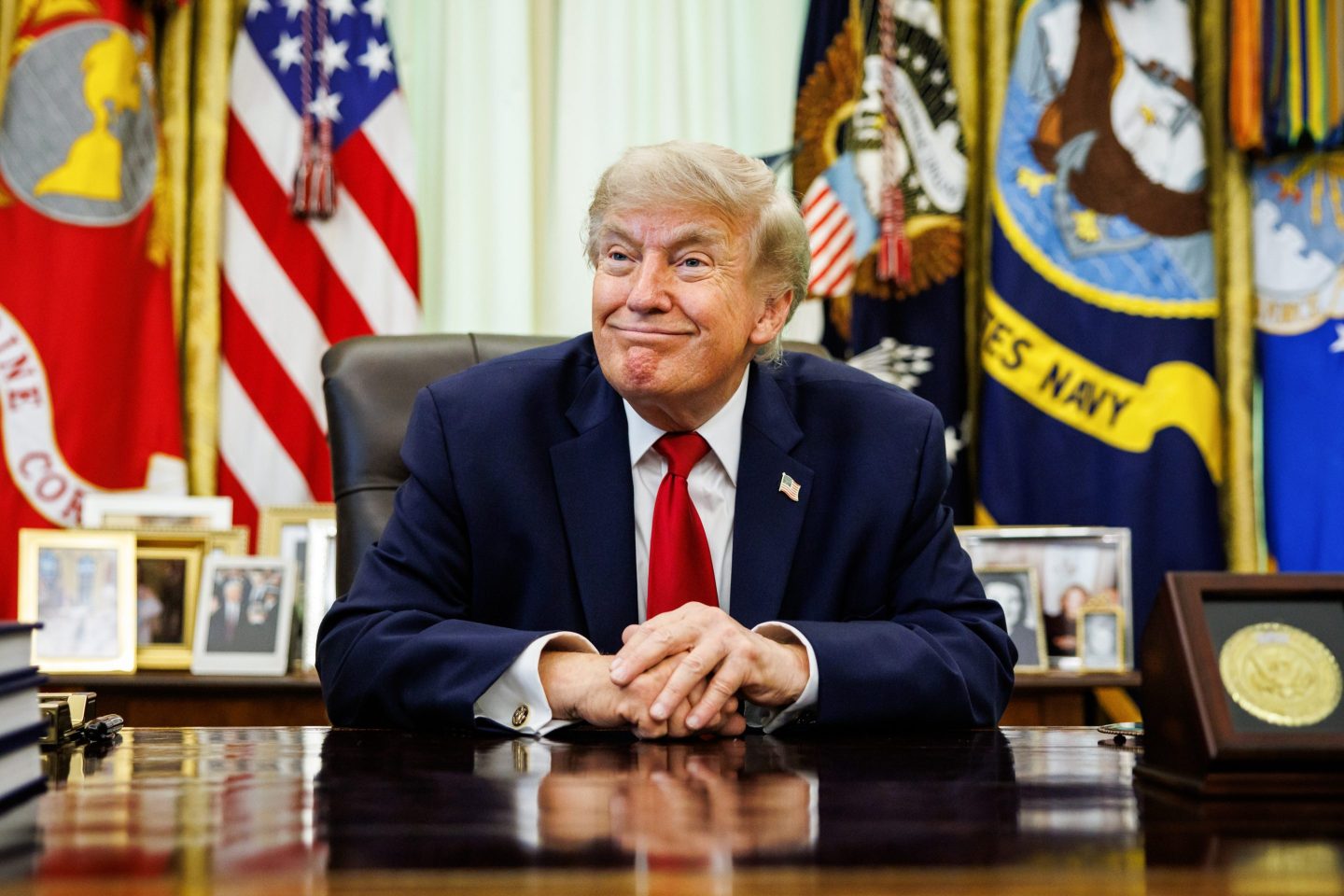
An hour in the Oval Office with President Trump Fortune Editor-in-Chief: Alyson Shontell sat down with President Trump in the Oval Office for an hour. Tariffs, Intel, AI, Boeing, Iran—and the question every CEO eventually has to answer: who's next?

An hour in the Oval Office with President Trump Fortune Editor-in-Chief: Alyson Shontell sat down with President Trump in the Oval Office for an hour. Tariffs, Intel, AI, Boeing, Iran—and the question every CEO eventually has to answer: who's next?

An hour in the Oval Office with President Trump Fortune Editor-in-Chief: Alyson Shontell sat down with President Trump in the Oval Office for an hour. Tariffs, Intel, AI, Boeing, Iran—and the question every CEO eventually has to answer: who's next?

An hour in the Oval Office with President Trump Fortune Editor-in-Chief: Alyson Shontell sat down with President Trump in the Oval Office for an hour. Tariffs, Intel, AI, Boeing, Iran—and the question every CEO eventually has to answer: who's next?

An hour in the Oval Office with President Trump Fortune Editor-in-Chief: Alyson Shontell sat down with President Trump in the Oval Office for an hour. Tariffs, Intel, AI, Boeing, Iran—and the question every CEO eventually has to answer: who's next?

An hour in the Oval Office with President Trump Fortune Editor-in-Chief: Alyson Shontell sat down with President Trump in the Oval Office for an hour. Tariffs, Intel, AI, Boeing, Iran—and the question every CEO eventually has to answer: who's next?

An hour in the Oval Office with President Trump Fortune Editor-in-Chief: Alyson Shontell sat down with President Trump in the Oval Office for an hour. Tariffs, Intel, AI, Boeing, Iran—and the question every CEO eventually has to answer: who's next?

An hour in the Oval Office with President Trump Fortune Editor-in-Chief: Alyson Shontell sat down with President Trump in the Oval Office for an hour. Tariffs, Intel, AI, Boeing, Iran—and the question every CEO eventually has to answer: who's next?

An hour in the Oval Office with President Trump Fortune Editor-in-Chief: Alyson Shontell sat down with President Trump in the Oval Office for an hour. Tariffs, Intel, AI, Boeing, Iran—and the question every CEO eventually has to answer: who's next?

An hour in the Oval Office with President Trump Fortune Editor-in-Chief: Alyson Shontell sat down with President Trump in the Oval Office for an hour. Tariffs, Intel, AI, Boeing, Iran—and the question every CEO eventually has to answer: who's next?

How France learned to hate capitalism

By
Chris Matthews
Chris Matthews
Down Arrow Button Icon
By
Chris Matthews
Chris Matthews
Down Arrow Button Icon
February 26, 2014, 2:14 PM ET

FORTUNE — As government balance sheets and national debt grow each year, some are fretting that government activism is stifling global capitalism. But look closer and you see that it’s quite the opposite.

Thomas Piketty, the French economist whose work informs much of the public debate over income and wealth inequality in the developed world, will release the English translation of his groundbreaking study, Capital in the 21st Century next month.

As you can probably glean from the title, Piketty is mostly concerned with the study of capital and how its concentration has changed over time. In the economic press, we’re used to hearing a lot about income, which, on a national scale, is gross domestic product (GDP). One of the fascinating things about Piketty’s book, however, is that it supplements our understanding of the global economy with exhaustive data about the world’s stock of capital, too. 

MORE: Taxpayers deserve every penny of Fannie and Freddie profits

By looking at capital, we can get a much different picture of the health and well being of capitalism in the rich world today than we do by simply looking at GDP. Most American conservatives claim that the government is gaining more control of the U.S. economy by pointing to the growing share of government spending as a percentage of GDP. Here’s a chart from Nate Silver that shows this statistic for the U.S. over time:

In countries like Britain and France, the share of GDP made up of government spending is much higher, at 48.5% and 56.1% of GDP, respectively.

But Piketty’s capital data paints a much different picture, especially of economies like France’s. If you look at the value of total privately owned capital relative to GDP, you see a country in which the value of private capital has increased significantly over the past two generations:

The same trend is present in all wealthy countries since World War II: the value of privately owned wealth has increased relative to national income by a factor of roughly two. The definition of capitalism is an economic system in which property and the means of production are controlled by private individuals, so it’s hard to see how one could argue the wealthy world has become less capitalistic in recent years.

MORE: Janet Yellen’s big fumble

Surely, there was a time when France was much more averse to private ownership of property. Here’s how Piketty explains it:

Not only in France, but in countries around the world, faith in private capitalism was greatly shaken by the economic crisis of the 1930s and the cataclysms that followed … a quarter of the working population in the United States, Germany, Britain and France found themselves out of work. The traditional doctrine of “laissez faire,” or nonintervention by the state in the economy … was durably discredited….

In France this general climate of distrust toward private capitalism was deepened by the fact that many members of the economic elite were suspected of having collaborated with the German occupiers and indecently enriched themselves during the war. It was in this highly charged post-Liberation climate that major sectors of the economy were nationalized, including in particular the banking sector, the coal mines and the automobile industry. The Renault factories were punitively seized after their owner, Louis Renault, was arrested as a collaborator in September 1944. The provisional government nationalized the firm in January 1945…. In 1950, the government of France owned 25-30 percent of the nation’s wealth, and perhaps a little more.

It was in this environment that the French economy, badly damaged by the war, embarked on nearly 30 years of rapid economic growth. Once that post-war catch-up period was over, however, the French actually embraced private ownership of property with great enthusiasm:

What is distinctive about the French trajectory is that public ownership, having thrived from 1950 to 1980, dropped to very low levels after 1980, even as private wealth — both financial and real estate — rose to levels even higher than Britain’s: nearly six years of national income in 2010, or 20 times the value of public wealth. Following a period of state capitalism after 1950, France became the promised land of the new private-ownership capitalism of the twenty-first century.

As Piketty points out, this trend in France is hardly mentioned when economic commentators compare France to the U.K. and the U.S. We remember the 1980s in the U.K. and the U.S. as a time of enthusiastic privatization and deregulation, but forget that the same thing occurred, sometimes even more intensely, across the rest of the rich world too.

So, what about that growing share of GDP coming from government spending? The fact that private wealth is growing much more quickly than overall income shows that government spending isn’t keeping up with private wealth accumulation, and that both trends should be acknowledged when discussing a nation’s economy. Furthermore, the growth of government spending after World War II is likely the result of two forces:

1) The growing concentration of private wealth, as shown by the chart above and Piketty’s book in general. As wealth and income grow more unequal within a given nation’s population, voters turn to the government to help compensate for the real feeling that they’re falling behind.

MORE: How a national sales tax could solve America’s inequality problem

2) Baumol’s cost disease: This is the theory that government spending will naturally grow to be a greater percentage of yearly output because government mostly provides services like education that cannot become more efficiently administered in the same way as products and services provided by the private sector can.

For instance, the U.S. produces a lot more food in 2014 for a lot less money than it did in 1914. Yet in a field like education, technology isn’t able to reduce the number of teachers needed for a fixed amount of students to learn algebra or reading (at least not yet). Governments are often heavily involved in the fields that are most resistant to automation.

The usefulness of economics is determined by the quality of data at our disposal. Piketty’s new volume offers a fresh perspective and a wealth of newly compiled data that will go a long way in helping us understand how capitalism actually works.

About the Author
By Chris Matthews
See full bioRight Arrow Button Icon

Latest in

Finance
Lorem ipsum dolor sit amet, consectetur adipiscing elit, sed do eiusmod tempor incididunt ut labore et dolore magna aliqua. Ut enim ad minim veniam
By Fortune Editors
October 20, 2025
Finance
Lorem ipsum dolor sit amet, consectetur adipiscing elit, sed do eiusmod tempor incididunt ut labore et dolore magna aliqua. Ut enim ad minim veniam
By Fortune Editors
October 20, 2025
Finance
Lorem ipsum dolor sit amet, consectetur adipiscing elit, sed do eiusmod tempor incididunt ut labore et dolore magna aliqua. Ut enim ad minim veniam
By Fortune Editors
October 20, 2025
Finance
Lorem ipsum dolor sit amet, consectetur adipiscing elit, sed do eiusmod tempor incididunt ut labore et dolore magna aliqua. Ut enim ad minim veniam
By Fortune Editors
October 20, 2025
Finance
Lorem ipsum dolor sit amet, consectetur adipiscing elit, sed do eiusmod tempor incididunt ut labore et dolore magna aliqua. Ut enim ad minim veniam
By Fortune Editors
October 20, 2025
Finance
Lorem ipsum dolor sit amet, consectetur adipiscing elit, sed do eiusmod tempor incididunt ut labore et dolore magna aliqua. Ut enim ad minim veniam
By Fortune Editors
October 20, 2025

Most Popular

Finance
Lorem ipsum dolor sit amet, consectetur adipiscing elit, sed do eiusmod tempor incididunt ut labore et dolore magna aliqua. Ut enim ad minim veniam
By Fortune Editors
October 20, 2025
Finance
Lorem ipsum dolor sit amet, consectetur adipiscing elit, sed do eiusmod tempor incididunt ut labore et dolore magna aliqua. Ut enim ad minim veniam
By Fortune Editors
October 20, 2025
Finance
Lorem ipsum dolor sit amet, consectetur adipiscing elit, sed do eiusmod tempor incididunt ut labore et dolore magna aliqua. Ut enim ad minim veniam
By Fortune Editors
October 20, 2025
Finance
Lorem ipsum dolor sit amet, consectetur adipiscing elit, sed do eiusmod tempor incididunt ut labore et dolore magna aliqua. Ut enim ad minim veniam
By Fortune Editors
October 20, 2025
Finance
Lorem ipsum dolor sit amet, consectetur adipiscing elit, sed do eiusmod tempor incididunt ut labore et dolore magna aliqua. Ut enim ad minim veniam
By Fortune Editors
October 20, 2025
Finance
Lorem ipsum dolor sit amet, consectetur adipiscing elit, sed do eiusmod tempor incididunt ut labore et dolore magna aliqua. Ut enim ad minim veniam
By Fortune Editors
October 20, 2025
Fortune Secondary Logo
Rankings
  • 100 Best Companies
  • Fortune 500
  • Global 500
  • Fortune 500 Europe
  • Most Powerful Women
  • World's Most Admired Companies
  • See All Rankings
  • Lists Calendar
Sections
  • Finance
  • Fortune Crypto
  • Features
  • Leadership
  • Health
  • Commentary
  • Success
  • Retail
  • Mpw
  • Tech
  • Lifestyle
  • CEO Initiative
  • Asia
  • Politics
  • Conferences
  • Europe
  • Newsletters
  • Personal Finance
  • Environment
  • Magazine
  • Education
Customer Support
  • Frequently Asked Questions
  • Customer Service Portal
  • Privacy Policy
  • Terms Of Use
  • Single Issues For Purchase
  • International Print
Commercial Services
  • Advertising
  • Fortune Brand Studio
  • Fortune Analytics
  • Fortune Conferences
  • Business Development
  • Group Subscriptions
About Us
  • About Us
  • Press Center
  • Work At Fortune
  • Terms And Conditions
  • Site Map
  • About Us
  • Press Center
  • Work At Fortune
  • Terms And Conditions
  • Site Map
  • Facebook icon
  • Twitter icon
  • LinkedIn icon
  • Instagram icon
  • Pinterest icon

Latest in

trump
EconomyCurrency
China will remain an ‘incomplete superpower’ until it can catch up with U.S. financial might, market veteran says
By Jason MaMay 18, 2026
49 minutes ago
David Solomon
SuccessCareers
Goldman Sachs’ CEO once scooped ice cream at Baskin-Robbins—he picked up a second job at McDonald’s after his dad gave him a time management lesson
By Preston ForeMay 18, 2026
57 minutes ago
griffin
AIBillionaires
Billionaire Ken Griffin used to dismiss AI as ‘garbage.’ Here’s why he changed his mind—and why he’s ‘depressed’
By Nick LichtenbergMay 18, 2026
2 hours ago
trump
North AmericaWhite House
Trump says China agreed to buy $17 billion of American beef per year
By Didi Tang and The Associated PressMay 18, 2026
2 hours ago
Top CD rates from major banks May 18, 2026: Chase CDs, Bank of America CDs, Citibank CDs, and more
BankingCertificates of Deposit (CDs)
Top CD rates from major banks on May 18, 2026: Chase CDs, Bank of America CDs, Citibank CDs, and more
By Danny BakstMay 18, 2026
3 hours ago
Current price of Ethereum for May 18, 2026
Personal FinanceEthereum
Current price of Ethereum for May 18, 2026
By Joseph HostetlerMay 18, 2026
3 hours ago

Most Popular

Microsoft AI chief gives it 18 months—for all white-collar work to be automated by AI
AI
Microsoft AI chief gives it 18 months—for all white-collar work to be automated by AI
By Jake AngeloMay 16, 2026
2 days ago
The top foreign holders of U.S. debt may soon dump Treasury bonds and bring their money back home, potentially spiking borrowing costs
Economy
The top foreign holders of U.S. debt may soon dump Treasury bonds and bring their money back home, potentially spiking borrowing costs
By Jason MaMay 17, 2026
23 hours ago
The Bezos family just donated $100 million to help achieve one of Mayor Zohran Mamdani’s top campaign promises
Politics
The Bezos family just donated $100 million to help achieve one of Mayor Zohran Mamdani’s top campaign promises
By Jake AngeloMay 12, 2026
6 days ago
'No one was coming to save me': How Reese Witherspoon built a $900 million company from a problem Hollywood wouldn't fix
Success
'No one was coming to save me': How Reese Witherspoon built a $900 million company from a problem Hollywood wouldn't fix
By Sydney LakeMay 17, 2026
1 day ago
SpaceX heads into a record-shattering IPO with the 'deepest moat that exists today' as investors vow to 'never bet against Elon'
Innovation
SpaceX heads into a record-shattering IPO with the 'deepest moat that exists today' as investors vow to 'never bet against Elon'
By Jason MaMay 16, 2026
2 days ago
Gen X is the most indebted generation in America. Their employers can fix that
Commentary
Gen X is the most indebted generation in America. Their employers can fix that
By Mary MorelandMay 17, 2026
1 day ago

© 2026 Fortune Media IP Limited. All Rights Reserved. Use of this site constitutes acceptance of our Terms of Use and Privacy Policy | CA Notice at Collection and Privacy Notice | Do Not Sell/Share My Personal Information
FORTUNE is a trademark of Fortune Media IP Limited, registered in the U.S. and other countries. FORTUNE may receive compensation for some links to products and services on this website. Offers may be subject to change without notice.