• Home
  • Latest
  • Fortune 500
  • Finance
  • Tech
  • Leadership
  • Lifestyle
  • Rankings
  • Multimedia

Trendingnow

1

The U.S. spent $30 billion to ditch textbooks for laptops and tablets: The result is the first generation less cognitively capable than their parents

2

Current price of oil as of July 13, 2026

3

Current price of silver as of Monday, July 13, 2026

1

The U.S. spent $30 billion to ditch textbooks for laptops and tablets: The result is the first generation less cognitively capable than their parents

2

Current price of oil as of July 13, 2026

3

Current price of silver as of Monday, July 13, 2026
FinanceTerm Sheet

El-Erian: Is Piketty right about investment strategies?

By
Mohamed El-Erian
Mohamed El-Erian
Down Arrow Button Icon
By
Mohamed El-Erian
Mohamed El-Erian
Down Arrow Button Icon
May 28, 2014, 4:37 PM ET
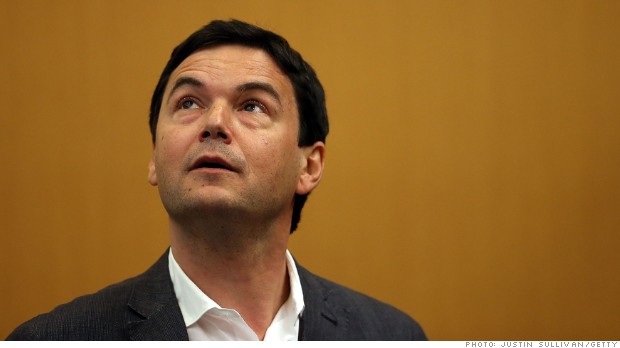
<<enter caption here>> on April 23, 2014 in Berkeley, California.
Justin Sullivan 2014 Getty Images
Add Fortune on Google for similar content.

FORTUNE – Having surged to the top of best-seller lists, Thomas Piketty’s Capital in the Twenty-First Century continues to attract attention, and rightly so. With the initial flurry over its conclusions now giving way to an intensifying debate over the underlying data, the interest will continue to grow for quite a while yet, as will analytical work on inequality – a topic that is capturing greater public awareness.

Yet there is one related area that, until now, remains under, if not unexplored: The extent to which the book can and should inform investment strategies.

Piketty’s analysis of several countries over history highlights how the return to owning capital (what he labels “r”), be it financial or real estate, tend to exceed the rate of economic growth (“g”). As such, income inequality rises; and it does so until the social fabric erodes excessively and/or the rich recognizes it is in their self-interest to capture less of the country’s wealth.

Piketty’s numbers-driven analysis, while subject to counters, reinforces what some others have documented using other data sources. Moreover, and quite counter-intuitively considering it has only been six years since the financial sector almost tipped the world into a Great Depression, increasing inequality has been a notable feature of the much-shorter post-financial crisis period.

MORE: How to boost your 401(k) by 25%

Turning to market implications, well-off households have been richly rewarded in recent years by taking significant exposure to capital markets. Luxury brands serving the rich have out-performed, as have activities aimed at supporting vulnerable segments of the population – that is to say, at the two extremes of the income and wealth distributions. The average returns to labor services have been disappointing as reflected in the protracted sluggishness of wage earnings and unusually high unemployment.

Taken at face value, Piketty’s analysis would suggest a deeply engrained nature to these market tendencies, suggesting that investors can exploit them further, especially on market pullbacks. Moreover, he is among those that acknowledge that effective measures to counter increasing inequality – in his opinion, a wealth tax – are political non-starters.

Meanwhile, there is little to indicate that the U.S. is anywhere near a tipping point when it comes to factors that would stop and reverse growing inequality – be they economic, political and social. And the rich appear in no rush to counter a trend that, left unchecked, would eventually result in an excessive level of inequality that would harm their own well-being.

But before investors rush to market insights from Piketty’s analysis, they would do well to remember a few things regardless of whether you agree with his analytical approach or not.

MORE: Did Geithner save America from a Second Great Depression?

First, the recent surge in U.S. inequality has also been fueled by a monetary policy approach that is highly supportive of asset markets. This is not because central banks favor inequality. Rather, they have been compelled to rely on an inevitably narrow policy tool kit in carrying the bulk of the policymaking burden – whatever it takes to boost financial asset prices as a means of stimulating economic growth.

This policy support is now being gradually withdrawn in the U.S., the most systemically important economy. Few can predict how quickly the changed conditions would eat into the wedge between market valuations and underlying fundamentals, particularly if economic growth fails to attain the desired lift-off.

Second, increasing inequality is but one of several secular/structural forces that influence returns. Others include ageing demographics, re-regulation, a new globalization phase, inadequate governance, a changing institutional landscape in finance and fluid geopolitics.

Third, the Piketty sectoral influences pale in comparison to the impact of advances in disruptive technologies, particularly those enabled by the powerful mix of the Internet, social media and innovation. These, as well as what is happening in energy, have the potential to upend whole segments and companies, giving rise to particularly bimodal investment outcomes.

Finally, the “r-g” phenomenon encourages financial leverage overshoots, particularly when “g” appears to be stuck in a stable low-level equilibrium, when policy intentions are well-telegraphed, and when investors are wedded to their forward-looking return targets regardless of how much valuations have moved.

MORE: The imperfect math of the automobile recall

This is the case today judging from the extent to which over-crowded trades have compressed virtually every risk premia – be they credit, default, liquidity, or volatility. The result is an increased risk of credit bubbles and, with that, sudden market corrections that can be quite indiscriminate in their scale and scope.

Piketty’s book is an important contribution to a broadening and timely debate on a key challenge facing a growing number of societies around the world. It also suggests interesting investment insights, though they do not aggregate into a playbook for markets.

Mohamed A. El-Erian is chief economic adviser to Allianz, chair of President Barack Obama’s Global Development Council, and author of ‘When Markets Collide.’ He is the former CEO and co-CIO of PIMCO. Follow him @elerianm


About the Author
By Mohamed El-Erian
See full bioRight Arrow Button Icon
Add Fortune on Google for similar content.

Latest in Finance

Finance
Lorem ipsum dolor sit amet, consectetur adipiscing elit, sed do eiusmod tempor incididunt ut labore et dolore magna aliqua. Ut enim ad minim veniam
By Fortune Editors
October 20, 2025
Finance
Lorem ipsum dolor sit amet, consectetur adipiscing elit, sed do eiusmod tempor incididunt ut labore et dolore magna aliqua. Ut enim ad minim veniam
By Fortune Editors
October 20, 2025
Finance
Lorem ipsum dolor sit amet, consectetur adipiscing elit, sed do eiusmod tempor incididunt ut labore et dolore magna aliqua. Ut enim ad minim veniam
By Fortune Editors
October 20, 2025
Finance
Lorem ipsum dolor sit amet, consectetur adipiscing elit, sed do eiusmod tempor incididunt ut labore et dolore magna aliqua. Ut enim ad minim veniam
By Fortune Editors
October 20, 2025
Finance
Lorem ipsum dolor sit amet, consectetur adipiscing elit, sed do eiusmod tempor incididunt ut labore et dolore magna aliqua. Ut enim ad minim veniam
By Fortune Editors
October 20, 2025
Finance
Lorem ipsum dolor sit amet, consectetur adipiscing elit, sed do eiusmod tempor incididunt ut labore et dolore magna aliqua. Ut enim ad minim veniam
By Fortune Editors
October 20, 2025

Most Popular

Finance
Lorem ipsum dolor sit amet, consectetur adipiscing elit, sed do eiusmod tempor incididunt ut labore et dolore magna aliqua. Ut enim ad minim veniam
By Fortune Editors
October 20, 2025
Finance
Lorem ipsum dolor sit amet, consectetur adipiscing elit, sed do eiusmod tempor incididunt ut labore et dolore magna aliqua. Ut enim ad minim veniam
By Fortune Editors
October 20, 2025
Finance
Lorem ipsum dolor sit amet, consectetur adipiscing elit, sed do eiusmod tempor incididunt ut labore et dolore magna aliqua. Ut enim ad minim veniam
By Fortune Editors
October 20, 2025
Finance
Lorem ipsum dolor sit amet, consectetur adipiscing elit, sed do eiusmod tempor incididunt ut labore et dolore magna aliqua. Ut enim ad minim veniam
By Fortune Editors
October 20, 2025
Finance
Lorem ipsum dolor sit amet, consectetur adipiscing elit, sed do eiusmod tempor incididunt ut labore et dolore magna aliqua. Ut enim ad minim veniam
By Fortune Editors
October 20, 2025
Finance
Lorem ipsum dolor sit amet, consectetur adipiscing elit, sed do eiusmod tempor incididunt ut labore et dolore magna aliqua. Ut enim ad minim veniam
By Fortune Editors
October 20, 2025
Fortune Secondary Logo
Rankings
  • 100 Best Companies
  • Fortune 500
  • Global 500
  • Fortune 500 Europe
  • Most Powerful Women
  • World's Most Admired Companies
  • See All Rankings
  • Lists Calendar
Sections
  • Finance
  • Fortune Crypto
  • Features
  • Leadership
  • Health
  • Commentary
  • Success
  • Retail
  • Mpw
  • Tech
  • Lifestyle
  • CEO Initiative
  • Asia
  • Politics
  • Conferences
  • Europe
  • Newsletters
  • Personal Finance
  • Environment
  • Magazine
  • Education
Customer Support
  • Frequently Asked Questions
  • Customer Service Portal
  • Privacy Policy
  • Terms Of Use
  • Single Issues For Purchase
  • International Print
Commercial Services
  • Advertising
  • Fortune Brand Studio
  • Fortune Analytics
  • Fortune Conferences
  • Business Development
  • Group Subscriptions
About Us
  • About Us
  • Press Center
  • Work At Fortune
  • Terms And Conditions
  • Site Map
  • About Us
  • Press Center
  • Work At Fortune
  • Terms And Conditions
  • Site Map
  • Facebook icon
  • Twitter icon
  • LinkedIn icon
  • Instagram icon
  • Pinterest icon

Latest in Finance

Mortgage rates today, July 14, 2026
Personal Financemortgages
Mortgage rates today, July 14, 2026
By Glen Luke FlanaganJuly 14, 2026
3 hours ago
Current refi mortgage rates report for July 14, 2026
Personal Financemortgage rates
Current refi mortgage rates report for July 14, 2026
By Glen Luke FlanaganJuly 14, 2026
3 hours ago
Current ARM mortgage rates report for July 14, 2026
Personal FinanceReal Estate
Current ARM mortgage rates report for July 14, 2026
By Glen Luke FlanaganJuly 14, 2026
3 hours ago
infra
EnergyData centers
Data centers have already hiked electricity prices on the public by $23 billion. Good luck clawing that back
By Theodore J. Kury and The ConversationJuly 14, 2026
3 hours ago
utah
EnvironmentData centers
Americans hate AI so much that politicians are starting to lose their jobs over it
By Laura Mullenbach and The ConversationJuly 14, 2026
3 hours ago
U.S. launches new strikes on Iran while Tehran mocks Trump’s reversal on charging for Hormuz transits — ‘20% is of course too much. We will be fair’
PoliticsIran
U.S. launches new strikes on Iran while Tehran mocks Trump’s reversal on charging for Hormuz transits — ‘20% is of course too much. We will be fair’
By Jon Gambrell, Konstantin Toropin, Will Weissert and The Associated PressJuly 13, 2026
10 hours ago

Most Popular

The U.S. spent $30 billion to ditch textbooks for laptops and tablets: The result is the first generation less cognitively capable than their parents
Innovation
The U.S. spent $30 billion to ditch textbooks for laptops and tablets: The result is the first generation less cognitively capable than their parents
By Sasha RogelbergJuly 12, 2026
2 days ago
Current price of oil as of July 13, 2026
Personal Finance
Current price of oil as of July 13, 2026
By Joseph HostetlerJuly 13, 2026
24 hours ago
Current price of silver as of Monday, July 13, 2026
Personal Finance
Current price of silver as of Monday, July 13, 2026
By Joseph HostetlerJuly 13, 2026
24 hours ago
How Pete Hegseth's DEI order just put Scouting America's future at stake
North America
How Pete Hegseth's DEI order just put Scouting America's future at stake
By Seth T. Kannarr, Derek H. Alderman and The ConversationJuly 13, 2026
14 hours ago
Trump embraces Australian retirement system backed by Larry Fink
Personal Finance
Trump embraces Australian retirement system backed by Larry Fink
By Brianna Sosa and BloombergJuly 12, 2026
2 days ago
The U.S. and Iran can't agree on fully reopening the Strait of Hormuz. The solution could be straight out of the Old Testament
Middle East
The U.S. and Iran can't agree on fully reopening the Strait of Hormuz. The solution could be straight out of the Old Testament
By Jason MaJuly 11, 2026
2 days ago

© 2026 Fortune Media IP Limited. All Rights Reserved. Use of this site constitutes acceptance of our Terms of Use and Privacy Policy | CA Notice at Collection and Privacy Notice | Do Not Sell/Share My Personal Information
FORTUNE is a trademark of Fortune Media IP Limited, registered in the U.S. and other countries. FORTUNE may receive compensation for some links to products and services on this website. Offers may be subject to change without notice.