• Home
  • Latest
  • Fortune 500
  • Finance
  • Tech
  • Leadership
  • Lifestyle
  • Rankings
  • Multimedia

Trendingnow

1

Microsoft AI chief gives it 18 months—for all white-collar work to be automated by AI

2

Former top Russian official admits the country is over Putin and can 'imagine a future without him' — even elites bail as Kremlin seizes their assets 

3

Meet the 20-year-old CEO who launched a company in high school to solve Gen Z's entry-level job crisis

1

Microsoft AI chief gives it 18 months—for all white-collar work to be automated by AI

2

Former top Russian official admits the country is over Putin and can 'imagine a future without him' — even elites bail as Kremlin seizes their assets 

3

Meet the 20-year-old CEO who launched a company in high school to solve Gen Z's entry-level job crisis
mobility

Intel’s vision for the future: Intel inside everything

By
Clay Dillow
Clay Dillow
Down Arrow Button Icon
By
Clay Dillow
Clay Dillow
Down Arrow Button Icon
July 8, 2014, 4:38 PM ET
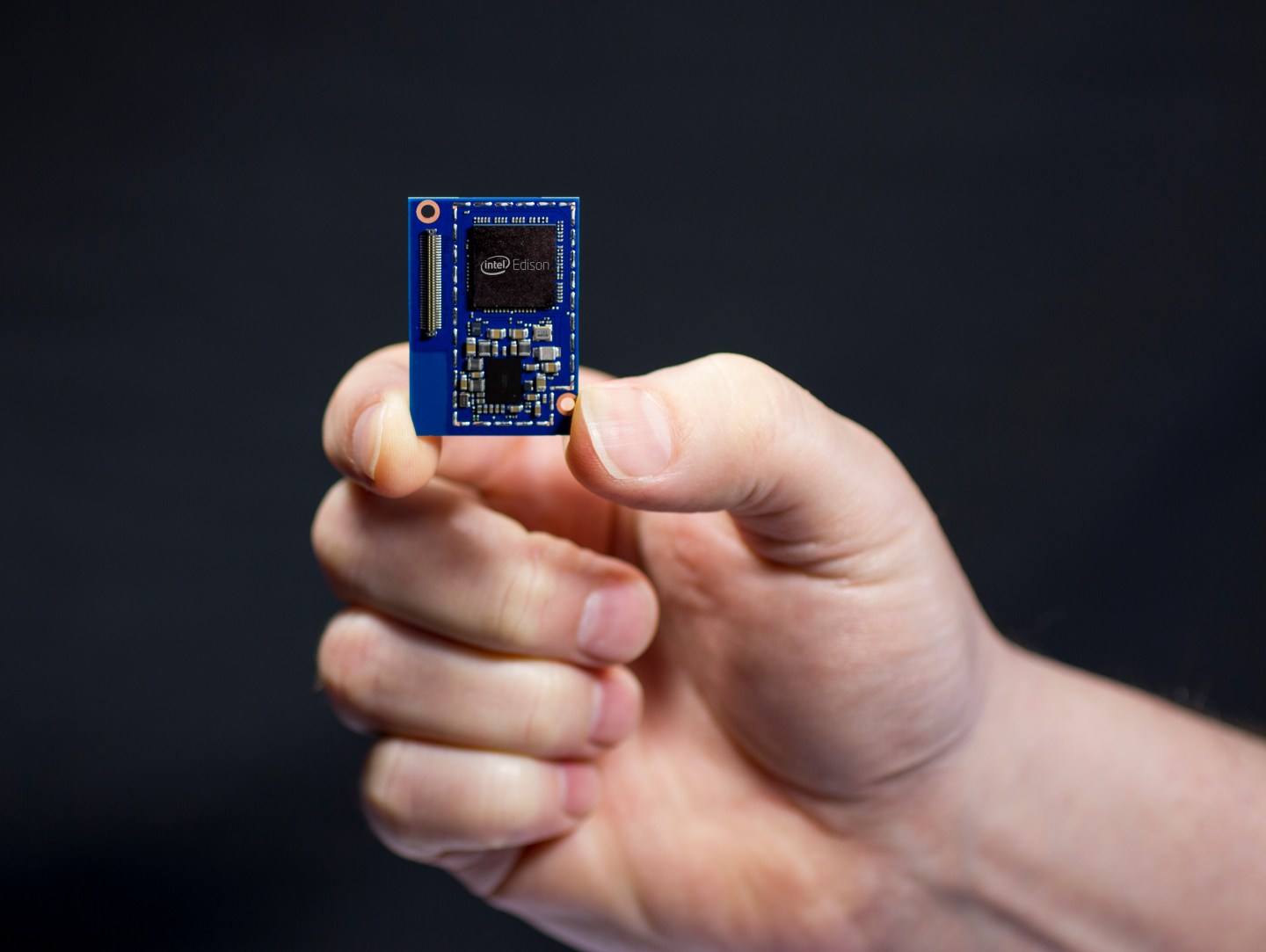
Intel's new Edison development platform, one key to the company's bid to dominate the Internet of Things.
Intel's new Edison development platform, one key to the company's bid to dominate the Internet of Things.Courtesy: Intel

In June, Intel pulled back the veil on a number of significant advancements in processing technology. It introduced its next-generation Xeon Phi processor, a piece of technology that the company predicts will drive 20 percent annual revenue growth in its high-performance computing business in the next few years. It announced new architecture for its versatile Atom chip, found in everything from tablet computers to cars. And it offered an update to the myriad processor projects—Bay Trail! Merrifield! Avoton! Rangeley!—in development.

Much of this plays into Intel’s vision of the future, one that signals the company’s commitment to developing the so-called Internet of Things—and, perhaps more important, its intense desire not to miss out on another major shift in computing.

The world’s largest maker of semiconductors was, without question, a late entrant to the mobile computing space. Though Intel (INTC) has historically dominated the supercomputing and personal computer markets, its lack of foresight (or timing) for the sudden and rapid growth of the mobile market allowed competitors like AMD (AMD) and Qualcomm (QCOM) to steal market share in the fastest-growing computing arena. With PC sales declining—Intel derives some 70 percent of its revenues from the PC market—the chipmaker is certainly aware of its own mortality. It doesn’t plan to miss the boat a second time.

“We’ve seen the screenification of the world, and now we’re moving to computational power in the environment,” says Brian David Johnson, Intel’s resident futurist and principal engineer, of the transition from smartphone- and tablet-centric computing toward wearable technology and other new types of computing that comprise the Internet of Things. “Before, we had to ask ourselves, ‘Can we take a desktop and make it fit onto somebody’s lap? Can we take a laptop and make it small enough to fit in somebody’s pocket?’ The question was always, ‘Can we do it?’ But now, as the size of meaningful computing power approaches zero, you can turn anything into a computer. So the question now becomes, ‘What do we want to turn into a computer, and why?’”

Intel clearly expects the answers to that question to be vast and diverse. During the June announcement, Johnson and other company representatives drove home the idea that the possibilities for computing applications grow exponentially as the size of meaningful computing power approaches zero, creating opportunities for mobile computing that go far beyond the tablet or smartphone. Intel thinks 500 million pieces of wearable tech will be sold globally each year by 2020. Each will pack some degree of processing power to consume and create data. (According to Gartner research cited by Intel, all of that data will generate some $2 trillion in value.)

Key to Intel’s bid in the area are two new products, Galileo and Edison. The first is a $60 development board that is compatible with Arduino, the open source electronics prototyping platform popular with “makers” and other do-it-yourself tinkerers. The second is a tiny system-on-a-chip, roughly the size of an SD card, that can be integrated into consumer products to provide processing, memory, storage, Wi-Fi, and Bluetooth connectivity and compatibility with a range of pluggable sensors.

Galileo is notable because it allows someone to retrofit a disconnected electronic device to become connected and be controlled from a smartphone. It’s a capability that other controller boards already allow, albeit with different architectures. Edison takes the general concept a step further, Johnson says, by allowing product developers to use it in items such as clothing, smart watches, smart glasses, personal robots, and other Internet-enabled appliances and devices.

If product developers take to Edison in a major way—”if” being the key word—it could put Intel out in front of its competition in the early days of the Internet of Things, a position the company has deeply coveted in the age of mobility. Better still, growth in Internet of Things technologies will also drive growth in Intel’s other major non-PC segments, a fact not lost on the company. More connected devices mean more data generated by those devices and the consumers that use them. More data means more data crunching, which means more processors needed to drive high-performance computing hardware as big data increasingly becomes a cornerstone technology for all kinds of enterprises.

This summer’s launch of Edison should provide Intel with an honest measure of whether the product designers already developing the wearable and embedded technologies that will populate the future will align their vision with Intel’s own. If they do, Intel could soon find itself powering any number of newly-connected devices that fall outside of the traditional computing markets. Which, Johnson notes, is exactly where Intel would like to be: inside.

“We’re not a PC company, we’re not a tablet company, we’re not a smartphone company. We’re an intelligence company,” Johnson says. “We can bring intelligence to anything. To me, Edison and Galileo are the first expression of that vision.”

Correction, Jul 9 2014: An earlier version of this article misspelled the code names of two Intel projects. They are Avoton and Rangeley.
About the Author
By Clay Dillow
See full bioRight Arrow Button Icon

Latest in

Finance
Lorem ipsum dolor sit amet, consectetur adipiscing elit, sed do eiusmod tempor incididunt ut labore et dolore magna aliqua. Ut enim ad minim veniam
By Fortune Editors
October 20, 2025
Finance
Lorem ipsum dolor sit amet, consectetur adipiscing elit, sed do eiusmod tempor incididunt ut labore et dolore magna aliqua. Ut enim ad minim veniam
By Fortune Editors
October 20, 2025
Finance
Lorem ipsum dolor sit amet, consectetur adipiscing elit, sed do eiusmod tempor incididunt ut labore et dolore magna aliqua. Ut enim ad minim veniam
By Fortune Editors
October 20, 2025
Finance
Lorem ipsum dolor sit amet, consectetur adipiscing elit, sed do eiusmod tempor incididunt ut labore et dolore magna aliqua. Ut enim ad minim veniam
By Fortune Editors
October 20, 2025
Finance
Lorem ipsum dolor sit amet, consectetur adipiscing elit, sed do eiusmod tempor incididunt ut labore et dolore magna aliqua. Ut enim ad minim veniam
By Fortune Editors
October 20, 2025
Finance
Lorem ipsum dolor sit amet, consectetur adipiscing elit, sed do eiusmod tempor incididunt ut labore et dolore magna aliqua. Ut enim ad minim veniam
By Fortune Editors
October 20, 2025

Most Popular

Finance
Lorem ipsum dolor sit amet, consectetur adipiscing elit, sed do eiusmod tempor incididunt ut labore et dolore magna aliqua. Ut enim ad minim veniam
By Fortune Editors
October 20, 2025
Finance
Lorem ipsum dolor sit amet, consectetur adipiscing elit, sed do eiusmod tempor incididunt ut labore et dolore magna aliqua. Ut enim ad minim veniam
By Fortune Editors
October 20, 2025
Finance
Lorem ipsum dolor sit amet, consectetur adipiscing elit, sed do eiusmod tempor incididunt ut labore et dolore magna aliqua. Ut enim ad minim veniam
By Fortune Editors
October 20, 2025
Finance
Lorem ipsum dolor sit amet, consectetur adipiscing elit, sed do eiusmod tempor incididunt ut labore et dolore magna aliqua. Ut enim ad minim veniam
By Fortune Editors
October 20, 2025
Finance
Lorem ipsum dolor sit amet, consectetur adipiscing elit, sed do eiusmod tempor incididunt ut labore et dolore magna aliqua. Ut enim ad minim veniam
By Fortune Editors
October 20, 2025
Finance
Lorem ipsum dolor sit amet, consectetur adipiscing elit, sed do eiusmod tempor incididunt ut labore et dolore magna aliqua. Ut enim ad minim veniam
By Fortune Editors
October 20, 2025
Fortune Secondary Logo
Rankings
  • 100 Best Companies
  • Fortune 500
  • Global 500
  • Fortune 500 Europe
  • Most Powerful Women
  • World's Most Admired Companies
  • See All Rankings
  • Lists Calendar
Sections
  • Finance
  • Fortune Crypto
  • Features
  • Leadership
  • Health
  • Commentary
  • Success
  • Retail
  • Mpw
  • Tech
  • Lifestyle
  • CEO Initiative
  • Asia
  • Politics
  • Conferences
  • Europe
  • Newsletters
  • Personal Finance
  • Environment
  • Magazine
  • Education
Customer Support
  • Frequently Asked Questions
  • Customer Service Portal
  • Privacy Policy
  • Terms Of Use
  • Single Issues For Purchase
  • International Print
Commercial Services
  • Advertising
  • Fortune Brand Studio
  • Fortune Analytics
  • Fortune Conferences
  • Business Development
  • Group Subscriptions
About Us
  • About Us
  • Press Center
  • Work At Fortune
  • Terms And Conditions
  • Site Map
  • About Us
  • Press Center
  • Work At Fortune
  • Terms And Conditions
  • Site Map
  • Facebook icon
  • Twitter icon
  • LinkedIn icon
  • Instagram icon
  • Pinterest icon

Latest in

A 45,000-person labor strike at Samsung’s memory chip plants could throw a wrench into the AI boom
EconomySamsung
A 45,000-person labor strike at Samsung’s memory chip plants could throw a wrench into the AI boom
By Catherina GioinoMay 17, 2026
41 minutes ago
Kevin Warsh, chairman of the US Federal Reserve nominee for US President Donald Trump, during a Senate Banking, Housing, and Urban Affairs Committee confirmation hearing in Washington, DC, US, on Tuesday, April 21, 2026.
BankingKevin Warsh
Wall Street is keeping a close eye on Kevin Warsh at the Fed. These are the red (and green) flags they’re watching for
By Eleanor PringleMay 17, 2026
2 hours ago
New NRG Energy CEO leans into growth with ‘bring your own power’ for the AI boom and affordability with ‘virtual power plants’
Energypower
New NRG Energy CEO leans into growth with ‘bring your own power’ for the AI boom and affordability with ‘virtual power plants’
By Jordan BlumMay 17, 2026
3 hours ago
U.S. allows Russia oil sales waiver to expire despite tight market
EnergyOil
U.S. allows Russia oil sales waiver to expire despite tight market
By Jennifer A. Dlouhy and BloombergMay 16, 2026
10 hours ago
AI poised to tilt job market leverage toward older workers
AIHiring
AI poised to tilt job market leverage toward older workers
By Victor Swezey and BloombergMay 16, 2026
11 hours ago
U.S., Iran stall on Hormuz reopening as oil supplies tighten
PoliticsIran
U.S., Iran stall on Hormuz reopening as oil supplies tighten
By Skylar Woodhouse, Jeff Mason, Arsalan Shahla and BloombergMay 16, 2026
11 hours ago

Most Popular

Microsoft AI chief gives it 18 months—for all white-collar work to be automated by AI
AI
Microsoft AI chief gives it 18 months—for all white-collar work to be automated by AI
By Jake AngeloMay 16, 2026
21 hours ago
Former top Russian official admits the country is over Putin and can 'imagine a future without him' — even elites bail as Kremlin seizes their assets 
Politics
Former top Russian official admits the country is over Putin and can 'imagine a future without him' — even elites bail as Kremlin seizes their assets 
By Jason MaMay 16, 2026
12 hours ago
Meet the 20-year-old CEO who launched a company in high school to solve Gen Z's entry-level job crisis
Future of Work
Meet the 20-year-old CEO who launched a company in high school to solve Gen Z's entry-level job crisis
By Jake AngeloMay 16, 2026
1 day ago
The Bezos family just donated $100 million to help achieve one of Mayor Zohran Mamdani’s top campaign promises
Politics
The Bezos family just donated $100 million to help achieve one of Mayor Zohran Mamdani’s top campaign promises
By Jake AngeloMay 12, 2026
5 days ago
‘You’re not a hero, you’re a liability’: Shark Tank’s Kevin O’Leary warns Gen Z founders to stop glorifying hustle culture
Future of Work
‘You’re not a hero, you’re a liability’: Shark Tank’s Kevin O’Leary warns Gen Z founders to stop glorifying hustle culture
By Jacqueline MunisMay 16, 2026
21 hours ago
Oil markets could be a month away from the moment of truth. Brace for a 'non-linear' price spike and panic buying, analysts warn
Energy
Oil markets could be a month away from the moment of truth. Brace for a 'non-linear' price spike and panic buying, analysts warn
By Jason MaMay 16, 2026
15 hours ago

© 2026 Fortune Media IP Limited. All Rights Reserved. Use of this site constitutes acceptance of our Terms of Use and Privacy Policy | CA Notice at Collection and Privacy Notice | Do Not Sell/Share My Personal Information
FORTUNE is a trademark of Fortune Media IP Limited, registered in the U.S. and other countries. FORTUNE may receive compensation for some links to products and services on this website. Offers may be subject to change without notice.