• Home
  • Latest
  • Fortune 500
  • Finance
  • Tech
  • Leadership
  • Lifestyle
  • Rankings
  • Multimedia

Exclusive

An hour in the Oval Office with President Trump Fortune Editor-in-Chief: Alyson Shontell sat down with President Trump in the Oval Office for an hour. Tariffs, Intel, AI, Boeing, Iran—and the question every CEO eventually has to answer: who's next?

An hour in the Oval Office with President Trump Fortune Editor-in-Chief: Alyson Shontell sat down with President Trump in the Oval Office for an hour. Tariffs, Intel, AI, Boeing, Iran—and the question every CEO eventually has to answer: who's next?

An hour in the Oval Office with President Trump Fortune Editor-in-Chief: Alyson Shontell sat down with President Trump in the Oval Office for an hour. Tariffs, Intel, AI, Boeing, Iran—and the question every CEO eventually has to answer: who's next?

An hour in the Oval Office with President Trump Fortune Editor-in-Chief: Alyson Shontell sat down with President Trump in the Oval Office for an hour. Tariffs, Intel, AI, Boeing, Iran—and the question every CEO eventually has to answer: who's next?

An hour in the Oval Office with President Trump Fortune Editor-in-Chief: Alyson Shontell sat down with President Trump in the Oval Office for an hour. Tariffs, Intel, AI, Boeing, Iran—and the question every CEO eventually has to answer: who's next?

An hour in the Oval Office with President Trump Fortune Editor-in-Chief: Alyson Shontell sat down with President Trump in the Oval Office for an hour. Tariffs, Intel, AI, Boeing, Iran—and the question every CEO eventually has to answer: who's next?

An hour in the Oval Office with President Trump Fortune Editor-in-Chief: Alyson Shontell sat down with President Trump in the Oval Office for an hour. Tariffs, Intel, AI, Boeing, Iran—and the question every CEO eventually has to answer: who's next?

An hour in the Oval Office with President Trump Fortune Editor-in-Chief: Alyson Shontell sat down with President Trump in the Oval Office for an hour. Tariffs, Intel, AI, Boeing, Iran—and the question every CEO eventually has to answer: who's next?

An hour in the Oval Office with President Trump Fortune Editor-in-Chief: Alyson Shontell sat down with President Trump in the Oval Office for an hour. Tariffs, Intel, AI, Boeing, Iran—and the question every CEO eventually has to answer: who's next?

An hour in the Oval Office with President Trump Fortune Editor-in-Chief: Alyson Shontell sat down with President Trump in the Oval Office for an hour. Tariffs, Intel, AI, Boeing, Iran—and the question every CEO eventually has to answer: who's next?

Commentary

Corporate America Just Became the LGBT Community’s Most Powerful Ally

By
Danielle Weatherby
Danielle Weatherby
Down Arrow Button Icon
By
Danielle Weatherby
Danielle Weatherby
Down Arrow Button Icon
April 2, 2016, 11:00 AM ET
APTOPIX Supreme Court Gay Marriage
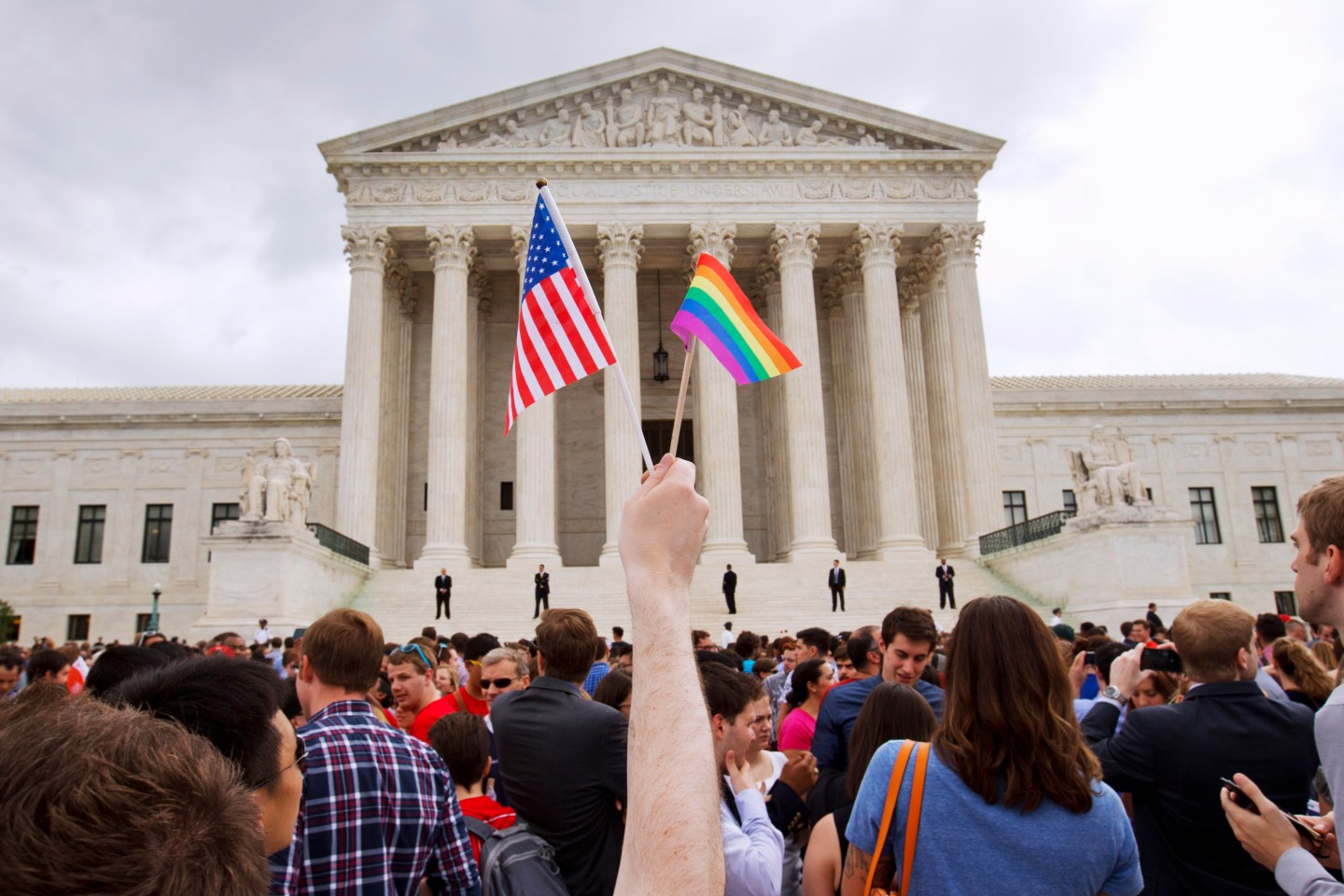
The crowd celebrates outside of the Supreme Court in Washington, Friday June 26, 2015, after the court declared that same-sex couples have a right to marry anywhere in the US. (AP Photo/Jacquelyn Martin)Photograph by Jacquelyn Martin — AP

As conservative legislatures in Southern states continue to plow ahead in the battle pitting religious freedom against LGBT-rights, mega-corporations like (DIS) Disney, (KO) Coca-Cola, and (FB) Facebook have earned an influential seat at the political roundtable. Earlier this week, Georgia Governor Nathan Deal vetoed a far-reaching religious freedom bill after facing pressure from these and other corporations threatening to pull their business out of the state.

North Carolina received similar scrutiny after passing House Bill 2, a sweeping religious freedom bill that essentially prohibits municipalities from passing LGBT-protective laws. The Charlotte-based Bank of America, Apple, and 80 other CEOs and business leaders signed onto a letter demanding that North Carolina Governor Pat McCrory repeal the controversial law.

These and other “license to discriminate” bills enabling business to refuse to hire or serve LGBT individuals in the name of religious freedom are part of a larger narrative – a continuing backlash to the Supreme Court’s historic 2015 same-sex marriage decision. But as businesses like Twitter, Marriot, Levi Strauss, and American Airlines voice objections to these bills, becoming central players in the political conversation, the business world questions whether and to what extent these companies should voice their progressive opinions so loudly.

See also: Mississippi Legislators Just Passed the “Most Sweeping Anti-LGBT Legislation” in the U.S.

Although corporate America cannot serve in a legislative or enforcement role, its certainly influencing legislative policy, as evidenced by Governor Deal’s recent veto of the Georgia religious freedom bill. Critics of corporate interference in policymaking take issue with these outspoken corporations’ expression of strong stances on political issues. After all, corporations are not structured for assuming a central role on the political stage. Indeed, the corporate structure is designed primarily for making money, and opponents of the new corporate conscience argue that money and politics should keep a safe distance. This is the argument espoused by opponents of the Supreme Court’s controversial 2010 decision in Citizens United v. Federal Election Commission, which upheld the First Amendment right of corporations to make unlimited independent expenditures to political causes. In short, this decision and its aftermath have reshaped the country’s political landscape.

Like it or not, however, dollars and cents play a leading role in today’s politics. In an age where Super PACS are flexing their political muscles by funding negative media campaigns against their candidate’s opponent or publishing disparaging pictures of a candidate’s wife, the political game is entirely about money. When money equals access to political discourse, and more money means more access and influence in the political arena, why shouldn’t corporations speak up on socially important matters?

The recent trend of corporate threats to boycott is part of a larger shift toward a more sophisticated political structure. While the recent threats of corporate boycotts are reminiscent of the efforts of civil rights groups like the ACLU or the NAACP during the civil rights movement, socially-minded consumers have become more savvy. They recognize that the most effective metaphorical carrot over a state politician’s nose is the threat of corporate abandonment.

Today, instead of civil rights groups like the NAACP influencing individuals to ban together on social policy issues, consumer activists have realized that pushing for corporate pressure on state governors is far more effective. Now, corporations are standing in the shoes of the consumer activists as “super-consumers” to state economies. The corporate influence on state economies is simply more powerful than any same-minded individual citizen activist because, in monetary terms, the corporate presence in a state has a greater impact on the state’s economy than even the aggregate of socially-conscious consumers.

But, as corporations navigate their way through uncharted territory, where the modern corporation exercises its political influence, justifying such expression as an act of corporate conscience, they must be cognizant of their shareholders. Where shares and wares are traded daily in the business world, and the stock market’s fluctuation is a symptom of consumer whim, corporations are held more accountable to their constituents than politicians, whose records are only reviewed every few years when they come up for reelection.

Regardless of whether a corporation’s motive is pure and altruistic, or whether it is acting solely for economic reasons (packaged in social consciousness), threats of corporate boycotts send both a symbolic and fiscal message that the business world will not tolerate efforts to cloak discrimination in religious freedom. When 80 businesses threaten a single state’s economy, the aggregate negative affect on interstate commerce could be substantial. As such, Coca-Cola, Disney, and other mega-corporations will continue to hold tremendous power in shaping social policy.

Danielle Weatherby is an assistant professor at the University of Arkansas School of Law.
About the Author
By Danielle Weatherby
See full bioRight Arrow Button Icon

Latest in Commentary

Finance
Lorem ipsum dolor sit amet, consectetur adipiscing elit, sed do eiusmod tempor incididunt ut labore et dolore magna aliqua. Ut enim ad minim veniam
By Fortune Editors
October 20, 2025
Finance
Lorem ipsum dolor sit amet, consectetur adipiscing elit, sed do eiusmod tempor incididunt ut labore et dolore magna aliqua. Ut enim ad minim veniam
By Fortune Editors
October 20, 2025
Finance
Lorem ipsum dolor sit amet, consectetur adipiscing elit, sed do eiusmod tempor incididunt ut labore et dolore magna aliqua. Ut enim ad minim veniam
By Fortune Editors
October 20, 2025
Finance
Lorem ipsum dolor sit amet, consectetur adipiscing elit, sed do eiusmod tempor incididunt ut labore et dolore magna aliqua. Ut enim ad minim veniam
By Fortune Editors
October 20, 2025
Finance
Lorem ipsum dolor sit amet, consectetur adipiscing elit, sed do eiusmod tempor incididunt ut labore et dolore magna aliqua. Ut enim ad minim veniam
By Fortune Editors
October 20, 2025
Finance
Lorem ipsum dolor sit amet, consectetur adipiscing elit, sed do eiusmod tempor incididunt ut labore et dolore magna aliqua. Ut enim ad minim veniam
By Fortune Editors
October 20, 2025

Most Popular

Finance
Lorem ipsum dolor sit amet, consectetur adipiscing elit, sed do eiusmod tempor incididunt ut labore et dolore magna aliqua. Ut enim ad minim veniam
By Fortune Editors
October 20, 2025
Finance
Lorem ipsum dolor sit amet, consectetur adipiscing elit, sed do eiusmod tempor incididunt ut labore et dolore magna aliqua. Ut enim ad minim veniam
By Fortune Editors
October 20, 2025
Finance
Lorem ipsum dolor sit amet, consectetur adipiscing elit, sed do eiusmod tempor incididunt ut labore et dolore magna aliqua. Ut enim ad minim veniam
By Fortune Editors
October 20, 2025
Finance
Lorem ipsum dolor sit amet, consectetur adipiscing elit, sed do eiusmod tempor incididunt ut labore et dolore magna aliqua. Ut enim ad minim veniam
By Fortune Editors
October 20, 2025
Finance
Lorem ipsum dolor sit amet, consectetur adipiscing elit, sed do eiusmod tempor incididunt ut labore et dolore magna aliqua. Ut enim ad minim veniam
By Fortune Editors
October 20, 2025
Finance
Lorem ipsum dolor sit amet, consectetur adipiscing elit, sed do eiusmod tempor incididunt ut labore et dolore magna aliqua. Ut enim ad minim veniam
By Fortune Editors
October 20, 2025
Fortune Secondary Logo
Rankings
  • 100 Best Companies
  • Fortune 500
  • Global 500
  • Fortune 500 Europe
  • Most Powerful Women
  • World's Most Admired Companies
  • See All Rankings
  • Lists Calendar
Sections
  • Finance
  • Fortune Crypto
  • Features
  • Leadership
  • Health
  • Commentary
  • Success
  • Retail
  • Mpw
  • Tech
  • Lifestyle
  • CEO Initiative
  • Asia
  • Politics
  • Conferences
  • Europe
  • Newsletters
  • Personal Finance
  • Environment
  • Magazine
  • Education
Customer Support
  • Frequently Asked Questions
  • Customer Service Portal
  • Privacy Policy
  • Terms Of Use
  • Single Issues For Purchase
  • International Print
Commercial Services
  • Advertising
  • Fortune Brand Studio
  • Fortune Analytics
  • Fortune Conferences
  • Business Development
  • Group Subscriptions
About Us
  • About Us
  • Press Center
  • Work At Fortune
  • Terms And Conditions
  • Site Map
  • About Us
  • Press Center
  • Work At Fortune
  • Terms And Conditions
  • Site Map
  • Facebook icon
  • Twitter icon
  • LinkedIn icon
  • Instagram icon
  • Pinterest icon

Latest in Commentary

charlie
CommentarySoftware
Anaplan CEO: AI isn’t eating software. It’s sorting it
By Charlie GottdienerMay 18, 2026
6 hours ago
shyam
CommentaryHealth
World Economic Forum: women’s health gets only 20% of R&D funding. We must seize this $1 trillion opportunity
By Shyam BishenMay 18, 2026
13 hours ago
murdochs
CommentaryMedia
OpenAI paid $100 million for a talk show. James Murdoch is eyeing an even bigger deal. The hot new asset class is humanity
By Lin CherryMay 17, 2026
1 day ago
dennis
CommentaryAI agents
Freshworks CEO: why agile enterprises are winning the AI race — and what they did differently
By Dennis WoodsideMay 17, 2026
1 day ago
Mary Moreland-Abbott Executive Vice President of Human Resources.
CommentaryRetirement
Gen X is the most indebted generation in America. Their employers can fix that
By Mary MorelandMay 17, 2026
1 day ago
liberman
Commentarystart-ups
We watched social media concentrate. The same thing is happening in AI, only at a deeper layer
By David Liberman and Daniil LibermanMay 16, 2026
2 days ago

Most Popular

Microsoft AI chief gives it 18 months—for all white-collar work to be automated by AI
AI
Microsoft AI chief gives it 18 months—for all white-collar work to be automated by AI
By Jake AngeloMay 16, 2026
2 days ago
The top foreign holders of U.S. debt may soon dump Treasury bonds and bring their money back home, potentially spiking borrowing costs
Economy
The top foreign holders of U.S. debt may soon dump Treasury bonds and bring their money back home, potentially spiking borrowing costs
By Jason MaMay 17, 2026
1 day ago
The Bezos family just donated $100 million to help achieve one of Mayor Zohran Mamdani’s top campaign promises
Politics
The Bezos family just donated $100 million to help achieve one of Mayor Zohran Mamdani’s top campaign promises
By Jake AngeloMay 12, 2026
6 days ago
'No one was coming to save me': How Reese Witherspoon built a $900 million company from a problem Hollywood wouldn't fix
Success
'No one was coming to save me': How Reese Witherspoon built a $900 million company from a problem Hollywood wouldn't fix
By Sydney LakeMay 17, 2026
1 day ago
SpaceX heads into a record-shattering IPO with the 'deepest moat that exists today' as investors vow to 'never bet against Elon'
Innovation
SpaceX heads into a record-shattering IPO with the 'deepest moat that exists today' as investors vow to 'never bet against Elon'
By Jason MaMay 16, 2026
2 days ago
Gen X is the most indebted generation in America. Their employers can fix that
Commentary
Gen X is the most indebted generation in America. Their employers can fix that
By Mary MorelandMay 17, 2026
1 day ago

© 2026 Fortune Media IP Limited. All Rights Reserved. Use of this site constitutes acceptance of our Terms of Use and Privacy Policy | CA Notice at Collection and Privacy Notice | Do Not Sell/Share My Personal Information
FORTUNE is a trademark of Fortune Media IP Limited, registered in the U.S. and other countries. FORTUNE may receive compensation for some links to products and services on this website. Offers may be subject to change without notice.