• Home
  • Latest
  • Fortune 500
  • Finance
  • Tech
  • Leadership
  • Lifestyle
  • Rankings
  • Multimedia

Exclusive

An hour in the Oval Office with President Trump Fortune Editor-in-Chief: Alyson Shontell sat down with President Trump in the Oval Office for an hour. Tariffs, Intel, AI, Boeing, Iran—and the question every CEO eventually has to answer: who's next?

An hour in the Oval Office with President Trump Fortune Editor-in-Chief: Alyson Shontell sat down with President Trump in the Oval Office for an hour. Tariffs, Intel, AI, Boeing, Iran—and the question every CEO eventually has to answer: who's next?

An hour in the Oval Office with President Trump Fortune Editor-in-Chief: Alyson Shontell sat down with President Trump in the Oval Office for an hour. Tariffs, Intel, AI, Boeing, Iran—and the question every CEO eventually has to answer: who's next?

An hour in the Oval Office with President Trump Fortune Editor-in-Chief: Alyson Shontell sat down with President Trump in the Oval Office for an hour. Tariffs, Intel, AI, Boeing, Iran—and the question every CEO eventually has to answer: who's next?

An hour in the Oval Office with President Trump Fortune Editor-in-Chief: Alyson Shontell sat down with President Trump in the Oval Office for an hour. Tariffs, Intel, AI, Boeing, Iran—and the question every CEO eventually has to answer: who's next?

An hour in the Oval Office with President Trump Fortune Editor-in-Chief: Alyson Shontell sat down with President Trump in the Oval Office for an hour. Tariffs, Intel, AI, Boeing, Iran—and the question every CEO eventually has to answer: who's next?

An hour in the Oval Office with President Trump Fortune Editor-in-Chief: Alyson Shontell sat down with President Trump in the Oval Office for an hour. Tariffs, Intel, AI, Boeing, Iran—and the question every CEO eventually has to answer: who's next?

An hour in the Oval Office with President Trump Fortune Editor-in-Chief: Alyson Shontell sat down with President Trump in the Oval Office for an hour. Tariffs, Intel, AI, Boeing, Iran—and the question every CEO eventually has to answer: who's next?

An hour in the Oval Office with President Trump Fortune Editor-in-Chief: Alyson Shontell sat down with President Trump in the Oval Office for an hour. Tariffs, Intel, AI, Boeing, Iran—and the question every CEO eventually has to answer: who's next?

An hour in the Oval Office with President Trump Fortune Editor-in-Chief: Alyson Shontell sat down with President Trump in the Oval Office for an hour. Tariffs, Intel, AI, Boeing, Iran—and the question every CEO eventually has to answer: who's next?

Commentary

Jill Stein: The Best Way to Boost the Economy Is by Saving the Planet

By
Jill Stein
Jill Stein
and
Bethany Cianciolo
Bethany Cianciolo
Down Arrow Button Icon
By
Jill Stein
Jill Stein
and
Bethany Cianciolo
Bethany Cianciolo
Down Arrow Button Icon
October 26, 2016, 2:24 PM ET
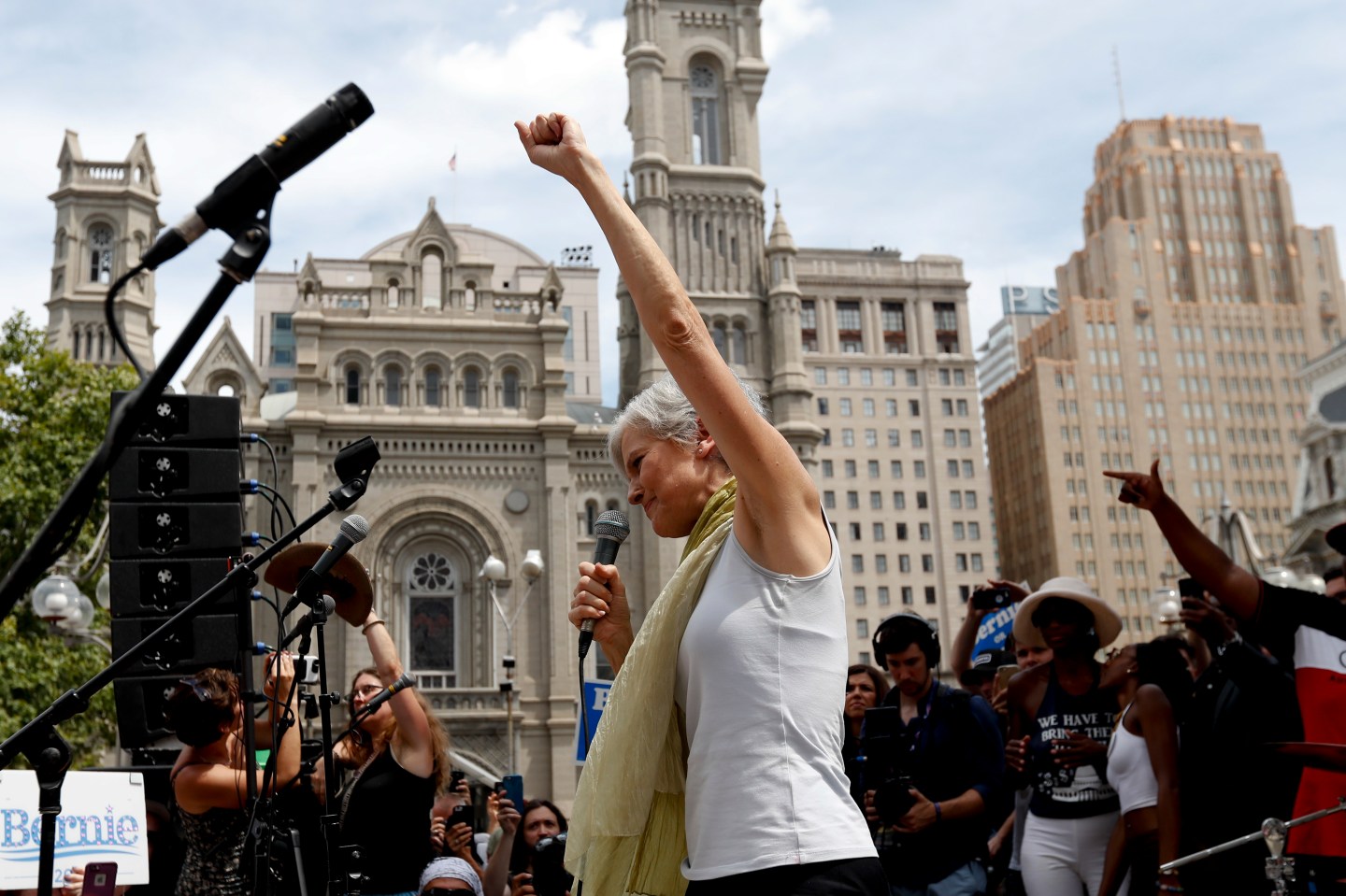
APTOPIX DEM 2016 Philadelphia
Dr. Jill Stein, presumptive Green Party presidential nominee, speaks at a rally in Philadelphia, Tuesday, July 26, 2016, during the second day of the Democratic National Convention. (AP Photo/Alex Brandon)Alex Brandon — AP

Our nation—and our world—face a perfect storm of economic and environmental crises that threaten not only the global economy, but life on Earth as we know it. The dire, existential threats of climate change, wars for oil, and a stagnating, crisis-ridden economic system require bold and visionary solutions. In this election, we are deciding not just what kind of a world we want, but whether we will have a world at all.

There is a growing concern in advanced economies that governments are running out of options to stabilize a precarious and volatile global economic system. Since the onset of the Great Recession in 2008, the Fed’s large-scale bond purchases, called quantitative easing, have helped push interest rates close to 0% and have done more to serve Wall Streets’ interests by way of propping up the stock market than by boosting the overall economy for average Americans.

These have proven to be temporary fixes, providing a semblance of “recovery” without addressing the underlying problems in the real economy: stagnating demand, lack of productive investment, staggering inequality and concentration of wealth—not to mention the climbing cost of climate-related disasters, like floods and wildfires, which have cost $26.9 billion dollars in 2016 alone. As recent warning signs in the U.S. market have shown, we are hardly out of the woods when it comes to preventing another big crash. Keeping interest rates super low has only produced the illusion of a healthy economy. Without sound fiscal policies targeted to help ordinary Americans, economic growth will stagnate.

Lasting economic recovery means going back to the basics: making things, buying things, and shoring up local communities and small businesses, which have always been the economic bedrock of our nation. It’s time to stop throwing good money after bad and address both economic and climate crises head-on by investing in the sectors most primed for innovation and growth: clean energy, eco-friendly infrastructure, sustainable food systems, public transit, and more—which also happen to be the tools we need for planetary survival.

See also: Hillary Clinton: What I Learned From Being a Mom Who Works

I believe the U.S. economy needs a Green New Deal: an ambitious yet secure economic and environmental program that will revive the economy, turn the tide on climate change, and make wars for oil obsolete—allowing us to cut our bloated, dangerous military budget in half. Building on the concept of Franklin D. Roosevelt’s New Deal, the Green New Deal calls on communities, government, and ordinary people on the scale of World War II to transition our energy system and economy to 100% clean, renewable energy by 2030.

The author of the best-known series of studies on transitioning to 100% clean energy, Stanford University professor Mark Jacobson, asserts that it is technologically and economically feasible. Bill Nye and others note that we have the technology to make this transition possible—and the science shows that we must. The only missing ingredient is political will.

Our government spends billions of dollars every year on activities that will make our planet uninhabitable: war, fracking, the construction and use of oil/gas pipelines, deforestation, industrial agriculture, and other acts that are threatening ecosystems and taking greenhouse gas emissions past the tipping point. The Green New Deal will redirect that money toward the real job creators who can create healthy and sustainable communities. We call for investment in green businesses, cooperatives, and non-profits, providing grants and loans with emphasis on small, locally based enterprises that keep wealth circulating in the community rather than offshoring profits to transnational corporations.

The Green New Deal will invest in clean energy technologies that are ready to go now, and redirect research funds from fossil fuels and other dead-end industries toward developing wind, solar, tidal, and geothermal energy. If the 50 U.S. states converted to 100% clean energy, the economy would generate 5.9 million lifetime construction and operation jobs for the energy facilities alone, which more than replaces the 3.9 million jobs displaced in the conventional energy sector.

See also: Gary Johnson: What Clinton and Trump Won’t Tell You About Entitlements

The Green New Deal will create up to 20 million jobs in green energy, agriculture, transportation, and essential services, directly and indirectly, through a nationally funded, locally controlled employment initiative, replacing unemployment offices with local employment offices. Communities will use a process of broad stakeholder input and democratic decision-making to fairly design and implement these programs. The government will be the employer of last resort, offering jobs meeting community-identified needs in the public and non-profit sectors to take up any slack in private-sector employment.

A job guarantee is good for the private sector, as it ensures that domestic demand never collapses as much as it does in the current system, with chronically low wages and structural unemployment and underemployment. It would also lift incomes for the most vulnerable households, helping to significantly reduce income inequality. We also call for canceling student debt, which will unleash a generation of young people to use their dollars toward consuming goods and starting businesses, putting their training, resourcefulness, and creativity to work to shape the economy of the future.

Of course, the big question is: How much will it cost? Estimated initial costs for the transition require an additional investment of 1% of global GDP (about $185 billion to $200 billion for the U.S.), plus $400 billion for public jobs programs. Overall, my team and I estimate that the government will need initial revenues of approximately $700 billion per year for the first few years to kick off the Green New Deal. The annual cost of the program is expected to decline rapidly over time as the stimulus takes effect and savings from other sectors offset the need for new sources of government revenue.


Much of those capital costs could be covered by diverting existing investments in nonrenewable energy. Based on figures from the International Energy Agency, it is estimated that the U.S. could build a 100% renewable energy system at costs comparable to or less than what the country would have to spend to continue its reliance on dirty energy. Prices for renewable energy have also been falling very fast in recent years due to performance improvements, which will reduce costs over time. In many parts of the United States, wind is now the cheapest source of electricity, and solar is on track to be the cheapest source of power in many parts of the world. Other costs could be covered through a Wall Street financial transaction tax, as well as a carbon tax of $60 per ton, which would raise $360 billion per year and make price signals more favorable toward private-sector development of renewable energy.

When we make these critical investments, our economy will be revitalized, and our national security will no longer be vulnerable to disruption of oil supplies. Wars for oil will be obsolete, which will allow hundreds of billions of dollars per year in the discretionary budget to be put toward production at home instead of destruction abroad.

Using renewable energy instead of coal and gas will also mean huge savings in health care costs because the foundations of a green economy—clean energy, a pollution-free environment, healthy food, and active transportation—are also the foundations of human health. The Green New Deal pays for itself within a matter of years through the prevention of chronic disease, which consumes a staggering 75% of our $3 trillion in annual health care expenditures.

All in all, the Green New Deal is an investment in our future that will pay off enormously as we build healthy, just, and sustainable communities. By addressing the root problems of global financial fragility, we can create a stable climate—pun intended—for long-term investment and economic growth, while ensuring that we also leave a livable world for future generations.

Dr. Jill Stein is a physician, environmental activist, and a mother on fire. She is the 2016 Green Party candidate for President of the United States.
About the Authors
By Jill Stein
See full bioRight Arrow Button Icon
By Bethany Cianciolo
See full bioRight Arrow Button Icon

Latest in Commentary

Finance
Lorem ipsum dolor sit amet, consectetur adipiscing elit, sed do eiusmod tempor incididunt ut labore et dolore magna aliqua. Ut enim ad minim veniam
By Fortune Editors
October 20, 2025
Finance
Lorem ipsum dolor sit amet, consectetur adipiscing elit, sed do eiusmod tempor incididunt ut labore et dolore magna aliqua. Ut enim ad minim veniam
By Fortune Editors
October 20, 2025
Finance
Lorem ipsum dolor sit amet, consectetur adipiscing elit, sed do eiusmod tempor incididunt ut labore et dolore magna aliqua. Ut enim ad minim veniam
By Fortune Editors
October 20, 2025
Finance
Lorem ipsum dolor sit amet, consectetur adipiscing elit, sed do eiusmod tempor incididunt ut labore et dolore magna aliqua. Ut enim ad minim veniam
By Fortune Editors
October 20, 2025
Finance
Lorem ipsum dolor sit amet, consectetur adipiscing elit, sed do eiusmod tempor incididunt ut labore et dolore magna aliqua. Ut enim ad minim veniam
By Fortune Editors
October 20, 2025
Finance
Lorem ipsum dolor sit amet, consectetur adipiscing elit, sed do eiusmod tempor incididunt ut labore et dolore magna aliqua. Ut enim ad minim veniam
By Fortune Editors
October 20, 2025

Most Popular

Finance
Lorem ipsum dolor sit amet, consectetur adipiscing elit, sed do eiusmod tempor incididunt ut labore et dolore magna aliqua. Ut enim ad minim veniam
By Fortune Editors
October 20, 2025
Finance
Lorem ipsum dolor sit amet, consectetur adipiscing elit, sed do eiusmod tempor incididunt ut labore et dolore magna aliqua. Ut enim ad minim veniam
By Fortune Editors
October 20, 2025
Finance
Lorem ipsum dolor sit amet, consectetur adipiscing elit, sed do eiusmod tempor incididunt ut labore et dolore magna aliqua. Ut enim ad minim veniam
By Fortune Editors
October 20, 2025
Finance
Lorem ipsum dolor sit amet, consectetur adipiscing elit, sed do eiusmod tempor incididunt ut labore et dolore magna aliqua. Ut enim ad minim veniam
By Fortune Editors
October 20, 2025
Finance
Lorem ipsum dolor sit amet, consectetur adipiscing elit, sed do eiusmod tempor incididunt ut labore et dolore magna aliqua. Ut enim ad minim veniam
By Fortune Editors
October 20, 2025
Finance
Lorem ipsum dolor sit amet, consectetur adipiscing elit, sed do eiusmod tempor incididunt ut labore et dolore magna aliqua. Ut enim ad minim veniam
By Fortune Editors
October 20, 2025
Fortune Secondary Logo
Rankings
  • 100 Best Companies
  • Fortune 500
  • Global 500
  • Fortune 500 Europe
  • Most Powerful Women
  • World's Most Admired Companies
  • See All Rankings
  • Lists Calendar
Sections
  • Finance
  • Fortune Crypto
  • Features
  • Leadership
  • Health
  • Commentary
  • Success
  • Retail
  • Mpw
  • Tech
  • Lifestyle
  • CEO Initiative
  • Asia
  • Politics
  • Conferences
  • Europe
  • Newsletters
  • Personal Finance
  • Environment
  • Magazine
  • Education
Customer Support
  • Frequently Asked Questions
  • Customer Service Portal
  • Privacy Policy
  • Terms Of Use
  • Single Issues For Purchase
  • International Print
Commercial Services
  • Advertising
  • Fortune Brand Studio
  • Fortune Analytics
  • Fortune Conferences
  • Business Development
  • Group Subscriptions
About Us
  • About Us
  • Press Center
  • Work At Fortune
  • Terms And Conditions
  • Site Map
  • About Us
  • Press Center
  • Work At Fortune
  • Terms And Conditions
  • Site Map
  • Facebook icon
  • Twitter icon
  • LinkedIn icon
  • Instagram icon
  • Pinterest icon

Latest in Commentary

altman
CommentarySam Altman
Musk vs. Altman: AI safety cannot be one man’s job
By Stavros GadinisMay 18, 2026
10 hours ago
charlie
CommentarySoftware
Anaplan CEO: AI isn’t eating software. It’s sorting it
By Charlie GottdienerMay 18, 2026
20 hours ago
shyam
CommentaryHealth
World Economic Forum: women’s health gets only 20% of R&D funding. We must seize this $1 trillion opportunity
By Shyam BishenMay 18, 2026
1 day ago
murdochs
CommentaryMedia
OpenAI paid $100 million for a talk show. James Murdoch is eyeing an even bigger deal. The hot new asset class is humanity
By Lin CherryMay 17, 2026
2 days ago
dennis
CommentaryAI agents
Freshworks CEO: why agile enterprises are winning the AI race — and what they did differently
By Dennis WoodsideMay 17, 2026
2 days ago
Mary Moreland-Abbott Executive Vice President of Human Resources.
CommentaryRetirement
Gen X is the most indebted generation in America. Their employers can fix that
By Mary MorelandMay 17, 2026
2 days ago

Most Popular

The Bezos family just donated $100 million to help achieve one of Mayor Zohran Mamdani’s top campaign promises
Politics
The Bezos family just donated $100 million to help achieve one of Mayor Zohran Mamdani’s top campaign promises
By Jake AngeloMay 12, 2026
6 days ago
While Trump insisted the Iran war would end ‘soon,’ an account in his name was buying millions in oil, defense and gold
Economy
While Trump insisted the Iran war would end ‘soon,’ an account in his name was buying millions in oil, defense and gold
By Eva RoytburgMay 18, 2026
12 hours ago
Current price of oil as of May 18, 2026
Personal Finance
Current price of oil as of May 18, 2026
By Joseph HostetlerMay 18, 2026
18 hours ago
Microsoft AI chief gives it 18 months—for all white-collar work to be automated by AI
AI
Microsoft AI chief gives it 18 months—for all white-collar work to be automated by AI
By Jake AngeloMay 16, 2026
3 days ago
EXCLUSIVE: An hour in the Oval Office with the CEO-in-Chief, President Trump
Politics
EXCLUSIVE: An hour in the Oval Office with the CEO-in-Chief, President Trump
By Alyson ShontellMay 18, 2026
1 day ago
The top foreign holders of U.S. debt may soon dump Treasury bonds and bring their money back home, potentially spiking borrowing costs
Economy
The top foreign holders of U.S. debt may soon dump Treasury bonds and bring their money back home, potentially spiking borrowing costs
By Jason MaMay 17, 2026
2 days ago

© 2026 Fortune Media IP Limited. All Rights Reserved. Use of this site constitutes acceptance of our Terms of Use and Privacy Policy | CA Notice at Collection and Privacy Notice | Do Not Sell/Share My Personal Information
FORTUNE is a trademark of Fortune Media IP Limited, registered in the U.S. and other countries. FORTUNE may receive compensation for some links to products and services on this website. Offers may be subject to change without notice.