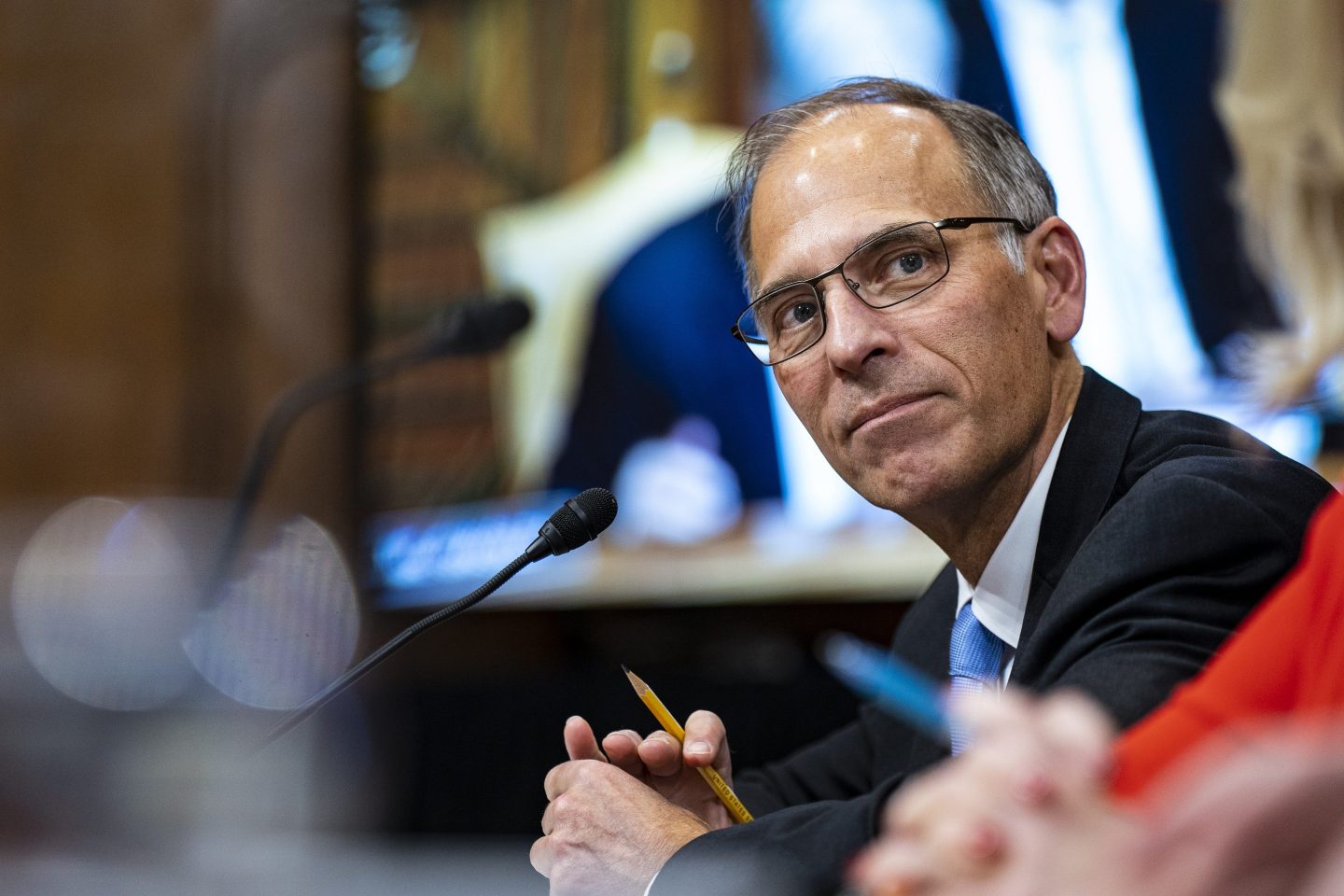
Steven Mnuchin, Donald Trump’s pick for Treasury Secretary, is worth an estimated half a billion dollars. And he likely owes more than half of his wealth to a single deal he struck with the government.
Wilbur Ross, Trump’s pick for Commerce Secretary, was already a very wealthy man when he inked a similar deal in 2009 with a government agency, but he still walked away as much as $350 million richer.
In both of the deals, the government, and taxpayers, were left billions of dollars poorer.
At the height of the financial crisis, the Federal Deposit Insurance Corp., the arm of the government charged with taking over failed banks and swallowing the losses, needed a savior. Banks were in danger of going under by the hundreds. The FDIC traditionally sold troubled banks to other, less troubled banks. But the nation’s biggest financial institutions, including Bank of America, J.P. Morgan Chase, and Wells Fargo, were tapped out after a number of deals. And the FDIC still had some rather large banks that looked like they were on the brink.
So in late 2008, the FDIC opened the door for other investors—private equity firms and hedge funds—to buy up banks in distress, and hopefully save the government some money in the process. The door was only opened briefly. But two of the small group of investors who walked through it, and walked away with a huge pile of riches, are now poised to serve Trump’s White House.
The Senate on Monday night confirmed Mnuchin to head the Treasury Department. Ross’s appointment has been approved by a Senate committee, and a full Senate confirmation vote could come later in the week.
Mnuchin led an investor group that bought California bank IndyMac, which the government had taken control of months earlier. Mnuchin quickly changed the bank’s name to OneWest after he took control. Ross’s firm was one of four investors in failing Florida lender BankUnited. The Mnuchin and Ross investor groups were the only ones to complete bank deals with the FDIC at the time. (Another firm with ties to Trump that cashed in on the BankUnited deal: Blackstone. The private equity firm is run by billionaire Stephen Schwarzman, who is the head of Trump’s CEO advisory panel. That’s an unpaid position with no formal authority.)
By mid-2009, the FDIC had established new rules that made it less lucrative for private equity firms to buy failing banks. It’s unclear why the FDIC tightened the rules, other than that the financial crisis was receding.
Neither of the deals has generated accusations of foul play. Mnuchin has been criticized for the many foreclosures OneWest initiated under his watch. Mnuchin has said he had few other options, since he took over a bank that had done many bad loans. In any case, the terms of the deal that led to the OneWest and BankUnited arrangements, and the profits that resulted, have not been big themes of debate around the confirmation of Mnuchin or Ross.
Still, some observers have said that the terms of the deals were too sweet for investors, and they fear that Mnuchin and Ross’s experience with these two deals could impact their interactions with private investors once they begin running major arms of the federal government. Ross has said that he thinks a good portion of the infrastructure spending that Trump has advocated should be done through public-private partnerships, and he has talked about the government using tax credits to help pay for those projects. Mnuchin has said that he would like to put the giant mortgage insurers Fannie Mae and Freddie Mac, which were taken over by the government at the height of the financial crisis, back into private hands.
One of the big questions in both of those instances is how generous such deals would be for private investors. Liberal economist Paul Krugman has criticized the public-private partnerships, as Trump has laid them out so far, as little more than corporate welfare.
And indeed some have suggested that Mnuchin and Ross’s backgrounds might influence who benefits from the deals they do. Senator Elizabeth Warren, the Massachusetts Democrat who has led the opposition to Mnuchin and Ross, along with other Trump cabinet picks, says that those relationships are a major reason she won’t support them.
“President-elect Trump promised over and over to ‘drain the swamp,’ but now he’s loading his administration with insiders like Mnuchin and Ross – guys who built their careers getting rich off the backs of working families and exploiting the financial crisis,” Warren tells Fortune. “Mnuchin and Ross have track records that show they tirelessly advance the interests of big corporations, but there’s little to show they would help working families one tiny bit as cabinet members.”
Legitimate deals, but troubling to critics
The government-assisted bailouts of OneWest and BankUnited have become little more than a footnote in the story of the financial crisis, especially compared to the deals struck to resolve Bear Stearns, Lehman Brothers, and Merrill Lynch. Nonetheless, for some FDIC officials, the deals remain hot topics. They still bristle at the fact that the deals were so generous. Fortune has talked to a number of former and current members of the FDIC who were closely familiar with the transactions. None of those who disagreed with the terms of the deal agreed to speak for attribution, however. Sheila Bair, a Republican who headed the FDIC at the time, declined to comment. Two former FDIC officials who were in charge of resolving troubled banks in late 2008 last month wrote an op-ed in the Wall Street Journal arguing the deal was “fair and square.”
All of the officials said that OneWest and BankUnited acquisitions were the result of a bidding process that was open to both banks and private equity investors. They said that the FDIC went with the best bids they got. And they agreed that while the FDIC lost billions on OneWest and BankUnited, selling the banks to private investors saved the government from losing billions more.
Critics, though, including John Taylor at the National Community Investment Coalition, an advocacy group for traditionally underbanked communities, have called the OneWest and BankUnited “sweetheart” deals. In retrospect, the deals do look generous. In both deals, the FDIC agreed to loss-sharing arrangements in which the government assumed much more of the losses than the private investors did. It also arranged to share the upside as well. But that upside ended up being a lot less than the private investors got.
In the OneWest deal, for instance, the FDIC agree to a loss sharing arrangement that opened up the federal agency to assuming as much as 80% of the total losses. The FDIC’s guarantees only kicked in after Mnuchin and his fellow investors swallowed over $2 billion in losses, but they were still costly for the government. In the end, the FDIC ended up losing $12.4 billion on the OneWest failure, according to the agency’s latest estimate. Mnuchin’s group of investors, meanwhile, netted $2.3 billion on OneWest when they sold their stakes in November 2015.
In the case of BankUnited, the FDIC agreed to cover 95% of the losses. WhenBankUnited went public in 2011, Ross and the other private equity investors, who along with Blackstone, included fellow private equity firm Carlyle and boutique Wall Street firm Centerbridge Partners, earned $522 million. The FDIC’s “profit share” from BankUnited’s IPO: a mere $25 million. In all, the FDIC lost $5.2 billion on BankUnited.
More than doubling their money
It’s not clear exactly how much Mnuchin and Ross personally made on their respective deals. Both were part of investor groups and neither disclosed their individual stake in the deals, either when they were struck or afterwards. But they and their investing partners clearly did a lot better than the taxpayers
Fortune computed Mnuchin and Ross’ likely gains on their respective deals by looking at the share of each bank they owned at the time each started to exit the deals. Mnuchin and Ross’s profits, though, could have been even bigger if they unloaded shares before details of the transactions became public. Mnuchin and Ross also ran investment firms that took in money from others. And so it is possible that some of the gains went to their investors. But if that was the case Mnuchin and Ross would have still collected management fees for those profits. In the case of Mnuchin, two trusts in his name, including one that appears to be set aside for his family, are listed as owners of the OneWest shares.
Based on Fortune‘s calculations, Mnuchin’s investment group made a 148% return on OneWest, or just over 15% a year over seven years. Ross’s BankUnited investment returned 134% over two years, or an annualized return of nearly 53%.
Donald Cohen, executive director of watchdog group In the Public Interest, said those returns are excessive given that deals with the government generally involve less risk, especially in these instances with their loss sharing arrangements. And Cohen is worried, given their experience, that Mnuchin and Ross will hand out similarly generous deals to investors now that they are negotiating on behalf of the government.
“We have already seen that these two individuals willingness to profit awesomely off the public purse and the public need,” says Cohen. “And now they are in the driver’s seat.”
The Trump administration did not respond to requests for comment from Fortune; this story will be updated with any future responses.
Editor’s note: This story was updated to reflect the Senate confirmation vote on Steven Mnuchin.