• Home
  • Latest
  • Fortune 500
  • Finance
  • Tech
  • Leadership
  • Lifestyle
  • Rankings
  • Multimedia

Exclusive

An hour in the Oval Office with President Trump Fortune Editor-in-Chief: Alyson Shontell sat down with President Trump in the Oval Office for an hour. Tariffs, Intel, AI, Boeing, Iran—and the question every CEO eventually has to answer: who's next?

An hour in the Oval Office with President Trump Fortune Editor-in-Chief: Alyson Shontell sat down with President Trump in the Oval Office for an hour. Tariffs, Intel, AI, Boeing, Iran—and the question every CEO eventually has to answer: who's next?

An hour in the Oval Office with President Trump Fortune Editor-in-Chief: Alyson Shontell sat down with President Trump in the Oval Office for an hour. Tariffs, Intel, AI, Boeing, Iran—and the question every CEO eventually has to answer: who's next?

An hour in the Oval Office with President Trump Fortune Editor-in-Chief: Alyson Shontell sat down with President Trump in the Oval Office for an hour. Tariffs, Intel, AI, Boeing, Iran—and the question every CEO eventually has to answer: who's next?

An hour in the Oval Office with President Trump Fortune Editor-in-Chief: Alyson Shontell sat down with President Trump in the Oval Office for an hour. Tariffs, Intel, AI, Boeing, Iran—and the question every CEO eventually has to answer: who's next?

An hour in the Oval Office with President Trump Fortune Editor-in-Chief: Alyson Shontell sat down with President Trump in the Oval Office for an hour. Tariffs, Intel, AI, Boeing, Iran—and the question every CEO eventually has to answer: who's next?

An hour in the Oval Office with President Trump Fortune Editor-in-Chief: Alyson Shontell sat down with President Trump in the Oval Office for an hour. Tariffs, Intel, AI, Boeing, Iran—and the question every CEO eventually has to answer: who's next?

An hour in the Oval Office with President Trump Fortune Editor-in-Chief: Alyson Shontell sat down with President Trump in the Oval Office for an hour. Tariffs, Intel, AI, Boeing, Iran—and the question every CEO eventually has to answer: who's next?

An hour in the Oval Office with President Trump Fortune Editor-in-Chief: Alyson Shontell sat down with President Trump in the Oval Office for an hour. Tariffs, Intel, AI, Boeing, Iran—and the question every CEO eventually has to answer: who's next?

An hour in the Oval Office with President Trump Fortune Editor-in-Chief: Alyson Shontell sat down with President Trump in the Oval Office for an hour. Tariffs, Intel, AI, Boeing, Iran—and the question every CEO eventually has to answer: who's next?

Commentary

Why it would be a huge mistake to allow Big Tech firms to acquire banks

By
Art Wilmarth
Art Wilmarth
Down Arrow Button Icon
By
Art Wilmarth
Art Wilmarth
Down Arrow Button Icon
November 26, 2020, 9:00 AM ET
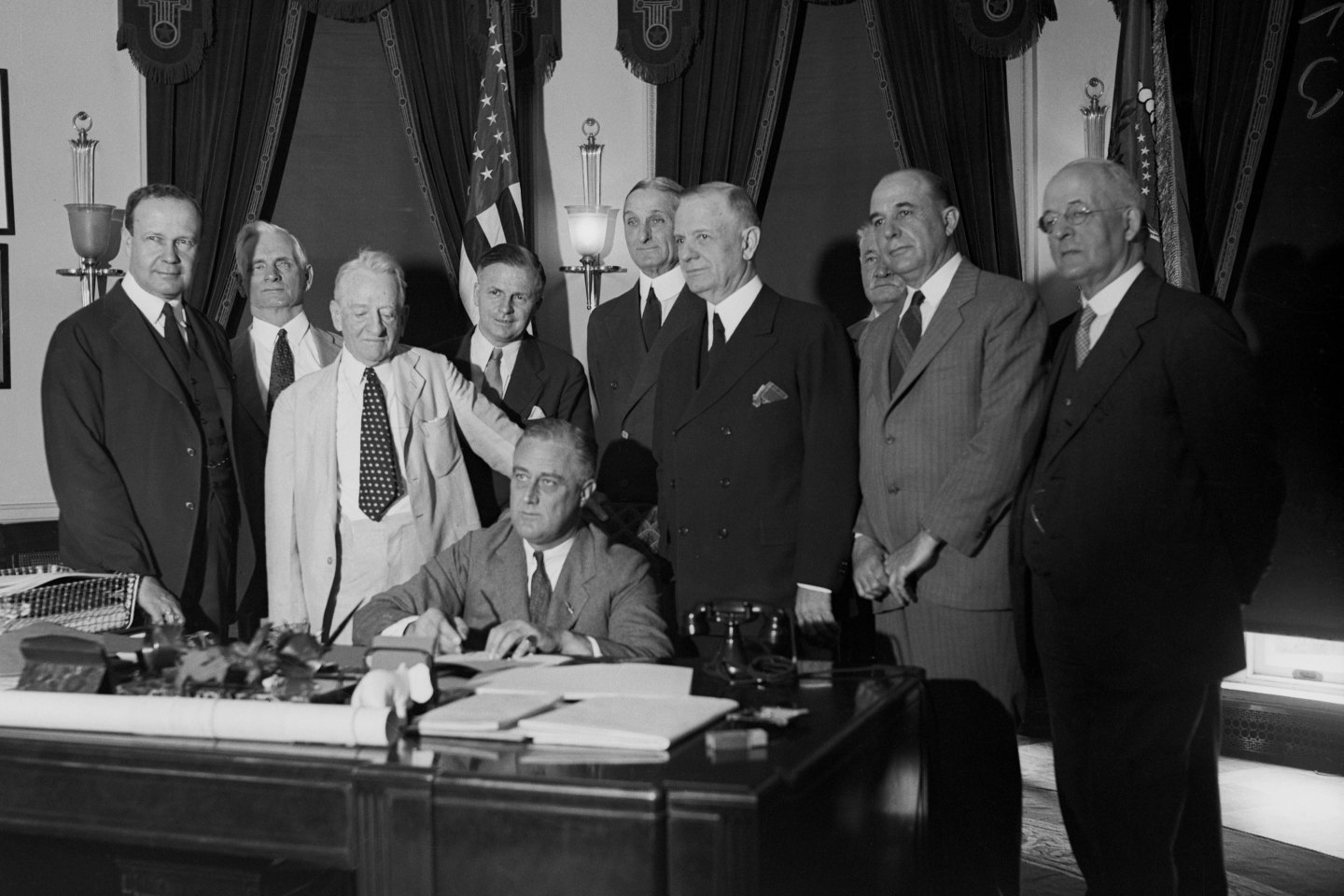
Commentary-Big Tech and Banks-Roosevelt Signing Glass-Steagall Act
President Franklin Roosevelt signs the Glass-Steagall bank reform legislation. Congress should pass a new Glass-Steagall Act to reinforce the separation between banking and commerce, writes Art Wilmarth.Bettmann—Getty Images

Prior to 1980, the Glass-Steagall Act of 1933 maintained a strict separation between our banking system and our capital markets. However, financial regulators opened loopholes in Glass-Steagall during the 1980s and 1990s, allowing banks to engage in securities activities and permitting nonbanks to offer bank-like products. 

“Universal banks” (banks engaged in securities activities) and “shadow banks” (nonbanks offering bank-like services) dominated our financial markets after Congress repealed Glass-Steagall in 1999. Universal banks and shadow banks played leading roles in the toxic subprime lending boom that led to the financial crisis of 2007–09.

In response to the financial crisis, the Treasury Department and the Federal Reserve bailed out big banks as well as large shadow banks (including AIG, Morgan Stanley, and Goldman Sachs). Federal agencies also protected short-term financial instruments that functioned as substitutes for bank deposits, such as money market mutual funds, commercial paper, and securities repurchase agreements (“repos”). 

The federal government’s response to the financial crisis went far beyond the traditional U.S. policy of protecting banks and bank depositors. Federal authorities effectively wrapped the federal “safety net” around our entire financial system. By doing so, they “bankified” our financial markets.

The Dodd-Frank Act’s regulatory reforms did not correct the deeply flawed structure of the financial system—including the dominance of universal banks and shadow banks—that caused the financial crisis of 2007–09. Consequently, federal agencies felt compelled to provide another series of bailouts when the COVID-19 pandemic triggered a new financial crisis. Federal authorities aggressively intervened in March to protect universal banks, shadow banks, and short-term financial markets from failure. In addition, federal agencies took the unprecedented step of backstopping the corporate bond market. 

That extraordinary measure was not coincidental. Universal banks and shadow banks promoted a massive expansion of corporate debt during the past decade. The debts of U.S. corporations reached a record level of $10.5 trillion in March 2020. Almost two-thirds of those debts were either rated as “junk” or received the lowest investment-grade rating (BBB). Corporate debt markets would have collapsed without the federal government’s backstop, with severe knock-on effects for our financial system and economy.

This year’s events have once again revealed the unhealthy bankification of our financial markets. Now federal regulators are trying to bankify the rest of the economy. The Office of the Comptroller of the Currency (OCC)—the regulator of national banks—wants to give national bank charters to fintechs that offer lending or payment services but do not accept deposits. The Federal Deposit Insurance Corporation (FDIC) is considering a rule that would allow all types of commercial firms to acquire FDIC-insured industrial banks (consumer banks chartered by Utah and several other states). 

The OCC’s and FDIC’s initiatives would allow technology firms and other commercial enterprises to obtain banking privileges and benefits—including access to the federal “safety net”—without complying with many of the prudential requirements governing FDIC-insured full-service banks. For example, commercial owners of fintech national banks and industrial banks would not have to comply with the Bank Holding Company (BHC) Act, which prohibits affiliations between FDIC-insured full-service banks and commercial firms. That prohibition is the cornerstone of our historic policy of separating banking and commerce.

The Glass-Steagall and BHC acts separated banking from commerce to prevent undue concentrations of financial and economic power and to minimize conflicts of interest in bank lending and investment advice. A bank that controls—or is controlled by—a commercial firm has powerful and dangerous incentives to use its lending and investment policies to support its commercial affiliate. Problems that arise in the commercial affiliate are likely to infect the bank, as shown by the recent collapse of Wirecard in Germany.

If the OCC’s and FDIC’s initiatives succeed, Congress will face intense pressure to repeal the separation of banking and commerce. Big Tech firms will lobby for permission to acquire full-service banks, and big banks will push for authority to acquire technology firms. If Congress gives in (as it did when it repealed Glass-Steagall), mergers between Big Tech companies and big banks are virtually certain to occur. 

The result will be a bankification of our economy. Giant banking-and-commercial conglomerates will spread across the nation. Commercial owners of banks will profit from the federal “safety net,” including the ability to offer FDIC-insured deposits—the cheapest and most stable source of funding available in the private market. Large commercial firms that own sizable banks will be considered “too big to fail” and will enjoy enormous advantages over smaller competitors that can’t afford to acquire banks. 

When the next crisis occurs, federal agencies will feel compelled to rescue not only our financial system but also our leading banking-and-commercial conglomerates. Market discipline, which has already been greatly weakened in our financial markets, will largely disappear from the rest of our economy.

Congress should adopt two crucial measures to reverse the bankification of our country. First, Congress should enact a new Glass-Steagall Act to reestablish a strict separation between our banking system and our capital markets. Congress should prohibit banks from underwriting and trading in securities and other capital market instruments, except for government bonds. 

Congress should also prohibit nonbanks from offering short-term financial instruments that function as deposit substitutes. Only banks should be allowed to issue money market mutual funds, commercial paper, and repos. Requiring nonbanks to fund their operations with longer-term securities would eliminate the shadow bank business model, restore market discipline, and improve the stability of our financial markets.

Second, Congress should reaffirm the separation of banking and commerce by overruling the OCC’s and FDIC’s initiatives. Both measures would return banks to their traditional roles as objective providers of deposit, credit, payment, and fiduciary services. The “too big to fail” problem would be greatly diminished with the elimination of universal banks and the likely disappearance of shadow banks. Banks and commercial firms would be prevented from exercising any type of control over each other. 

Banks and the capital markets would once again become independent sectors with strong incentives to serve the needs of consumers, communities, and Main Street businesses. Our financial system and our economy would become more stable, more competitive, and more productive. 

Art Wilmarth is a professor emeritus of law at George Washington University. This essay is based on his recently published book, Taming the Megabanks: Why We Need a New Glass-Steagall Act, and his testimony before the House Financial Services Committee’s Task Force on Financial Technology on Sept. 29, 2020. 
About the Author
By Art Wilmarth
See full bioRight Arrow Button Icon

Latest in Commentary

Finance
Lorem ipsum dolor sit amet, consectetur adipiscing elit, sed do eiusmod tempor incididunt ut labore et dolore magna aliqua. Ut enim ad minim veniam
By Fortune Editors
October 20, 2025
Finance
Lorem ipsum dolor sit amet, consectetur adipiscing elit, sed do eiusmod tempor incididunt ut labore et dolore magna aliqua. Ut enim ad minim veniam
By Fortune Editors
October 20, 2025
Finance
Lorem ipsum dolor sit amet, consectetur adipiscing elit, sed do eiusmod tempor incididunt ut labore et dolore magna aliqua. Ut enim ad minim veniam
By Fortune Editors
October 20, 2025
Finance
Lorem ipsum dolor sit amet, consectetur adipiscing elit, sed do eiusmod tempor incididunt ut labore et dolore magna aliqua. Ut enim ad minim veniam
By Fortune Editors
October 20, 2025
Finance
Lorem ipsum dolor sit amet, consectetur adipiscing elit, sed do eiusmod tempor incididunt ut labore et dolore magna aliqua. Ut enim ad minim veniam
By Fortune Editors
October 20, 2025
Finance
Lorem ipsum dolor sit amet, consectetur adipiscing elit, sed do eiusmod tempor incididunt ut labore et dolore magna aliqua. Ut enim ad minim veniam
By Fortune Editors
October 20, 2025

Most Popular

Finance
Lorem ipsum dolor sit amet, consectetur adipiscing elit, sed do eiusmod tempor incididunt ut labore et dolore magna aliqua. Ut enim ad minim veniam
By Fortune Editors
October 20, 2025
Finance
Lorem ipsum dolor sit amet, consectetur adipiscing elit, sed do eiusmod tempor incididunt ut labore et dolore magna aliqua. Ut enim ad minim veniam
By Fortune Editors
October 20, 2025
Finance
Lorem ipsum dolor sit amet, consectetur adipiscing elit, sed do eiusmod tempor incididunt ut labore et dolore magna aliqua. Ut enim ad minim veniam
By Fortune Editors
October 20, 2025
Finance
Lorem ipsum dolor sit amet, consectetur adipiscing elit, sed do eiusmod tempor incididunt ut labore et dolore magna aliqua. Ut enim ad minim veniam
By Fortune Editors
October 20, 2025
Finance
Lorem ipsum dolor sit amet, consectetur adipiscing elit, sed do eiusmod tempor incididunt ut labore et dolore magna aliqua. Ut enim ad minim veniam
By Fortune Editors
October 20, 2025
Finance
Lorem ipsum dolor sit amet, consectetur adipiscing elit, sed do eiusmod tempor incididunt ut labore et dolore magna aliqua. Ut enim ad minim veniam
By Fortune Editors
October 20, 2025
Fortune Secondary Logo
Rankings
  • 100 Best Companies
  • Fortune 500
  • Global 500
  • Fortune 500 Europe
  • Most Powerful Women
  • World's Most Admired Companies
  • See All Rankings
  • Lists Calendar
Sections
  • Finance
  • Fortune Crypto
  • Features
  • Leadership
  • Health
  • Commentary
  • Success
  • Retail
  • Mpw
  • Tech
  • Lifestyle
  • CEO Initiative
  • Asia
  • Politics
  • Conferences
  • Europe
  • Newsletters
  • Personal Finance
  • Environment
  • Magazine
  • Education
Customer Support
  • Frequently Asked Questions
  • Customer Service Portal
  • Privacy Policy
  • Terms Of Use
  • Single Issues For Purchase
  • International Print
Commercial Services
  • Advertising
  • Fortune Brand Studio
  • Fortune Analytics
  • Fortune Conferences
  • Business Development
  • Group Subscriptions
About Us
  • About Us
  • Press Center
  • Work At Fortune
  • Terms And Conditions
  • Site Map
  • About Us
  • Press Center
  • Work At Fortune
  • Terms And Conditions
  • Site Map
  • Facebook icon
  • Twitter icon
  • LinkedIn icon
  • Instagram icon
  • Pinterest icon

Latest in Commentary

altman
CommentarySam Altman
Musk vs. Altman: AI safety cannot be one man’s job
By Stavros GadinisMay 18, 2026
27 minutes ago
charlie
CommentarySoftware
Anaplan CEO: AI isn’t eating software. It’s sorting it
By Charlie GottdienerMay 18, 2026
10 hours ago
shyam
CommentaryHealth
World Economic Forum: women’s health gets only 20% of R&D funding. We must seize this $1 trillion opportunity
By Shyam BishenMay 18, 2026
18 hours ago
murdochs
CommentaryMedia
OpenAI paid $100 million for a talk show. James Murdoch is eyeing an even bigger deal. The hot new asset class is humanity
By Lin CherryMay 17, 2026
1 day ago
dennis
CommentaryAI agents
Freshworks CEO: why agile enterprises are winning the AI race — and what they did differently
By Dennis WoodsideMay 17, 2026
1 day ago
Mary Moreland-Abbott Executive Vice President of Human Resources.
CommentaryRetirement
Gen X is the most indebted generation in America. Their employers can fix that
By Mary MorelandMay 17, 2026
1 day ago

Most Popular

The top foreign holders of U.S. debt may soon dump Treasury bonds and bring their money back home, potentially spiking borrowing costs
Economy
The top foreign holders of U.S. debt may soon dump Treasury bonds and bring their money back home, potentially spiking borrowing costs
By Jason MaMay 17, 2026
1 day ago
Microsoft AI chief gives it 18 months—for all white-collar work to be automated by AI
AI
Microsoft AI chief gives it 18 months—for all white-collar work to be automated by AI
By Jake AngeloMay 16, 2026
2 days ago
The Bezos family just donated $100 million to help achieve one of Mayor Zohran Mamdani’s top campaign promises
Politics
The Bezos family just donated $100 million to help achieve one of Mayor Zohran Mamdani’s top campaign promises
By Jake AngeloMay 12, 2026
6 days ago
SpaceX heads into a record-shattering IPO with the 'deepest moat that exists today' as investors vow to 'never bet against Elon'
Innovation
SpaceX heads into a record-shattering IPO with the 'deepest moat that exists today' as investors vow to 'never bet against Elon'
By Jason MaMay 16, 2026
2 days ago
'No one was coming to save me': How Reese Witherspoon built a $900 million company from a problem Hollywood wouldn't fix
Success
'No one was coming to save me': How Reese Witherspoon built a $900 million company from a problem Hollywood wouldn't fix
By Sydney LakeMay 17, 2026
1 day ago
Mamdani's New York is coming to tax your private jet. Here's how to prepare
Personal Finance
Mamdani's New York is coming to tax your private jet. Here's how to prepare
By Greg RaiffMay 16, 2026
3 days ago

© 2026 Fortune Media IP Limited. All Rights Reserved. Use of this site constitutes acceptance of our Terms of Use and Privacy Policy | CA Notice at Collection and Privacy Notice | Do Not Sell/Share My Personal Information
FORTUNE is a trademark of Fortune Media IP Limited, registered in the U.S. and other countries. FORTUNE may receive compensation for some links to products and services on this website. Offers may be subject to change without notice.