• Home
  • Latest
  • Fortune 500
  • Finance
  • Tech
  • Leadership
  • Lifestyle
  • Rankings
  • Multimedia

Exclusive

An hour in the Oval Office with President Trump Fortune Editor-in-Chief: Alyson Shontell sat down with President Trump in the Oval Office for an hour. Tariffs, Intel, AI, Boeing, Iran—and the question every CEO eventually has to answer: who's next?

An hour in the Oval Office with President Trump Fortune Editor-in-Chief: Alyson Shontell sat down with President Trump in the Oval Office for an hour. Tariffs, Intel, AI, Boeing, Iran—and the question every CEO eventually has to answer: who's next?

An hour in the Oval Office with President Trump Fortune Editor-in-Chief: Alyson Shontell sat down with President Trump in the Oval Office for an hour. Tariffs, Intel, AI, Boeing, Iran—and the question every CEO eventually has to answer: who's next?

An hour in the Oval Office with President Trump Fortune Editor-in-Chief: Alyson Shontell sat down with President Trump in the Oval Office for an hour. Tariffs, Intel, AI, Boeing, Iran—and the question every CEO eventually has to answer: who's next?

An hour in the Oval Office with President Trump Fortune Editor-in-Chief: Alyson Shontell sat down with President Trump in the Oval Office for an hour. Tariffs, Intel, AI, Boeing, Iran—and the question every CEO eventually has to answer: who's next?

An hour in the Oval Office with President Trump Fortune Editor-in-Chief: Alyson Shontell sat down with President Trump in the Oval Office for an hour. Tariffs, Intel, AI, Boeing, Iran—and the question every CEO eventually has to answer: who's next?

An hour in the Oval Office with President Trump Fortune Editor-in-Chief: Alyson Shontell sat down with President Trump in the Oval Office for an hour. Tariffs, Intel, AI, Boeing, Iran—and the question every CEO eventually has to answer: who's next?

An hour in the Oval Office with President Trump Fortune Editor-in-Chief: Alyson Shontell sat down with President Trump in the Oval Office for an hour. Tariffs, Intel, AI, Boeing, Iran—and the question every CEO eventually has to answer: who's next?

An hour in the Oval Office with President Trump Fortune Editor-in-Chief: Alyson Shontell sat down with President Trump in the Oval Office for an hour. Tariffs, Intel, AI, Boeing, Iran—and the question every CEO eventually has to answer: who's next?

An hour in the Oval Office with President Trump Fortune Editor-in-Chief: Alyson Shontell sat down with President Trump in the Oval Office for an hour. Tariffs, Intel, AI, Boeing, Iran—and the question every CEO eventually has to answer: who's next?

CommentaryAI

The battle between autocracy and democracy has blinded us to the A.l. oligopoly

By
Wendell Wallach
Wendell Wallach
Down Arrow Button Icon
By
Wendell Wallach
Wendell Wallach
Down Arrow Button Icon
June 16, 2022, 9:47 AM ET
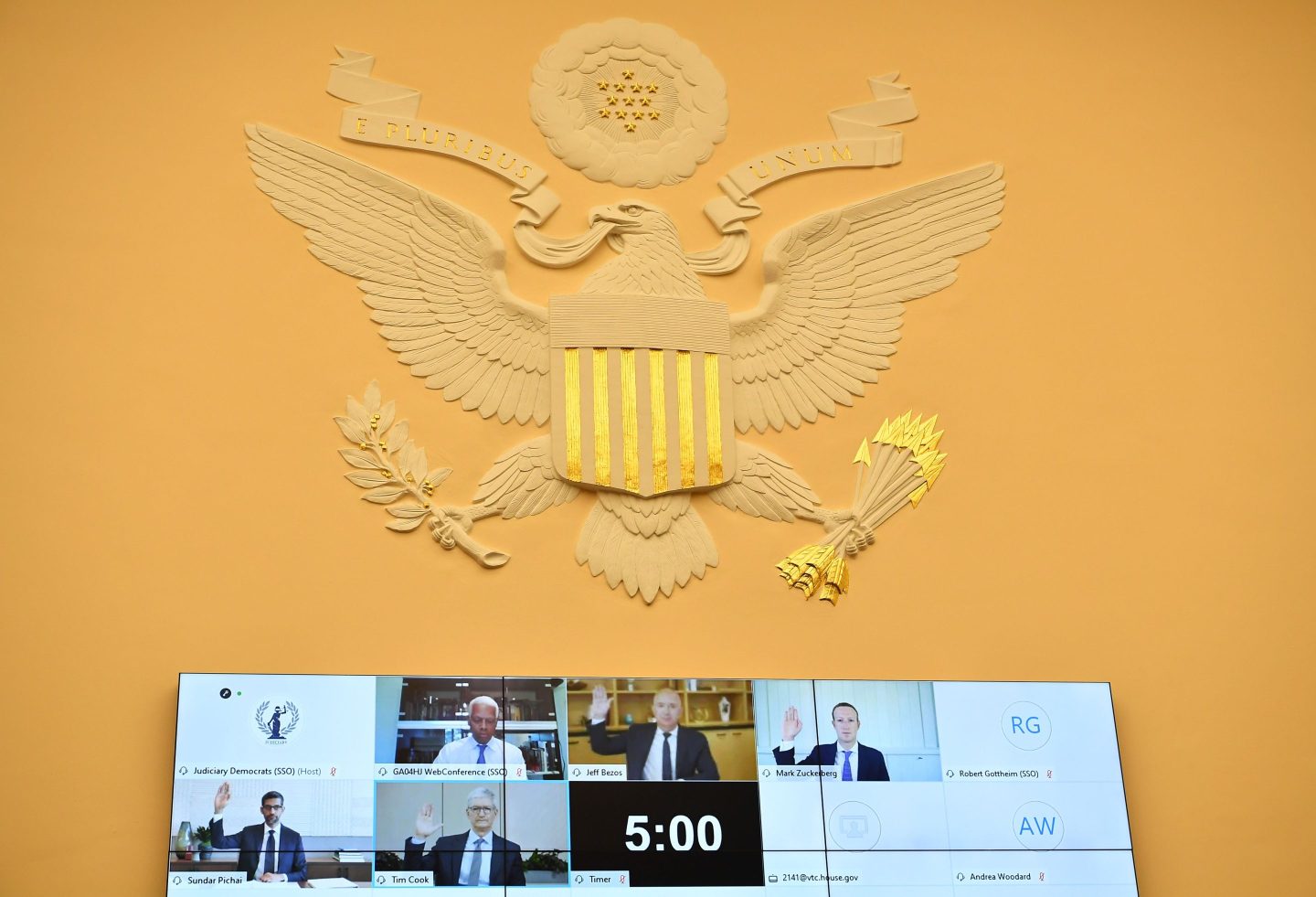
Big Tech CEOs testify before the House Judiciary Subcommittee on Antitrust, Commercial, and Administrative Law on 'Online Platforms and Market Power' on July 29, 2020.
Big Tech CEOs testify before the House Judiciary Subcommittee on Antitrust, Commercial, and Administrative Law on 'Online Platforms and Market Power' on July 29, 2020. Mandel Ngan—AFP/Getty Images

In 411 BC, during the Peloponnesian War, the democratic government of Athens was overthrown and replaced by an oligarchy. While it literally means “rule of a few,” Aristotle used the term oligarchia to signify also rule by bad people–a form of debased autocracy.

In this sense, today’s tech oligopolists fall short of being oligarchs. Like past ruling groups, such as the titans of oil and steel, the oligopolists of A.I. exercise influence through their vast and growing wealth. However, they show no collective interest or ability to rule directly, beyond a general desire to maintain their privileged position. 

They exercise power in a new way–through destabilizing and replacing existing institutions and fragmenting the body politic. This makes it harder to achieve any coherent political aim, whether it is the liberal ideals that motivated Jeff Bezos to purchase The Washington Post, the conservative worldviews of the likes of Peter Thiel or Eric Schmidt, or the libertarianism professed by Elon Musk to justify his recent attempt to take over Twitter.

The fragmentation among their political orientations is not a problem for the new breed of A.I. oligarchs. Indeed, it implicitly serves their purpose by making it harder to build momentum for political action that could rein in their power. They are willing to defer to the power of algorithms, as long as it does not undermine the stability of the tech infrastructure on which they rely.

As Columbia University Professor Jean-Marie Guéhenno recently wrote, “The owners of Google or Facebook or Amazon are not the masters of our destiny in the same sense as previous corporate titans.” He makes the case that algorithms have a life of their own and are becoming so powerful that how a given society approaches controlling them will be more important than whether it is democratic or autocratic. In other words, characterizing the present global political context as a confrontation between democracy and autocracy misses the point.

I agree that the all-encompassing power of technology is rapidly making irrelevant the distinction between forms of government: We have already reached the initial stages of what Jürgen Habermas called a “legitimation crisis,” in which citizens lose faith in their leaders and governmental systems to solve their problems.

However, I think Guéhenno overestimates the power of algorithms and underestimates the power of the tech oligarch. While the algorithms may often be undecipherable, they do not have minds of their own. They remain vehicles of influence for those whose companies shape and deploy them.

Democracies and autocracies face the challenge of controlling not just the algorithms, but also those who oversee the leading technology companies. Three broad approaches have emerged around the world. 

In China, apparent consensus together with constraints on criticism of the government mean that social media-induced fragmentation of the body politic is not such an issue as it is in Western democracies. Nonetheless, the government has clearly been spooked by the potential for tech leaders to amass fortunes that are large enough to potentially translate into influence that might compete with that of the state.

The response has been heavy-handed regulation of the Chinese tech giants, dramatically decreasing their market value. The leading example is Jack Ma, who went from being the most powerful capitalist in China to becoming effectively invisible.

China’s government justified its crackdown as protecting users’ privacy, though this claim rings hollow when there are no constraints on the government’s own use of technology to monitor and shape people’s behavior. But even China may yet be forced to backtrack on its control of the tech giants, as regulations have already weakened their productivity and, in combination with the COVID-19 pandemic, undermined the growth of the Chinese economy.

The EU’s good-faith efforts to control technology are clearly driven by ethics. There is an acceptance that these controls will involve sacrificing some productivity growth. Nevertheless, there remains considerable concern about losing any semblance of leadership in innovation or too much ground economically.

In the U.S., the fear of undermining growth has become so great that there is no prospect of meaningful regulation of technology. Even when there is a consensus that something needs to be done, it has been impossible to agree on specific new regulations.

The tech oligarchs use their money and influence to ensure that this dominant “cult of innovation” remains unchallenged.

Unlike the evil oligarchy of ancient Athens, the A.I. oligopoly set out to do good. When social media platforms were invented, nobody anticipated how they would fragment democratic discourse into such a confusing cacophony–but as this fragmentation happens to undermine any efforts to regulate tech, the new oligarchs have a shared interest in letting it continue.

When policy and technology are directed at fragmentation, there are serious downsides for humanity: It may become impossible to address challenges that require not only consensus but international cooperation, such as climate change.

In our transition to a modern form of oligarchy, I fear that we are losing the proactive ability to shape the future.

Wendell Wallach is a Carnegie-Uehiro Fellow at Carnegie Council for Ethics in International Affairs, where co-directs the Artificial Intelligence & Equality Initiative (AIEI). His latest book is “A Dangerous Master: How to Keep Technology From Slipping Beyond Our Control.”

The opinions expressed in Fortune.com commentary pieces are solely the views of their authors and do not reflect the opinions and beliefs of Fortune.

More must-read commentary published by Fortune:

  • TSMC chairman Mark Liu describes how the world’s largest chipmaker is reimagining the semiconductor industry
  • American businesses are coming home. Innovators in logistics will reap massive rewards
  • Web3 is not dead. Here’s what the crypto space will look like in 2030
  • Zelensky unplugged: Ukraine’s president gives American CEOs advice and sobering warnings about ‘our common war’
  • I was a senior executive at WeWork before it imploded. Here’s the one behavior that could have saved the company
Sign up for the Fortune Features email list so you don’t miss our biggest features, exclusive interviews, and investigations.
About the Author
By Wendell Wallach
See full bioRight Arrow Button Icon

Latest in Commentary

Finance
Lorem ipsum dolor sit amet, consectetur adipiscing elit, sed do eiusmod tempor incididunt ut labore et dolore magna aliqua. Ut enim ad minim veniam
By Fortune Editors
October 20, 2025
Finance
Lorem ipsum dolor sit amet, consectetur adipiscing elit, sed do eiusmod tempor incididunt ut labore et dolore magna aliqua. Ut enim ad minim veniam
By Fortune Editors
October 20, 2025
Finance
Lorem ipsum dolor sit amet, consectetur adipiscing elit, sed do eiusmod tempor incididunt ut labore et dolore magna aliqua. Ut enim ad minim veniam
By Fortune Editors
October 20, 2025
Finance
Lorem ipsum dolor sit amet, consectetur adipiscing elit, sed do eiusmod tempor incididunt ut labore et dolore magna aliqua. Ut enim ad minim veniam
By Fortune Editors
October 20, 2025
Finance
Lorem ipsum dolor sit amet, consectetur adipiscing elit, sed do eiusmod tempor incididunt ut labore et dolore magna aliqua. Ut enim ad minim veniam
By Fortune Editors
October 20, 2025
Finance
Lorem ipsum dolor sit amet, consectetur adipiscing elit, sed do eiusmod tempor incididunt ut labore et dolore magna aliqua. Ut enim ad minim veniam
By Fortune Editors
October 20, 2025

Most Popular

Finance
Lorem ipsum dolor sit amet, consectetur adipiscing elit, sed do eiusmod tempor incididunt ut labore et dolore magna aliqua. Ut enim ad minim veniam
By Fortune Editors
October 20, 2025
Finance
Lorem ipsum dolor sit amet, consectetur adipiscing elit, sed do eiusmod tempor incididunt ut labore et dolore magna aliqua. Ut enim ad minim veniam
By Fortune Editors
October 20, 2025
Finance
Lorem ipsum dolor sit amet, consectetur adipiscing elit, sed do eiusmod tempor incididunt ut labore et dolore magna aliqua. Ut enim ad minim veniam
By Fortune Editors
October 20, 2025
Finance
Lorem ipsum dolor sit amet, consectetur adipiscing elit, sed do eiusmod tempor incididunt ut labore et dolore magna aliqua. Ut enim ad minim veniam
By Fortune Editors
October 20, 2025
Finance
Lorem ipsum dolor sit amet, consectetur adipiscing elit, sed do eiusmod tempor incididunt ut labore et dolore magna aliqua. Ut enim ad minim veniam
By Fortune Editors
October 20, 2025
Finance
Lorem ipsum dolor sit amet, consectetur adipiscing elit, sed do eiusmod tempor incididunt ut labore et dolore magna aliqua. Ut enim ad minim veniam
By Fortune Editors
October 20, 2025
Fortune Secondary Logo
Rankings
  • 100 Best Companies
  • Fortune 500
  • Global 500
  • Fortune 500 Europe
  • Most Powerful Women
  • World's Most Admired Companies
  • See All Rankings
  • Lists Calendar
Sections
  • Finance
  • Fortune Crypto
  • Features
  • Leadership
  • Health
  • Commentary
  • Success
  • Retail
  • Mpw
  • Tech
  • Lifestyle
  • CEO Initiative
  • Asia
  • Politics
  • Conferences
  • Europe
  • Newsletters
  • Personal Finance
  • Environment
  • Magazine
  • Education
Customer Support
  • Frequently Asked Questions
  • Customer Service Portal
  • Privacy Policy
  • Terms Of Use
  • Single Issues For Purchase
  • International Print
Commercial Services
  • Advertising
  • Fortune Brand Studio
  • Fortune Analytics
  • Fortune Conferences
  • Business Development
  • Group Subscriptions
About Us
  • About Us
  • Press Center
  • Work At Fortune
  • Terms And Conditions
  • Site Map
  • About Us
  • Press Center
  • Work At Fortune
  • Terms And Conditions
  • Site Map
  • Facebook icon
  • Twitter icon
  • LinkedIn icon
  • Instagram icon
  • Pinterest icon

Latest in Commentary

charlie
CommentarySoftware
Anaplan CEO: AI isn’t eating software. It’s sorting it
By Charlie GottdienerMay 18, 2026
8 hours ago
shyam
CommentaryHealth
World Economic Forum: women’s health gets only 20% of R&D funding. We must seize this $1 trillion opportunity
By Shyam BishenMay 18, 2026
15 hours ago
murdochs
CommentaryMedia
OpenAI paid $100 million for a talk show. James Murdoch is eyeing an even bigger deal. The hot new asset class is humanity
By Lin CherryMay 17, 2026
1 day ago
dennis
CommentaryAI agents
Freshworks CEO: why agile enterprises are winning the AI race — and what they did differently
By Dennis WoodsideMay 17, 2026
1 day ago
Mary Moreland-Abbott Executive Vice President of Human Resources.
CommentaryRetirement
Gen X is the most indebted generation in America. Their employers can fix that
By Mary MorelandMay 17, 2026
1 day ago
liberman
Commentarystart-ups
We watched social media concentrate. The same thing is happening in AI, only at a deeper layer
By David Liberman and Daniil LibermanMay 16, 2026
2 days ago

Most Popular

The top foreign holders of U.S. debt may soon dump Treasury bonds and bring their money back home, potentially spiking borrowing costs
Economy
The top foreign holders of U.S. debt may soon dump Treasury bonds and bring their money back home, potentially spiking borrowing costs
By Jason MaMay 17, 2026
1 day ago
Microsoft AI chief gives it 18 months—for all white-collar work to be automated by AI
AI
Microsoft AI chief gives it 18 months—for all white-collar work to be automated by AI
By Jake AngeloMay 16, 2026
2 days ago
The Bezos family just donated $100 million to help achieve one of Mayor Zohran Mamdani’s top campaign promises
Politics
The Bezos family just donated $100 million to help achieve one of Mayor Zohran Mamdani’s top campaign promises
By Jake AngeloMay 12, 2026
6 days ago
'No one was coming to save me': How Reese Witherspoon built a $900 million company from a problem Hollywood wouldn't fix
Success
'No one was coming to save me': How Reese Witherspoon built a $900 million company from a problem Hollywood wouldn't fix
By Sydney LakeMay 17, 2026
1 day ago
SpaceX heads into a record-shattering IPO with the 'deepest moat that exists today' as investors vow to 'never bet against Elon'
Innovation
SpaceX heads into a record-shattering IPO with the 'deepest moat that exists today' as investors vow to 'never bet against Elon'
By Jason MaMay 16, 2026
2 days ago
Gen X is the most indebted generation in America. Their employers can fix that
Commentary
Gen X is the most indebted generation in America. Their employers can fix that
By Mary MorelandMay 17, 2026
1 day ago

© 2026 Fortune Media IP Limited. All Rights Reserved. Use of this site constitutes acceptance of our Terms of Use and Privacy Policy | CA Notice at Collection and Privacy Notice | Do Not Sell/Share My Personal Information
FORTUNE is a trademark of Fortune Media IP Limited, registered in the U.S. and other countries. FORTUNE may receive compensation for some links to products and services on this website. Offers may be subject to change without notice.