• Home
  • Latest
  • Fortune 500
  • Finance
  • Tech
  • Leadership
  • Lifestyle
  • Rankings
  • Multimedia

Exclusive

An hour in the Oval Office with President Trump Fortune Editor-in-Chief: Alyson Shontell sat down with President Trump in the Oval Office for an hour. Tariffs, Intel, AI, Boeing, Iran—and the question every CEO eventually has to answer: who's next?

An hour in the Oval Office with President Trump Fortune Editor-in-Chief: Alyson Shontell sat down with President Trump in the Oval Office for an hour. Tariffs, Intel, AI, Boeing, Iran—and the question every CEO eventually has to answer: who's next?

An hour in the Oval Office with President Trump Fortune Editor-in-Chief: Alyson Shontell sat down with President Trump in the Oval Office for an hour. Tariffs, Intel, AI, Boeing, Iran—and the question every CEO eventually has to answer: who's next?

An hour in the Oval Office with President Trump Fortune Editor-in-Chief: Alyson Shontell sat down with President Trump in the Oval Office for an hour. Tariffs, Intel, AI, Boeing, Iran—and the question every CEO eventually has to answer: who's next?

An hour in the Oval Office with President Trump Fortune Editor-in-Chief: Alyson Shontell sat down with President Trump in the Oval Office for an hour. Tariffs, Intel, AI, Boeing, Iran—and the question every CEO eventually has to answer: who's next?

An hour in the Oval Office with President Trump Fortune Editor-in-Chief: Alyson Shontell sat down with President Trump in the Oval Office for an hour. Tariffs, Intel, AI, Boeing, Iran—and the question every CEO eventually has to answer: who's next?

An hour in the Oval Office with President Trump Fortune Editor-in-Chief: Alyson Shontell sat down with President Trump in the Oval Office for an hour. Tariffs, Intel, AI, Boeing, Iran—and the question every CEO eventually has to answer: who's next?

An hour in the Oval Office with President Trump Fortune Editor-in-Chief: Alyson Shontell sat down with President Trump in the Oval Office for an hour. Tariffs, Intel, AI, Boeing, Iran—and the question every CEO eventually has to answer: who's next?

An hour in the Oval Office with President Trump Fortune Editor-in-Chief: Alyson Shontell sat down with President Trump in the Oval Office for an hour. Tariffs, Intel, AI, Boeing, Iran—and the question every CEO eventually has to answer: who's next?

An hour in the Oval Office with President Trump Fortune Editor-in-Chief: Alyson Shontell sat down with President Trump in the Oval Office for an hour. Tariffs, Intel, AI, Boeing, Iran—and the question every CEO eventually has to answer: who's next?

Economy
Europe

A broken global economy is jacking up prices around the world. Experts say we’ve seen this before: World War I 

Will Daniel
By
Will Daniel
Will Daniel
Down Arrow Button Icon
Will Daniel
By
Will Daniel
Will Daniel
Down Arrow Button Icon
July 16, 2022, 5:30 AM ET
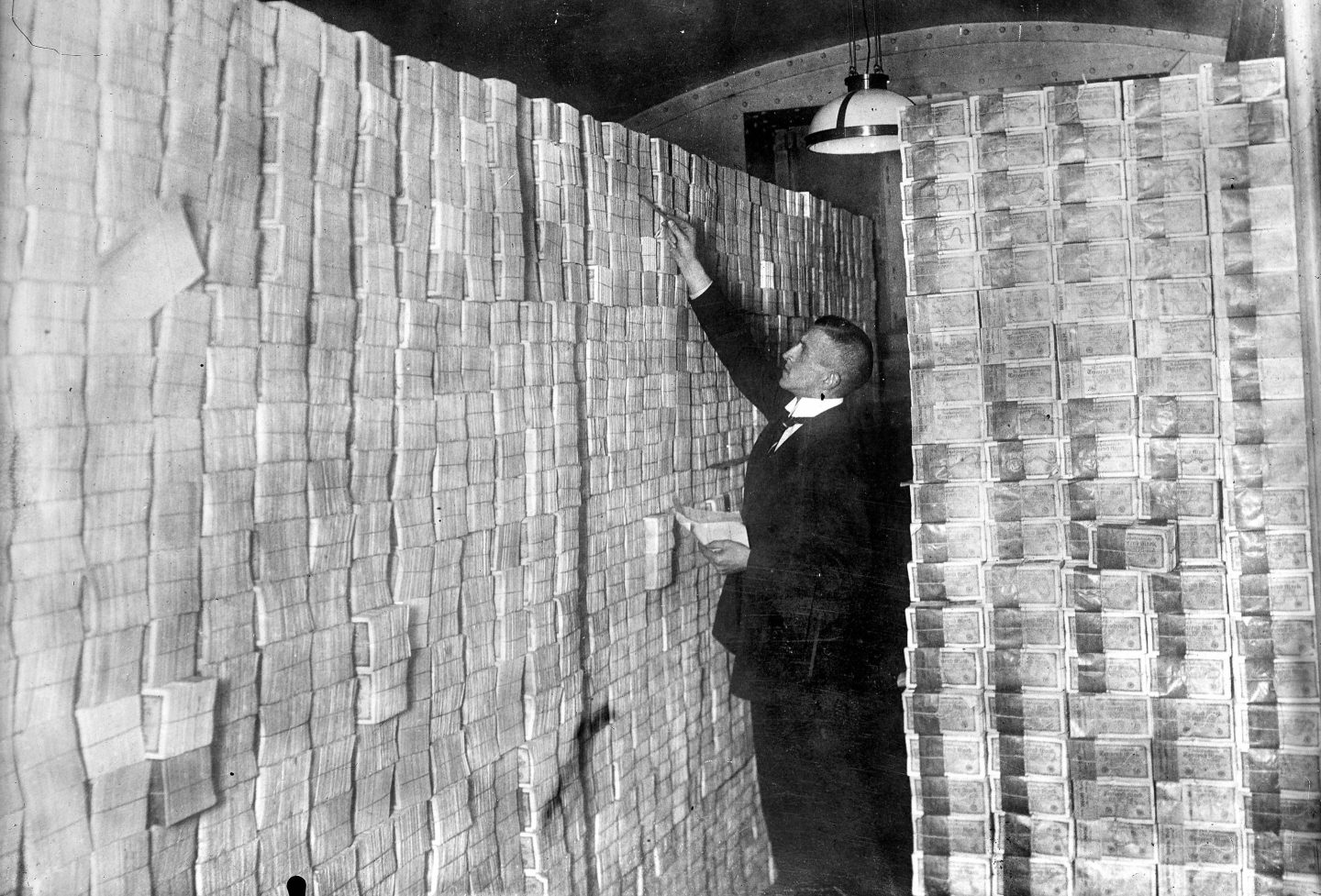
A man stands in front of stacks of banknotes in Germany in 1923.
Basement of a bank full of banknotes, at the time of the Mark devaluation, during the economic crisis, Weimar Republic, Germany, 1923.Harlingue—Roger Viollet/Getty Images

The end of an era is sometimes obvious, but not always.

Over 100 years ago, as the world took up arms in what was then called “the Great War,” it was clear that something had changed. Beyond the cataclysm of the birth of modern warfare, major economies had their first brush with hyperinflation and the economic chaos that ensued.

Now, some of the brightest minds on Wall Street say 2022 could be a similar kind of turning point.

“The world is at a great risk of dividing into economic spheres,” Marcus Brauchli, a managing partner at North Base Media, told the audience at this week’s Fortune Brainstorm Tech conference in Aspen, Colo.

The Russia-Ukraine war, U.S. tensions with China, and the ongoing chaos of Brexit are all signs that an era of deglobalization has arrived, bringing long-term inflation along with it.
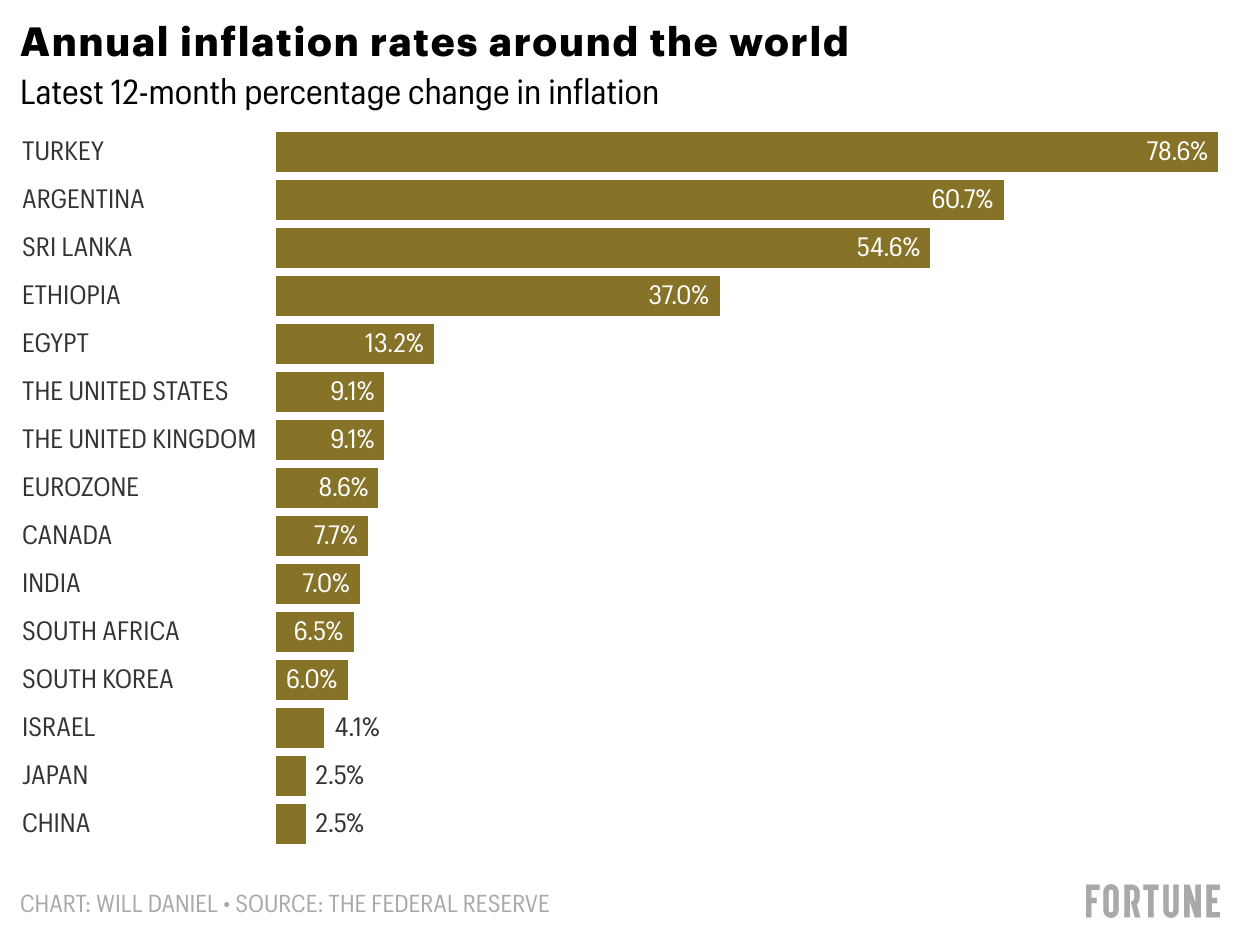
Larry Fink thinks so, and that’s significant. Fink is CEO of the world’s largest asset manager, BlackRock, and has been dubbed one of Wall Street’s “new bunch of emperors” by one of the world’s greatest investors, Charlie Munger, the vice chairman of Berkshire Hathaway. 

In his closely watched annual shareholder letter in March, Fink wrote that the Russian invasion of Ukraine has “put an end to the globalization we have experienced over the last three decades.” 

He argued that companies and governments will be looking to reduce their dependencies on international trade in the coming years, leading many to onshore their operations.

“This decoupling will inevitably create challenges for companies, including higher costs and margin pressures,” he said, adding that there will be an era of increasing inflationary pressures worldwide as global supply chains are remade.

Fink’s argument helps to explain the confusing and often conflicting economic data that keeps coming out. 

In June, inflation raged at a four-decade high while the labor market remained tight, as another strong jobs report blew past economists’ expectations. At the same time, corporate profits are falling, and there is evidence global economic growth is slowing.

These economic signposts make sense together if you consider that companies are hiring massively to onshore or reorient for a more deglobalized world, while also incurring higher costs—which they’re passing on to consumers.

Fink is not alone in his view, either. Fortune canvassed Wall Street banks, economic historians, and money managers to see just how much deglobalization the world economy is in for, and what that could mean for inflation. Will we relive the economic cycle of World War I, even if the current conflict stays within Ukraine?

How globalization enabled low inflation for decades

Throughout modern history, globalization has been a deflationary force. Increased trade and migration between nations have acted to reduce labor and materials costs for decades now, leading many critical consumer prices to fall.

Brendan McKenna, an international economist at Wells Fargo, told Fortune that globalization has also increased competition among businesses consistently over the past century, which has helped to reduce inflation.

“One of the benefits of globalization is that it creates competition amongst businesses,” he said. “As corporates compete with each other, they typically set the lowest possible price points which is a deflationary effect. De-globalization can have the opposite effect.”

The “first true wave of globalization” took place from the latter part of the 19th century through the start of World War I in 1914, Carola Frydman, an economist, and professor of finance at Northwestern’s Kellogg School of Management, told Fortune.

This period, also known as the “Belle Epoque,” or “Beautiful Age,” was characterized by increasingly free trade, reduced restrictions on migration, and the free flow of capital, which helped to enable a rapid decrease in global transportation and communication costs.

“During that period of high globalization, what we saw primarily was a narrowing of price and wage differences across areas, but also a period of relatively low inflation,” Frydman said. 

When World War I hit in 1914, that all ended, and inflationary pressures rose, with some countries even suffering from hyperinflation, Frydman noted. It wasn’t until the 1970s, when an oil shock caused inflation to rise to unsustainable levels, that another era of globalization took hold.

Former Fed Chair Alan Greenspan admitted in a 2005 speech that this most recent era of globalization that defined the years following the 1970s, helped to reduce inflation worldwide, maybe even more so than central bank policy.

Lori Van Dusen, the founder and CEO of the wealth management firm LVW Advisors, told Fortune that the global economy is going to lose some of the “disinflationary benefit” that was gained over the past few decades from this period of globalization and the formation of global supply chains. 

She sees a future where there are “parallel economies” that each have their own technology platforms and supply chains, due to the current state of increased nationalism and onshoring worldwide. 

Wells Fargo’s McKenna agrees, noting that we will likely see an era of increased tariffs and protectionism which can lead to a “lack of competition and ultimately higher prices.” 

“These forces tend to be inflationary, and if the trend we are seeing now persists, inflation can remain at somewhat elevated levels over the longer term,” he said.

Angela Weiss—AFP/Getty Images

Three scenarios for deglobalization and inflation

But how much will inflation rise due to deglobalization?

In an April 27 research note, Goldman Sachs’ Chief Economist Jan Hatzius broke down three potential deglobalization scenarios, and how they might impact inflation.

In the first scenario, which he called “blanket deglobalization,” Hatzius said that a 25% decline in trade with lower-wage countries around the world, including China, could result in a 2% jump in the core personal consumption expenditures (PCE) index.

PCE is a key inflation gauge used by the Federal Reserve. In May, it rose at a 6.6% annual rate, with core PCE, which excludes volatile food and energy costs, rising 4.7%, Bureau of Labor Statistics data shows.

LVW Advisors’ Van Dusen said that Goldman’s first scenario seems unlikely and extreme. 

“We’re probably going to settle out at higher costs, and that will hit profit margins, but it’s not as draconian as what their first scenario is painting,” she said.

Hatzius’ second scenario assumes a 50% decline in trade with China, while trade with other lower-wage countries continues at its current pace. If this happens, Goldman believes core PCE in the U.S. could be lifted by 1.9%.

Finally, Hatzius said a third scenario could take place, where a 50% decline in trade with China is made up for by higher imports from other lower-wage countries. This case could add 0.6% to core PCE.

Van Dusen said that she sees this scenario as the most likely, with core PCE jumping by between 0.5% and 1%, due to the effects of de-globalization. She added that investors should look at what individual companies are doing with their supply chains to get a better idea of the future path of inflation.

The more firms that are forced to remake their supply chains around regional economies, the more inflationary pressures the global economy and the U.S. are likely to experience. To Van Dusen’s point, some companies have already decided to move some of their operations in order to cope with the ongoing deglobalization trend. 

In June, Lego said it would invest $1 billion and create 1,760 jobs over 10 years with its new factory in Virginia in order to shorten its supply chains for the key U.S. market.

The Goldman team argued in their research report that reductions in trade with global partners and the fracturing of global supply chains, as evidenced by Lego’s move, will likely continue to cause a period of “slowbalization,” in which the flow of goods, capital, and people across borders slows.

Hatzius and his team wrote that investors should “expect somewhat higher inflation and thus higher nominal interest rates” as a result.

However, they added that reductions in trade with specific partners, including China, are “unlikely to be a huge inflation issue” as long as new trade partners can be added and there is a “gradual transition period” to build new supply chains. Without that transition period, however, the situation could be much worse. 

As Stephen Mihm, a professor of history at the University of Georgia, wrote in a Bloomberg op-ed last week:

“Perhaps the recent inflation scare will prove transitory after all. But if the assault on globalization continues, history suggests that the days of stable low prices are likely to become a thing of the past.”

Sign up for the Fortune Features email list so you don’t miss our biggest features, exclusive interviews, and investigations.


About the Author
Will Daniel
By Will Daniel
LinkedIn iconTwitter icon
See full bioRight Arrow Button Icon

Latest in

Finance
Lorem ipsum dolor sit amet, consectetur adipiscing elit, sed do eiusmod tempor incididunt ut labore et dolore magna aliqua. Ut enim ad minim veniam
By Fortune Editors
October 20, 2025
Finance
Lorem ipsum dolor sit amet, consectetur adipiscing elit, sed do eiusmod tempor incididunt ut labore et dolore magna aliqua. Ut enim ad minim veniam
By Fortune Editors
October 20, 2025
Finance
Lorem ipsum dolor sit amet, consectetur adipiscing elit, sed do eiusmod tempor incididunt ut labore et dolore magna aliqua. Ut enim ad minim veniam
By Fortune Editors
October 20, 2025
Finance
Lorem ipsum dolor sit amet, consectetur adipiscing elit, sed do eiusmod tempor incididunt ut labore et dolore magna aliqua. Ut enim ad minim veniam
By Fortune Editors
October 20, 2025
Finance
Lorem ipsum dolor sit amet, consectetur adipiscing elit, sed do eiusmod tempor incididunt ut labore et dolore magna aliqua. Ut enim ad minim veniam
By Fortune Editors
October 20, 2025
Finance
Lorem ipsum dolor sit amet, consectetur adipiscing elit, sed do eiusmod tempor incididunt ut labore et dolore magna aliqua. Ut enim ad minim veniam
By Fortune Editors
October 20, 2025

Most Popular

Finance
Lorem ipsum dolor sit amet, consectetur adipiscing elit, sed do eiusmod tempor incididunt ut labore et dolore magna aliqua. Ut enim ad minim veniam
By Fortune Editors
October 20, 2025
Finance
Lorem ipsum dolor sit amet, consectetur adipiscing elit, sed do eiusmod tempor incididunt ut labore et dolore magna aliqua. Ut enim ad minim veniam
By Fortune Editors
October 20, 2025
Finance
Lorem ipsum dolor sit amet, consectetur adipiscing elit, sed do eiusmod tempor incididunt ut labore et dolore magna aliqua. Ut enim ad minim veniam
By Fortune Editors
October 20, 2025
Finance
Lorem ipsum dolor sit amet, consectetur adipiscing elit, sed do eiusmod tempor incididunt ut labore et dolore magna aliqua. Ut enim ad minim veniam
By Fortune Editors
October 20, 2025
Finance
Lorem ipsum dolor sit amet, consectetur adipiscing elit, sed do eiusmod tempor incididunt ut labore et dolore magna aliqua. Ut enim ad minim veniam
By Fortune Editors
October 20, 2025
Finance
Lorem ipsum dolor sit amet, consectetur adipiscing elit, sed do eiusmod tempor incididunt ut labore et dolore magna aliqua. Ut enim ad minim veniam
By Fortune Editors
October 20, 2025
Fortune Secondary Logo
Rankings
  • 100 Best Companies
  • Fortune 500
  • Global 500
  • Fortune 500 Europe
  • Most Powerful Women
  • World's Most Admired Companies
  • See All Rankings
  • Lists Calendar
Sections
  • Finance
  • Fortune Crypto
  • Features
  • Leadership
  • Health
  • Commentary
  • Success
  • Retail
  • Mpw
  • Tech
  • Lifestyle
  • CEO Initiative
  • Asia
  • Politics
  • Conferences
  • Europe
  • Newsletters
  • Personal Finance
  • Environment
  • Magazine
  • Education
Customer Support
  • Frequently Asked Questions
  • Customer Service Portal
  • Privacy Policy
  • Terms Of Use
  • Single Issues For Purchase
  • International Print
Commercial Services
  • Advertising
  • Fortune Brand Studio
  • Fortune Analytics
  • Fortune Conferences
  • Business Development
  • Group Subscriptions
About Us
  • About Us
  • Press Center
  • Work At Fortune
  • Terms And Conditions
  • Site Map
  • About Us
  • Press Center
  • Work At Fortune
  • Terms And Conditions
  • Site Map
  • Facebook icon
  • Twitter icon
  • LinkedIn icon
  • Instagram icon
  • Pinterest icon

Latest in

monet
CybersecuritySocial Media
6.7 million people thought they were ripping apart an AI-generated Monet painting. But it was real
By Nick LichtenbergMay 18, 2026
17 minutes ago
President Donald Trump speaks to the media aboard Air Force One on May 15, 2026.
EconomyDonald Trump
While Trump insisted the Iran war would end ‘soon,’ an account in his name was buying millions in oil, defense and gold
By Eva RoytburgMay 18, 2026
41 minutes ago
PARIS, FRANCE - JUNE 16: Chief Executive Officer of SpaceX and Tesla and owner of Twitter, Elon Musk attends the Viva Technology conference dedicated to innovation and startups at the Porte de Versailles exhibition centre on June 16, 2023 in Paris, France. Elon Musk is visiting Paris for the VivaTech show where he gives a conference in front of 4,000 technology enthusiasts. He also took the opportunity to meet Bernard Arnaud, CEO of LVMH and the French President. Emmanuel Macron, who has already met Elon Musk twice in recent months, hopes to convince him to set up a Tesla battery factory in France, his pioneer company in electric cars. (Photo by Chesnot/Getty Images)
AIOpenAI
Jury rules against Elon Musk in $150 billion lawsuit against OpenAI and Sam Altman
By Sharon GoldmanMay 18, 2026
49 minutes ago
Ryanair’s CFO says the airline has plans for an ‘armageddon situation’ as the jet fuel crisis threatens weaker European airlines this winter
EnergyAirline industry
Ryanair’s CFO says the airline has plans for an ‘armageddon situation’ as the jet fuel crisis threatens weaker European airlines this winter
By Marco Quiroz-GutierrezMay 18, 2026
50 minutes ago
broker
Investingbubble
AI is eating the market and Wall Street strategists have bubble brain as they debate: are we in 1997 or 1999?
By Nick LichtenbergMay 18, 2026
2 hours ago
Donald Trump smiles
LawDonald Trump
Trump creates $1.7 billion ‘Anti-Weaponization Fund’ to compensate allies as part of his IRS lawsuit settlement
By Fatima Hussein, Eric Tucker, Alanna Durkin Richer and The Associated PressMay 18, 2026
2 hours ago

Most Popular

The top foreign holders of U.S. debt may soon dump Treasury bonds and bring their money back home, potentially spiking borrowing costs
Economy
The top foreign holders of U.S. debt may soon dump Treasury bonds and bring their money back home, potentially spiking borrowing costs
By Jason MaMay 17, 2026
1 day ago
Microsoft AI chief gives it 18 months—for all white-collar work to be automated by AI
AI
Microsoft AI chief gives it 18 months—for all white-collar work to be automated by AI
By Jake AngeloMay 16, 2026
2 days ago
The Bezos family just donated $100 million to help achieve one of Mayor Zohran Mamdani’s top campaign promises
Politics
The Bezos family just donated $100 million to help achieve one of Mayor Zohran Mamdani’s top campaign promises
By Jake AngeloMay 12, 2026
6 days ago
'No one was coming to save me': How Reese Witherspoon built a $900 million company from a problem Hollywood wouldn't fix
Success
'No one was coming to save me': How Reese Witherspoon built a $900 million company from a problem Hollywood wouldn't fix
By Sydney LakeMay 17, 2026
1 day ago
SpaceX heads into a record-shattering IPO with the 'deepest moat that exists today' as investors vow to 'never bet against Elon'
Innovation
SpaceX heads into a record-shattering IPO with the 'deepest moat that exists today' as investors vow to 'never bet against Elon'
By Jason MaMay 16, 2026
2 days ago
Gen X is the most indebted generation in America. Their employers can fix that
Commentary
Gen X is the most indebted generation in America. Their employers can fix that
By Mary MorelandMay 17, 2026
1 day ago

© 2026 Fortune Media IP Limited. All Rights Reserved. Use of this site constitutes acceptance of our Terms of Use and Privacy Policy | CA Notice at Collection and Privacy Notice | Do Not Sell/Share My Personal Information
FORTUNE is a trademark of Fortune Media IP Limited, registered in the U.S. and other countries. FORTUNE may receive compensation for some links to products and services on this website. Offers may be subject to change without notice.