• Home
  • Latest
  • Fortune 500
  • Finance
  • Tech
  • Leadership
  • Lifestyle
  • Rankings
  • Multimedia

Trendingnow

1

Microsoft AI chief gives it 18 months—for all white-collar work to be automated by AI

2

The Bezos family just donated $100 million to help achieve one of Mayor Zohran Mamdani’s top campaign promises

3

The top foreign holders of U.S. debt may soon dump Treasury bonds and bring their money back home, potentially spiking borrowing costs

1

Microsoft AI chief gives it 18 months—for all white-collar work to be automated by AI

2

The Bezos family just donated $100 million to help achieve one of Mayor Zohran Mamdani’s top campaign promises

3

The top foreign holders of U.S. debt may soon dump Treasury bonds and bring their money back home, potentially spiking borrowing costs
climate change
Europe

Extreme heat in the US, Europe and China is slamming economies around the world—and making inflation worse

By
Colin Lodewick
Colin Lodewick
Down Arrow Button Icon
By
Colin Lodewick
Colin Lodewick
Down Arrow Button Icon
August 27, 2022, 6:00 AM ET
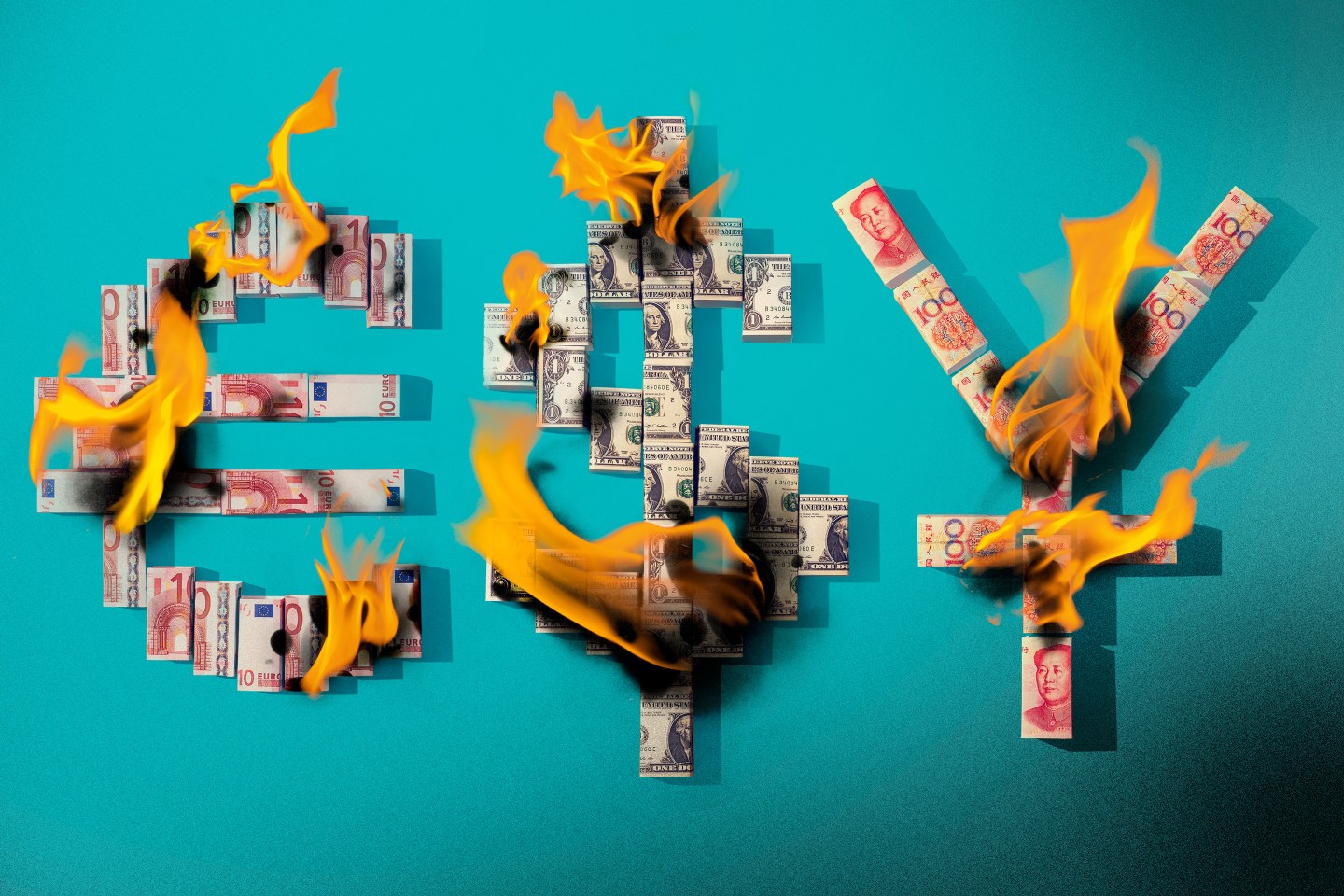
Bills on fire
Photoillustration by Josue Evilla – Fortune; original photos by Getty Images

This summer across the U.S., Europe, and China, a historic heat wave and drought has turned mighty rivers into mudflats. Farmers have helplessly watched their valuable crops wilt in the fields. And hundreds of millions of people across the globe have had to huddle indoors, away from work, to avoid heat stroke and to keep the electrical grid from crashing. 

The extreme weather has come at a huge cost to consumers worldwide. Already feeling the pain of 18 months of inflation due to supply chain snags and Russia’s invasion of Ukraine, they’re now having to pay even more to keep themselves fed and to buy many other things they want. 

Water shortages in California have caused tomato prices to jump, pushing the cost of tomato paste up as much as 80% since last year. Meanwhile, record heat in England and France have hurt those countries’ meat and dairy industries. The price of meat in the EU is now up 12% year-over year.

Merely transporting products costs more now in Europe because of low water levels on key rivers. To avoid running aground, cargo ships must reduce their loads, slowing deliveries and raising prices.

“I think it’s too early to quantify, but I have no doubt that these extreme events are contributing to high prices,” Sergey Paltsev, deputy director of MIT’s joint program on the science and policy of global change, told Fortune. “In the future, if we don’t change the course of action, it’s going to be worse.” 

Ruined crops

Currently, three quarters of farmers across the American West, Southwest, and Central Plains say that extreme heat is negatively impacting their harvests, according to a recent survey by the American Farm Bureau Federation. 

Across the wide swath of the U.S. that accounts for 80% of American wheat production and three quarters of beef production, 60% is currently suffering from severe drought conditions, according to the AFBF. It’s an area that overlaps a growing “extreme heat belt” in the Midwest and South that’s expected to be home to nearly a third of the country’s population in the coming decades.

“The Midwest produces up to a quarter of some of the staples of the global food supply,” says Amir Jina, an assistant professor at the University of Chicago’s school of social policy. “What happens when you suddenly have this big shock to a quarter of the food being produced? You’re definitely going to see price increases.”

Those price increases, says Jina, will ultimately fall the hardest on the poorest people. That’s because lower income households spend a larger proportion of their income on food and will therefore feel the pressure of rising food prices more quickly.

One long-term solution, according to Jina, is to shift certain crops that are at risk from harsher weather to where they’ll be able to thrive in the future. But it’ll take years before relocating something as massive as farming has an impact. 

Russia’s invasion of Ukraine offers a view into what happens when crops from a highly productive farming region suddenly become unavailable for export. For months, until recently, Ukraine couldn’t export its grain because of a Russian blockade at sea, causing the price of crops like wheat to soar globally. 

“A large wildfire or a drought in one of the big breadbasket areas can have this knock down effect on food prices around the world,” Jina says. “We can’t instantly move that grain production from where it currently is to somewhere more predictable.”

Factory shutdowns

Earlier this month, China’s Sichuan province ordered all factories in most of its cities to shut down due to the country’s worst heat wave in six decades—a measure that extended through August 25. The extreme weather put enormous pressure on the country’s power grid, and the shutdown was expected to alleviate some of the stress.

Sichuan is home to some of the world’s major semiconductor and electronic parts factories and is a significant supplier of lithium, a key metal used in electric car batteries. A brief shutdown in manufacturing, therefore, can have a significant downstream impact on a variety of consumer goods.

Already, a global semiconductor shortage since last year has caused higher prices for things like new and used cars and electronics. It has laid bare the fragility of essential supply chains.

“Global economies are so interconnected that if one of these extreme weather shocks happens in a certain country, it doesn’t only affect the people there,” says Jina. “It can spread out through this very intricately connected network.” 

While China’s factory shutdowns will have immediate consequences, Jina says there are more “insidious” ways that extreme heat can affect the global economy. Because people work a bit less in high temperatures and suffer more from heat exhaustion, it reduces labor productivity.

Last year, a group of climate researchers estimated that extreme heat waves in the last decade lowered Europe’s annual GDP by 0.3% to 0.5% during the years that they occured due to lower worker productivity. 

Around the same time, the D.C.-based think tank Adrienne Arsht-Rockefeller Foundation Resilience Center released a report estimating that extreme heat-related productivity losses cost the U.S. economy about $100 billion annually.

Reduced efficiency may prompt companies to spend more on a larger labor force, higher wages to offset hardship conditions, or better facilities. “The money has to come from somewhere and a lot of that’s going to get passed through to the consumer,” says Jina.

Blocked delivery routes as European rivers dry up

In Europe, the current heat wave has dried up the heavily-trafficked Rhine river, the continent’s most significant trade artery. Its water is currently so low that cargo ships can carry as much as before, making shipping more difficult and expensive, according to Deutsche Bank analysts.

The low water has also exacerbated an existing energy crisis in Europe that was triggered by the Ukraine war. For example, coal-carrying transport ships can’t necessarily get their product where it needs to be. Deutsche Bank wrote in a report earlier this month that “the problem with low water is particularly pressing, as coal-fired power plants are being fired up to ensure electricity supply in the face of significantly reduced gas supplies.” 

If the low water levels persist through the end of the year, it will have a real impact on Germany’s economy, according to a report earlier this month by Capital Economics. The country’s GDP could sink 0.2% because of it—a significant number for Europe’s biggest economy.

Meanwhile, shrinking rivers also have consequences for the continent’s nuclear power production. In France, the Loire river is now so low that the government has released water from dams to ensure a high enough water flow to cool four nuclear plants located downstream, Reuters reported. The plants contribute a combined one fifth of total electricity produced in the country. 

A warmer future

Compared to the mid 19th-century, the world has  one degree Celsius warmer than pre-industrial times, according to the Intergovernmental Panel for Climate Change (IPCC). Experts expect more warming and therefore an even greater impact of weather on farming and other industries. 

“If we’re already experiencing these events at one degree, you can imagine how unbearable it’s going to be when it’s double or triple that,” Paltsev says. “We are going to have bigger events, bigger impacts on inflation,” he says.

Sign up for the Fortune Features email list so you don’t miss our biggest features, exclusive interviews, and investigations.

About the Author
By Colin Lodewick
See full bioRight Arrow Button Icon

Latest in

Finance
Lorem ipsum dolor sit amet, consectetur adipiscing elit, sed do eiusmod tempor incididunt ut labore et dolore magna aliqua. Ut enim ad minim veniam
By Fortune Editors
October 20, 2025
Finance
Lorem ipsum dolor sit amet, consectetur adipiscing elit, sed do eiusmod tempor incididunt ut labore et dolore magna aliqua. Ut enim ad minim veniam
By Fortune Editors
October 20, 2025
Finance
Lorem ipsum dolor sit amet, consectetur adipiscing elit, sed do eiusmod tempor incididunt ut labore et dolore magna aliqua. Ut enim ad minim veniam
By Fortune Editors
October 20, 2025
Finance
Lorem ipsum dolor sit amet, consectetur adipiscing elit, sed do eiusmod tempor incididunt ut labore et dolore magna aliqua. Ut enim ad minim veniam
By Fortune Editors
October 20, 2025
Finance
Lorem ipsum dolor sit amet, consectetur adipiscing elit, sed do eiusmod tempor incididunt ut labore et dolore magna aliqua. Ut enim ad minim veniam
By Fortune Editors
October 20, 2025
Finance
Lorem ipsum dolor sit amet, consectetur adipiscing elit, sed do eiusmod tempor incididunt ut labore et dolore magna aliqua. Ut enim ad minim veniam
By Fortune Editors
October 20, 2025

Most Popular

Finance
Lorem ipsum dolor sit amet, consectetur adipiscing elit, sed do eiusmod tempor incididunt ut labore et dolore magna aliqua. Ut enim ad minim veniam
By Fortune Editors
October 20, 2025
Finance
Lorem ipsum dolor sit amet, consectetur adipiscing elit, sed do eiusmod tempor incididunt ut labore et dolore magna aliqua. Ut enim ad minim veniam
By Fortune Editors
October 20, 2025
Finance
Lorem ipsum dolor sit amet, consectetur adipiscing elit, sed do eiusmod tempor incididunt ut labore et dolore magna aliqua. Ut enim ad minim veniam
By Fortune Editors
October 20, 2025
Finance
Lorem ipsum dolor sit amet, consectetur adipiscing elit, sed do eiusmod tempor incididunt ut labore et dolore magna aliqua. Ut enim ad minim veniam
By Fortune Editors
October 20, 2025
Finance
Lorem ipsum dolor sit amet, consectetur adipiscing elit, sed do eiusmod tempor incididunt ut labore et dolore magna aliqua. Ut enim ad minim veniam
By Fortune Editors
October 20, 2025
Finance
Lorem ipsum dolor sit amet, consectetur adipiscing elit, sed do eiusmod tempor incididunt ut labore et dolore magna aliqua. Ut enim ad minim veniam
By Fortune Editors
October 20, 2025
Fortune Secondary Logo
Rankings
  • 100 Best Companies
  • Fortune 500
  • Global 500
  • Fortune 500 Europe
  • Most Powerful Women
  • World's Most Admired Companies
  • See All Rankings
  • Lists Calendar
Sections
  • Finance
  • Fortune Crypto
  • Features
  • Leadership
  • Health
  • Commentary
  • Success
  • Retail
  • Mpw
  • Tech
  • Lifestyle
  • CEO Initiative
  • Asia
  • Politics
  • Conferences
  • Europe
  • Newsletters
  • Personal Finance
  • Environment
  • Magazine
  • Education
Customer Support
  • Frequently Asked Questions
  • Customer Service Portal
  • Privacy Policy
  • Terms Of Use
  • Single Issues For Purchase
  • International Print
Commercial Services
  • Advertising
  • Fortune Brand Studio
  • Fortune Analytics
  • Fortune Conferences
  • Business Development
  • Group Subscriptions
About Us
  • About Us
  • Press Center
  • Work At Fortune
  • Terms And Conditions
  • Site Map
  • About Us
  • Press Center
  • Work At Fortune
  • Terms And Conditions
  • Site Map
  • Facebook icon
  • Twitter icon
  • LinkedIn icon
  • Instagram icon
  • Pinterest icon

Latest in

Markets are jittery as the global oil crisis bleeds into a global debt selloff, while Trump weighs new military options on Iran
EnergyOil
Markets are jittery as the global oil crisis bleeds into a global debt selloff, while Trump weighs new military options on Iran
By Jason MaMay 17, 2026
4 hours ago
CDC to escalate Ebola response after WHO declares emergency
HealthHealth
CDC to escalate Ebola response after WHO declares emergency
By Jessica Nix and BloombergMay 17, 2026
5 hours ago
Four crew members ejected safely after two Navy jets collide and crash during air show in Idaho
North AmericaMilitary
Four crew members ejected safely after two Navy jets collide and crash during air show in Idaho
By The Associated PressMay 17, 2026
6 hours ago
Gundlach says it’s ‘just not possible’ for the Fed to cut rates
EconomyFederal Reserve
Gundlach says it’s ‘just not possible’ for the Fed to cut rates
By Jordan Fitzgerald, Sam Kim and BloombergMay 17, 2026
7 hours ago
Supply shocks weren’t random. They were strategic—and should be seen as ‘supply coercion’ instead, former Fed official says 
Economysupply chains
Supply shocks weren’t random. They were strategic—and should be seen as ‘supply coercion’ instead, former Fed official says 
By Jason MaMay 17, 2026
7 hours ago
U.S. says China to buy $17 billion of agricultural goods annually
EconomyChina
U.S. says China to buy $17 billion of agricultural goods annually
By Yash Roy and BloombergMay 17, 2026
9 hours ago

Most Popular

Microsoft AI chief gives it 18 months—for all white-collar work to be automated by AI
AI
Microsoft AI chief gives it 18 months—for all white-collar work to be automated by AI
By Jake AngeloMay 16, 2026
2 days ago
The Bezos family just donated $100 million to help achieve one of Mayor Zohran Mamdani’s top campaign promises
Politics
The Bezos family just donated $100 million to help achieve one of Mayor Zohran Mamdani’s top campaign promises
By Jake AngeloMay 12, 2026
5 days ago
The top foreign holders of U.S. debt may soon dump Treasury bonds and bring their money back home, potentially spiking borrowing costs
Economy
The top foreign holders of U.S. debt may soon dump Treasury bonds and bring their money back home, potentially spiking borrowing costs
By Jason MaMay 17, 2026
10 hours ago
Former top Russian official admits the country is over Putin and can 'imagine a future without him' — even elites bail as Kremlin seizes their assets 
Politics
Former top Russian official admits the country is over Putin and can 'imagine a future without him' — even elites bail as Kremlin seizes their assets 
By Jason MaMay 16, 2026
1 day ago
'No one was coming to save me': How Reese Witherspoon built a $900 million company from a problem Hollywood wouldn't fix
Success
'No one was coming to save me': How Reese Witherspoon built a $900 million company from a problem Hollywood wouldn't fix
By Sydney LakeMay 17, 2026
17 hours ago
SpaceX heads into a record-shattering IPO with the 'deepest moat that exists today' as investors vow to 'never bet against Elon'
Innovation
SpaceX heads into a record-shattering IPO with the 'deepest moat that exists today' as investors vow to 'never bet against Elon'
By Jason MaMay 16, 2026
1 day ago

© 2026 Fortune Media IP Limited. All Rights Reserved. Use of this site constitutes acceptance of our Terms of Use and Privacy Policy | CA Notice at Collection and Privacy Notice | Do Not Sell/Share My Personal Information
FORTUNE is a trademark of Fortune Media IP Limited, registered in the U.S. and other countries. FORTUNE may receive compensation for some links to products and services on this website. Offers may be subject to change without notice.