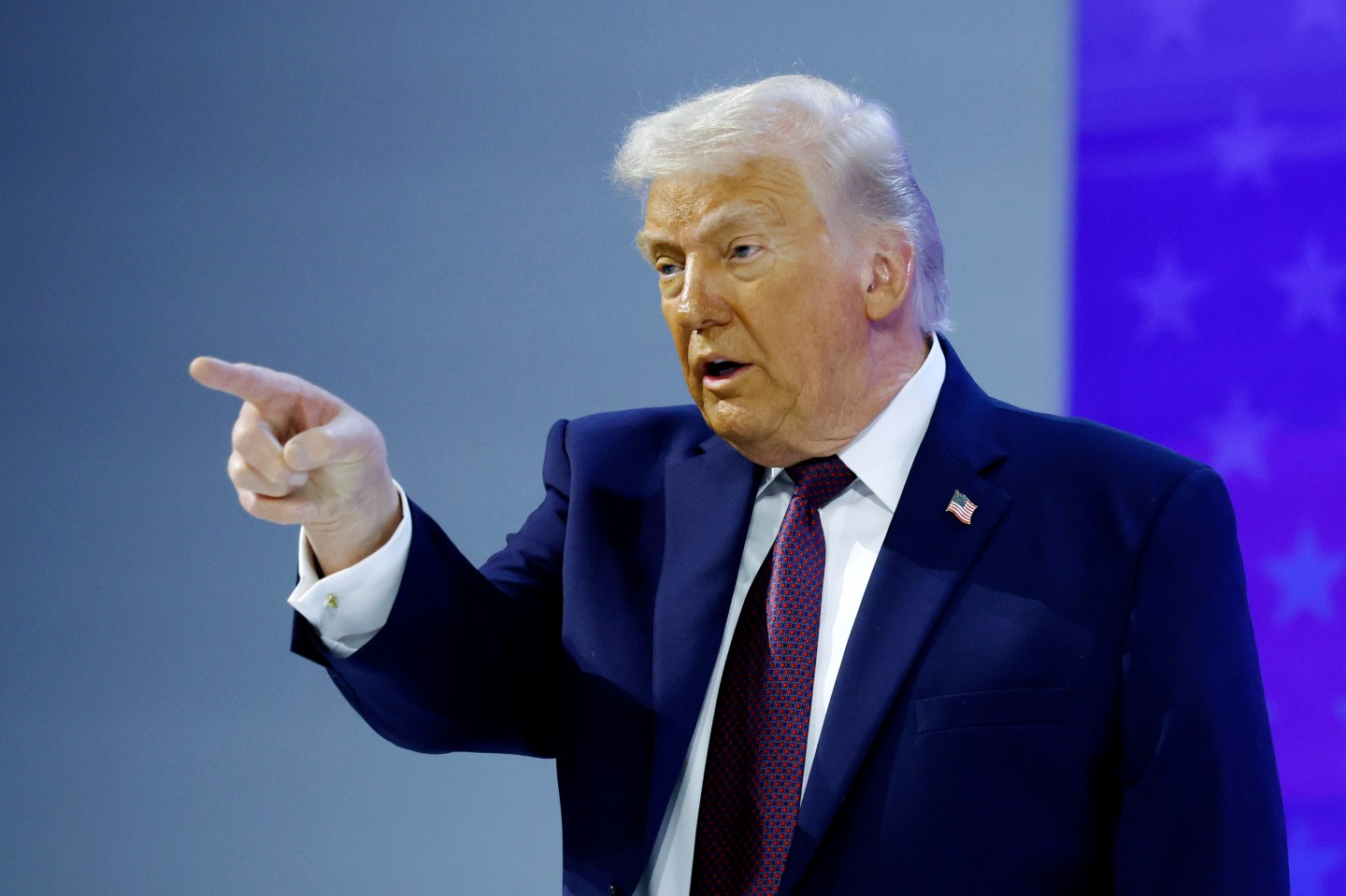
In an onstage interview at the World Economic Forum on Jan. 21, President Trump was asked how he intends to tackle the gigantic increase in federal deficits and debt, which according to the Congressional Budget Office (CBO) and almost all private forecasts, will only keep worsening under current policies. “The big thing is growth,” responded the POTUS. “Growth is the way we go from high debt to low debt. We’re going to be growing our way out, and I think we’re going to be paying down debt.” Trump has frequently stated that his manifesto, which champions sweeping deregulation and domestic manufacturing, alongside the rapid rise of AI—Trump trumpets that he personally orchestrated the technology’s single biggest initiative, the $500 billion, multi-partner Stargate data center project—will unleash a revolution igniting a historic surge in productivity. His thesis: As America generates more and more goods and services per worker and dollar newly invested in plants, fabs, and data centers, GDP will shift to a far higher gear, bringing an enduring surge of tax receipts—even at the One Big Beautiful Bill’s reduced rates.
The question naturally arises: What pace of expansion, versus what the CBO now predicts, would be required to erase the bulging, structural gulf between revenues and expenses, so that our debt and interest expense stops its explosive rise? And is that remotely realistic?
The best view for what lies ahead: a highly realistic scenario developed by the Committee for a Responsible Federal Budget
To calculate how a supercharged, Reagan-era-style economy would reshape the outlook, the first step is choosing the best “baseline” forecasting revenues, expenses, and deficits over the next decade. For this writer, that’s the August 2025 “alternative scenario” developed by the nonpartisan Committee for a Responsible Federal Budget. The CRFB essentially took the CBO’s forecast for 2026 through 2035 from January 2025, and made two major categories of adjustments. First, it updated the CBO figures to reflect the big policy changes enacted under President Trump, most notably the tax and spending programs in the OBBB, and the new tariff regime. Second, the CRFB made several important calls on the probable future impact of the Trump changes, and also forecast higher future interest rates than the CBO.
The One Big Beautiful Bill (OBBB) extends the big tax reductions for individuals from Trump’s first term slated to expire, adds half-a-dozen major tax breaks for individuals, including large deductions for tips, overtime, and auto loans, and for companies, 100% immediate expensing for acquiring or developing plants, equipment, and software. The legislation also substantially increases spending for immigration control and defense. But several of the provisions that lift outlays, such as for border security, and lower taxes, including the reductions for businesses and individuals, are scheduled to expire, so that officially they won’t swell the deficit nearly as much as if made permanent. The CRFB predicts that as with so many such provisions in the past, Congress will renew the OBBB tax and spending measures.
Here’s a crucial thing to understand. Prior to passage of the OBBB, Trump’s “growth” math stood a chance of closing the gap sooner. Instead, the OBBB makes getting to long-term balance significantly harder. According to the alternative scenario, the bill—if as it predicts the policies don’t sunset—will lift total deficits by $5.5 trillion over the next decade, or around 10%.
The CRFB further posits that the Supreme Court upholds the International Court of Trade ruling that found the Trump tariff regime illegal, eliminating most of the revenue they would add if left in place. Even if this happens, Trump will probably find a way to replace most of the duties. But consider this one a placeholder for a lot of other things not included in the alternative course that could go wrong. On future interest rates, the alternative scenario forecasts that the 10-year yield will average where it’s been hovering recently at roughly 4.3%, much higher than the CBO’s prediction of 3.7%.
For the alternative scenario, the CRFB uses the same forecast for “real” GDP that the CBO adopted in January 2025 report: 1.8%. Adding annual inflation of 2%, that’s a total of 3.8%. The inflation-adjusted number is far lower than the around 2.2% real growth trajectory over the past five years. The CBO explains that the deteriorating budget picture will significantly contribute to the falloff, writing that “mounting debt would slow economic growth.” The agency also cites that the strong population expansion in the past three decades gave a big boost to the economy, and that the U.S. will add far fewer households in the decades to come. “Without immigration, the U.S. population would begin in shrink in 2033,” states the CBO. It does not address the potential further drag from the Trump administration crackdown on immigration.
The CRFB’s alternative scenario is truly terrifying—and it could easily happen
The alternative scenario presents a disastrous picture of what’s to come. By 2035, spending would zoom to almost $10.9 trillion, while receipts would reach just $7.4 trillion, leaving a shortfall of about $3.5 trillion, or nearly 8% of GDP. That’s three times the gap between revenues and expenses in FY 2025, and two points higher as a share of national income. The federal debt would double to around $59 trillion, rising to 134% of GPD, a third higher than the current share. Interest expense in FY 2035 would soar to over $2.5 trillion, versus just over $1 trillion today. That’s 22 cents in every dollar of outlays.
The “primary deficit” is a crucial metric in determining the future budget path. It’s the bedrock difference between revenues and outlays before interest. The problem in the alternative scenario is that the primary deficit keeps ballooning so that the U.S. needs to keep borrowing the bigger and bigger annual difference, driving the debt and interest payments ever higher. Under the alternative scenario, the primary deficit would equal around $1 trillion, meaning that the debt, deficits, and interest spiral would keep churning.
The best argument against the alternative scenario: If the tariffs are ruled illegal, Trump will find a way to replace at least most of them under different trade rules. Or maybe he’ll win in the highest court. All other things being equal, those outcomes might improve the prospects from perilous to extremely difficult. But many other things could go wrong that could blunt the revenue gains from replacing existing duties with new ones. The CRFB cites that neither its predictions nor the CBO’s factor in any recessions that would slash tax receipts. Trump’s also been promising “tariff rebates” that would reduce their net contribution to revenues. Plus, the future outlook of towering trade duties as a revenue raiser is murky. The U.S. is traditionally a free-trade nation; hence, a new administration and Congress may scale back or eliminate most of Trump’s border taxes.
Here’s what happens if the U.S. manages to grow at 3% a year
Now let’s assume that the U.S. succeeds in expanding output far faster than the CBO and the CRFB are anticipating—the Trump ticket to conquering the debt-and-deficits challenge. Say GDP rises at 3% a year in real terms, or 5% including inflation, over the next decade. That’s two-thirds faster than the 3.8% nominal number in the alternative scenario (adopted from the CBO forecast). Keep in mind that the U.S. machine hasn’t waxed consistently at that clip since the 1990s.
In that model, revenues would grow at a far more rapidly. As a result, the trajectory of receipts would outpace the increases in costs, the opposite of what’s happening today. In other words, the primary deficit would gradually decline, so that the additions to the deficits and debt wouldn’t be as nearly as large as projected at the slower growth picture incorporated in the alternative scenario.
Here are the numbers by the end of 2035. (These are my own projections; the CRFB didn’t run numbers assuming higher growth rates.) They’re a lot better. The deficit would reach $2.4 trillion, or under 5% of GDP, compared to $3.5 trillion and around 8% under the alternative scenario. Spending and revenues would come roughly into balance at approximately $8.5 billion each. So the U.S. would no longer need to keep filling a deepening hole via more and more borrowing. As a result, interest expense would flatten, and if the 5% trend continued, the U.S. would start generating surpluses, and for the first time in a quarter-century harbor the excess cash to pay down debt, a stated Trump objective.
Here’s the dark side. The U.S. would remain a heavily indebted nation, owing around $53 trillion. That’s $6 trillion better than if the economy kept trudging slowly, but it’s still over 100% of GDP. Interest expense would total $2.2 trillion, a big improvement, but still over double today’s number, and almost certainly the biggest budget item. Even this analysis is too optimistic. Higher growth means greater Medicare costs as a more affluent America demands more advanced health care and pricey medical treatments. The Social Security bill rises via wage indexing and higher lifetime earnings. In part for these reasons, Jessica Riedl of the Brookings Institution, one of America’s leading budget sages, says, “Three percent might do it temporarily, but I don’t think 3% gets you there in the long run.”
The bottom line: First, it will be extremely difficult to get national income roaring at a 3%, inflation-adjusted clip. In part, that’s because our current profligacy amounts to the opposite of a growth policy. As the U.S. borrows more and more, we reduce the savings needed to fund capital investment, the biggest driver in productivity. Second, as Riedl points out, the declining labor force growth ahead means that productivity would need to pull the freight by rising at two and a half times the current pace.
Then, the route to erasing the primary deficit is long even on the 3% track. The debt and interest expense will keep piling higher even as the long-term outlook improves. The world’s investors will watch the mountain grow and need convincing that the speedy new course will prove durable and deliver a safe landing. If they don’t buy our story, the bond vigilantes will dump our debt and push rates so high that a crisis will strike. The likely way out: a big value-added tax similar to those in virtually other major country. That will make the U.S. economy much more European.
But we’re already approaching the worst of the European nations, notably France, Italy, and even Greece, in terms of amassing deficits and debt. And the irony is, of course, that nobody disparages the European model more than, you guessed it, Donald Trump.