The American consumer didn’t disappear in the first quarter of 2026. They just got pickier about where they spent their money — and the divergence is rippling through the fast food industry with unusual force.
This week’s cascade of restaurant earnings produced a striking set of contradictions: Taco Bell delivered a blowout 8% same-store sales gain while Wingstop cratered with an 8.7% domestic comp decline. McDonald’s posted 3.9% U.S. comp growth while its own CEO acknowledged “the low income is absolutely still declining.” Papa John’s saw its U.K. business surge 11% while North America fell mid-single digits — a story of two entirely different consumer environments playing out under the same brand umbrella.
What’s happening is what economists have come to call the K-shaped fast-food economy. At the top: value-forward brands with crisp messaging, loyal digitally engaged customers, and menus that offer affordability as a feature, not a response to a crisis. At the bottom: concepts losing their grip on lower-income consumers who are being squeezed by gas prices, wage stagnation, and a sense of economic dread that has become the defining mood of 2026. U.S. consumer spending recorded itssharpest decline in four years in January, a $14 billion annualized hit tied to wage volatility and thinning household savings buffers.
In a remarkably well-timed note, economists at Bank of America Research wrote on Wednesday that this divergence began showing up in their card data in late 2024 and has persisted into 2026, with higher‑income households growing spending roughly twice as fast as lower‑income households on discretionary categories like dining out. Zooming out, the split sits inside what BofA economists call a “two‑pace” economy, where overall spending looks steady only because the top 10% of earners, who drive about 22% of total consumption, are still spending freely even as the bottom 10% — responsible for just 4% — just tread water.
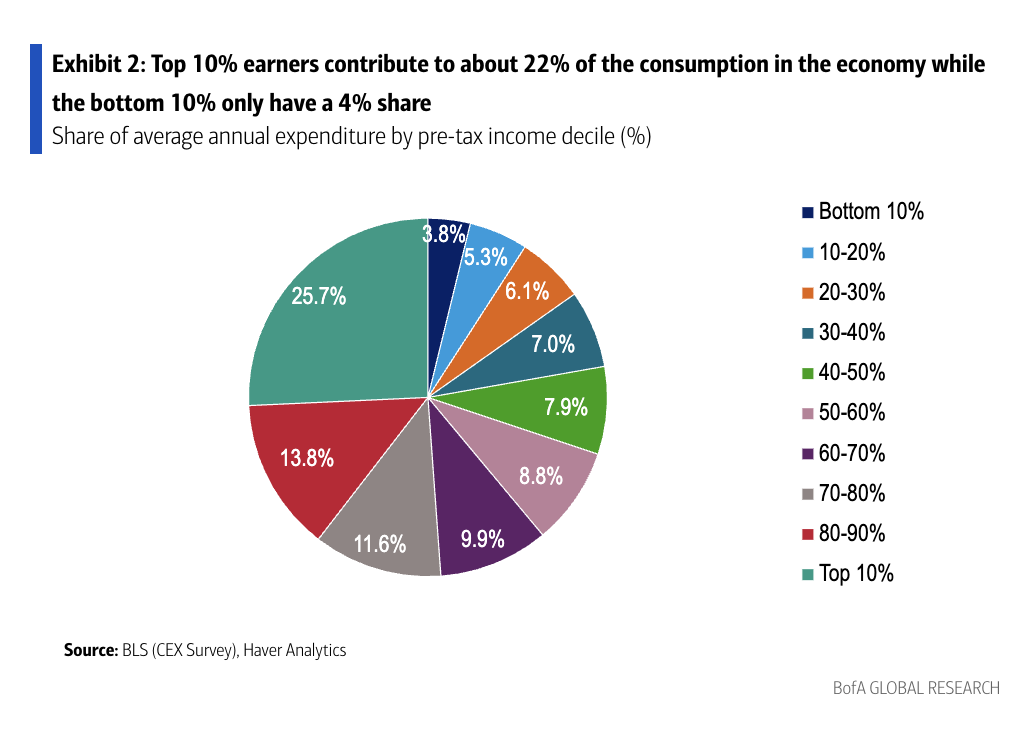
The team led by Aditya Bhave argues that this K-shaped pattern is being driven by five overlapping “Ks”: stronger balance sheets at the top of the income ladder, lower housing costs for homeowners compared to renters, a labor market that has recently favored higher‑income workers, tax stimulus that skews toward middle‑ and upper‑income households, and a “K-shaped affordability shock” from higher energy prices that hits low‑income drivers hardest. Add it all up and that hamburger or pizza is a tougher sell. Just listen to what the food executives said.
McDonald’s: Winning the battle, naming the war
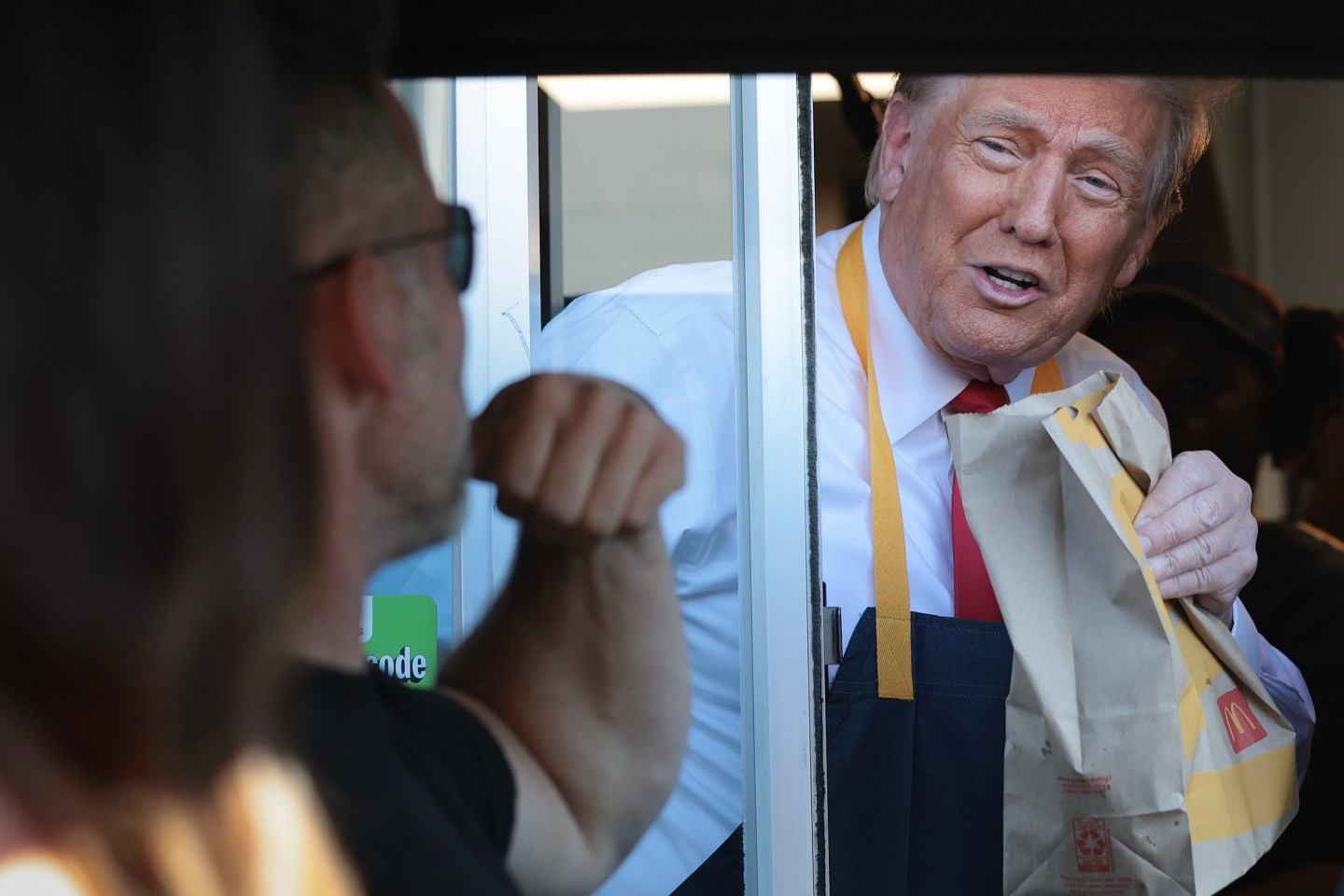
Among the major chains reporting this week, McDonald’s CEO Chris Kempczinski was the most candid about the structural challenge facing the industry. He described consumer sentiment as “heightened anxiety, let’s just say,” while CFO Ian Borden warned the macro environment is “certainly not improving, and it may be getting a little bit worse.”
The most telling data point: McDonald’s is still losing lower-income customers. “The low income is absolutely still declining,” Borden told analysts — a frank acknowledgment that even the world’s largest fast food company, a brand synonymous with affordability, cannot fully insulate itself from the economic bifurcation underway. Elevated gas prices, Borden noted, “are not gonna be helpful, particularly for lower-income consumers who are already under pressure.”
That matches what BofA sees in broader sentiment data: confidence among higher‑income households has held up, while lower‑income sentiment has lagged, even as official labor market numbers look decent. BofA quantifies that pressure, estimating that gas and other energy goods make up nearly 4% of outlays for the bottom income decile, compared with about 1.5% for the top decile, turning higher pump prices into a de facto regressive tax on the very customers that McDonald’s relies on for low‑ticket, high‑frequency visits.
McDonald’s response has been to flood the zone with value. The revamped McValue platform, relaunched in mid-April with unanimous franchisee approval, added an everyday affordable price menu including a $2.50 McDouble and $1.50 Sausage McMuffin. The strategy is working well enough to deliver 3.8% global comp growth and market share gains in nearly all of its top 10 markets — but company-operated restaurant margins remain, in Borden’s own words, “not acceptable,” and franchisees are “feeling under pressure from a cash flow standpoint.”
Papa John’s: international rescue
Papa John’s may be the starkest illustration of how the same brand can exist in two economic realities at once. CEO Todd Penegor, who took over the struggling chain late last year, opened his prepared remarks by name-checking the “highly promotional QSR marketplace” and distinguishing Papa John’s deliberately from competitors who have “outlined their strategy to compress restaurant margins.”
Internationally, the strategy is working. The brand posted its sixth consecutive quarter of positive international comps, led by accelerating growth in the U.K., surging growth in the Middle East, and strength in Korea. At home, a different story: North America comp sales fell mid-single digits, driven almost entirely by lower transaction volume — specifically, a collapse in single-pizza orders. “The transaction loss was in orders that contained only one or no pizzas,” CFO Ravi Thanawala told analysts. “We continue to see order growth in multi-pie orders.” Translation: the loyal, multi-pizza ordering core held up. The marginal customer — the one ordering a single pie because it was the cheapest available dinner option — disappeared.
To lure them back, Papa John’s is leaning on the most improbable weapon in the arsenal: Toy Story 5. The chain announced what it called the first-ever Disney-Pixar partnership for a Toy Story film release, a global collaboration timed to the June 19 theatrical debut, featuring custom packaging, a Pixar-produced animated ad spot, and a new line of personal-sized Toy Story 5 pizzas. The eight-inch pie, Penegor said, is meant to become “a new innovation platform with a compelling price point to drive customer acquisition.”
Taco Bell and the value playbook
The most instructive contrast to both McDonald’s and Papa John’s may be Taco Bell, where the value proposition has been hardwired into the brand’s identity so thoroughly that a tough consumer environment barely registers as a headwind. Taco Bell’s 8% same-store sales growth significantly outpaced the QSR industry and Wall Street’s 5.6% estimate, driven by what Yum CEO Chris Turner called a “magic formula [that] is firing on all cylinders,” a mixture of cultural significance, enticing innovations, and exceptional value offerings. Digital system sales across Yum’s brands approached $11 billion, with digital mix reaching a record 63%.
Taco Bell’s success offers a lesson for chains still searching for footing: the brands winning in this environment aren’t just offering discounts — they’re offering a value identity that gives lower-income consumers a reason to feel good about choosing them. That’s a harder thing to manufacture on short notice.
What comes next
Every CEO on this week’s calls threaded the same needle: optimistic about the back half of the year, cautious about the macro environment, and careful not to promise more than their innovation pipelines can deliver. McDonald’s guided for a meaningful comp deceleration in Q2, citing a tough lap against last year’s Minecraft promotion. Papa John’s acknowledged April North America comps are trending “slightly worse than Q1 on a year-over-year basis.” Wingstop is now bracing for a full-year domestic comp decline in the low single digits.
What none of them could fully answer is when the lower-income consumer comes back — or whether, after years of price increases that have outpaced wage growth for the bottom quintile, the value equation in fast food has simply broken. The industry built its entire existence on the premise that when times got hard, people would trade down to the drive-thru. The K-shaped economy has complicated that assumption in ways that a $2.50 McDouble and a Toy Story 5 pizza box, however clever, may not fully resolve.
For this story, Fortune journalists used generative AI as a research tool. An editor verified the accuracy of the information before publishing.