At commencement ceremonies across the country this May, a telling phenomenon is obvious. A speaker steps to the podium. They say the words “artificial intelligence.” And the audience erupts in boos.
It happened at the University of Central Florida, when real estate executive Gloria Caulfield told arts and humanities graduates that “the rise of artificial intelligence is the next industrial revolution.” It happened at the University of Arizona with former Google CEO Eric Schmidt, even though he went out of his way to calm the obviously strong emotions. “There is a fear in your generation that the future has already been written,” according to remarks reported by NBC News, “that the machines are coming, that the jobs are evaporating, that the climate is breaking, that politics is fractured, and that you are inheriting a mess that you did not create, and I understand that fear.”
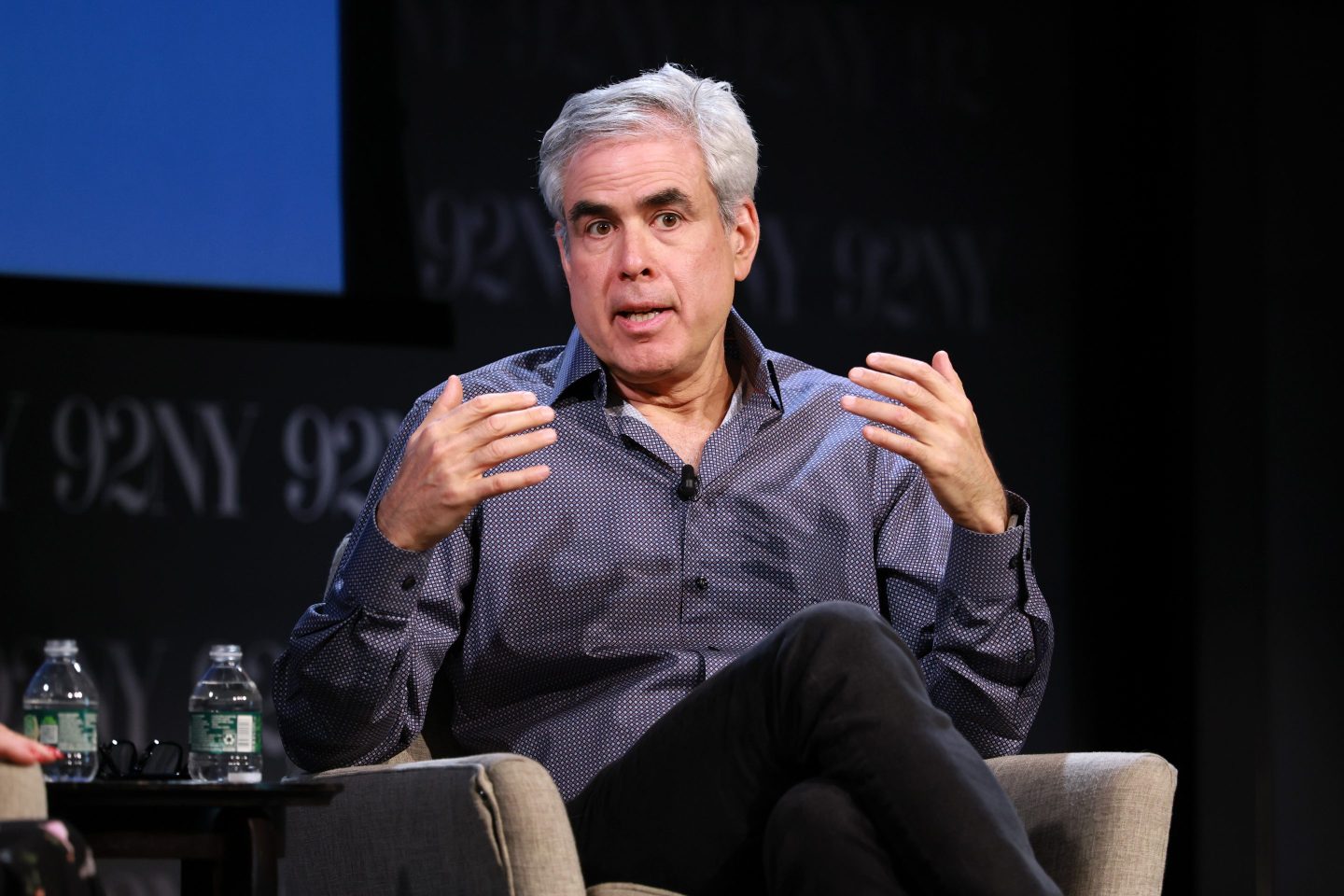
At New York University’s ceremony at Yankee Stadium, psychologist Jonathan Haidt was met with walkouts and jeers the moment he took the stage. The author of The Anxious Generation was invited, in part, because of his work diagnosing Gen Z’s fragility.
But as Fortune has been reporting for the past several years, if you want to understand why graduates are booing, the story doesn’t start at the podium. It doesn’t even start with AI.
The wound was already there
For more than a decade, economists have been tracking a quiet inversion in American well-being: young people are now the most despairing age group in the country. A 2025 working paper from the National Bureau of Economic Research by Dartmouth economist David Blanchflower and University College London’s Alex Bryson documented a dramatic rise in despair among young workers since the years just following the Great Recession — roughly 2012 to 2014 — reversing the classic pattern of the “midlife crisis.”
Blanchflower previously told Fortune that the midlife crisis was “one of the most important patterns in the world, in social science … until it isn’t.” He admitted that he had never heard the phrase “quarterlife crisis” but it was absolutely appropriate, and said he was “freaked” out by what his research showed: “Suddenly young workers look to be in big trouble.”
The decline tracks changes that hit young workers hardest: rising housing and healthcare costs, student debt, eroding entry-level job quality, the hollowing of the career ladder. As Bryson put it: “Moving on up the ladder, it feels as if, perhaps, for some of them, somebody’s removed some of the rungs.” Puzzlingly, Blanchflower and Bryson found that the decline isn’t about wages, as real wages for young workers have risen over the past several decades. It seems to be about the gap between what this generation was promised and what it has received.
Shortly afterward, in August 2025, an influential Stanford study led by AI researcher Erik Brynjolfsson found that since late 2022, fewer young people were being hired into occupations heavily exposed to automation — meaning AI was beginning to compress even the diminished pool of entry-level opportunity that remained. The cycle of innovation has only accelerated since then.
2020 broke something
The NBER research describes a decades-long deterioration. Retired University of Chicago economist Sam Peltzman found something sharper: a single rupture. Combing through 50 years of General Social Survey data — the longest-running poll asking Americans simply “are you happy?” — he identified a crash in 2020 that has not healed. The collapse was 22.2 percentage points in a single year, by far the largest single move in the survey’s history. The number of Americans saying “not very happy” exceeded those saying “very happy” for the first time ever. The measure has recovered only to around 6 points above baseline as of 2024, leaving Americans at their least happy sustained level since the GSS began in 1972.
Peltzman told me earlier this month that he considered this a “regime change” — not just a shift in numbers, but a shift in the underlying mechanism generating the numbers. “Unless the next wave of data shows a return to the norm,” he told me, “you have to proceed on the assumption that the world is different.” And who was hit hardest? Not the poor. Not the least educated. “The biggest decline over this period is among the most educated,” he told me. “The ones with the largest concentration of people who have reached the dream — biggest decline.” These are, disproportionately, the people walking across the stages this month.
A Gallup poll published in April surveyed 1,500 people ages 14 to 29 found that excitement about AI among Gen Z dropped 14 percentage points, hopefulness fell 9 points, and anger rose 9 points. Gen Z workers are more than three times as likely as older workers to say AI’s risks outweigh its benefits. But the numbers beneath these numbers are older and harder: young workers’ mental health has been declining since the early 2010s, the pandemic’s happiness crash has not healed, and a generation’s brains were neurologically rewired by social media before any of them could vote. These are not separate crises. They are the same crisis, arriving in successive waves.
The phones issue and Jonathan Haidt
Before the labor market turned against them, and before AI became a household word, something else was reshaping this generation at the neurological level. Haidt — whose work was cited approvingly by Blanchflower and Bryson in the very NBER research on young worker despair — argues that children born after 1995 are fundamentally different from earlier generations because they experienced puberty amid omnipresent smartphones and social media. Speaking at a Dartmouth-UN symposium last October, Haidt described the consequences with a vivid metaphor: “Their brains have been growing around their phones very much in the way that this tree grew around this tombstone.”
The rewiring Haidt places between 2010 and 2015 coincided with a synchronized global collapse in teen mental health — nonfatal self-harm among early teen girls more than quintupled between 2010 and 2015. Fifty years of progress in educational achievement metrics ended in 2012, according to NAEP data, suggesting a broader erosion in the human capacity for focus. “We’re getting dumber,” Haidt said at the symposium, “exactly as our machines are getting smarter and taking over more areas of life.” He reported that some of his students described an inability to read a full page: “I open a book, I read a sentence, I get bored, I go to TikTok.”
This makes what happened at NYU’s commencement — where Haidt himself was booed — one of the more layered scenes of the 2026 graduation season. The student government called his selection “deeply unsettling,” citing his arguments against DEI programs and other positions. About three dozen students walked out. The irony was noted widely: the man who spent years diagnosing this generation’s anxiety as excessive was rejected by the very generation he diagnosed.
The Haidt controversy was not as straightforward as the other examples of commencement AI backlash. A self-described heterodox teacher, Haidt has provoked student ire because of his political positioning on DEI, Palestine, and campus free speech culture.
The student letter objecting to his speaking appointment referenced cultural issues, calling him “an individual who has been accused of making homophobic remarks in a class and public misconceptions about transgender identity, and has promoted disturbing rhetoric around antiracism, social justice, and diversity, equity and inclusion.”
The NYU students seemed to express a desire for a celebrity presence that would not challenge their beliefs, however, bemoaning the “gold standard” from years past of “figures of universal inspiration,” mentioning the entertainers Molly Shannon and Taylor Swift next to superlawyer David Boies and Supreme Court Justice Sonia Sotomayor. The need for this generation to find universal truths where they don’t exist, of course, is a core argument that Haidt has long been making.
The students at NYU may have been rejecting not just Haidt’s politics but his premise: that their distress is primarily a product of their own digital habits, rather than the economy they were handed.
AI didn’t create the problem—It made it impossible to ignore
Economic historian Dror Poleg offered a different frame when I spoke with him recently. Poleg, whose forthcoming book addresses how to thrive in an era of intensifying uncertainty and inequality, pointed to remote work as a template: the technology didn’t create a new reality so much as force people to confront one that had been quietly arriving for years. “AI is like a catalyst, or a forcing function,” he told me, “a bit like COVID forced us to realize things about remote work and the internet that maybe were true five or 15 years before COVID.”
His deeper argument: for 50 years, the economy’s center of gravity has been moving toward producing intangible rather than tangible things — “more inequality, more uncertainty, more professions, fewer places to hide, like fewer normal jobs where you can just learn something, and that knowledge will remain useful for the next 20, 30, 40 years.” AI, he said, “is just the thing that made this more visible.” When a speaker steps to a podium and praises the next industrial revolution, they may think they’re talking to graduates about an exciting new technology, but the students seem to be putting a face to a threat that has been accumulating beneath the surface of their entire working lives.
Peak generation, peak anxiety
This collision lands on the largest class of young Americans in history. The country is currently at “peak 18,” according to Apollo Global Management chief economist Torsten Slok — the highest number of 18-year-olds ever recorded. The cohort will shrink roughly 14% over the coming decade, Slok calculated in his Daily Spark blog.
They are on track to surpass millennials as the most credentialed generation in history, entering a labor market that has been quietly restructuring away from the entry-level positions that once absorbed them. Gad Levanon, chief economist at the Burning Glass Institute, sees the AI-driven hollowing of entry-level white-collar work as potentially analogous to the manufacturing collapse of the Midwest in the 1990s — devastating for the affected communities, largely invisible to everyone else. “If the manufacturing thing happened to the entire population rather than just the manufacturing communities,” he told me, “it would have been a very, very big shock.”
The infrastructure buildout makes the stakes concrete. Slok has separately pointed out that roughly 4,000 data centers are currently operating in the United States, and nearly 3,000 more are under construction — the country’s AI capacity is about to nearly double, imminently. The machines are scaling. The question graduates are asking, with justified urgency, is: scaling toward what kind of economy, and for whom?