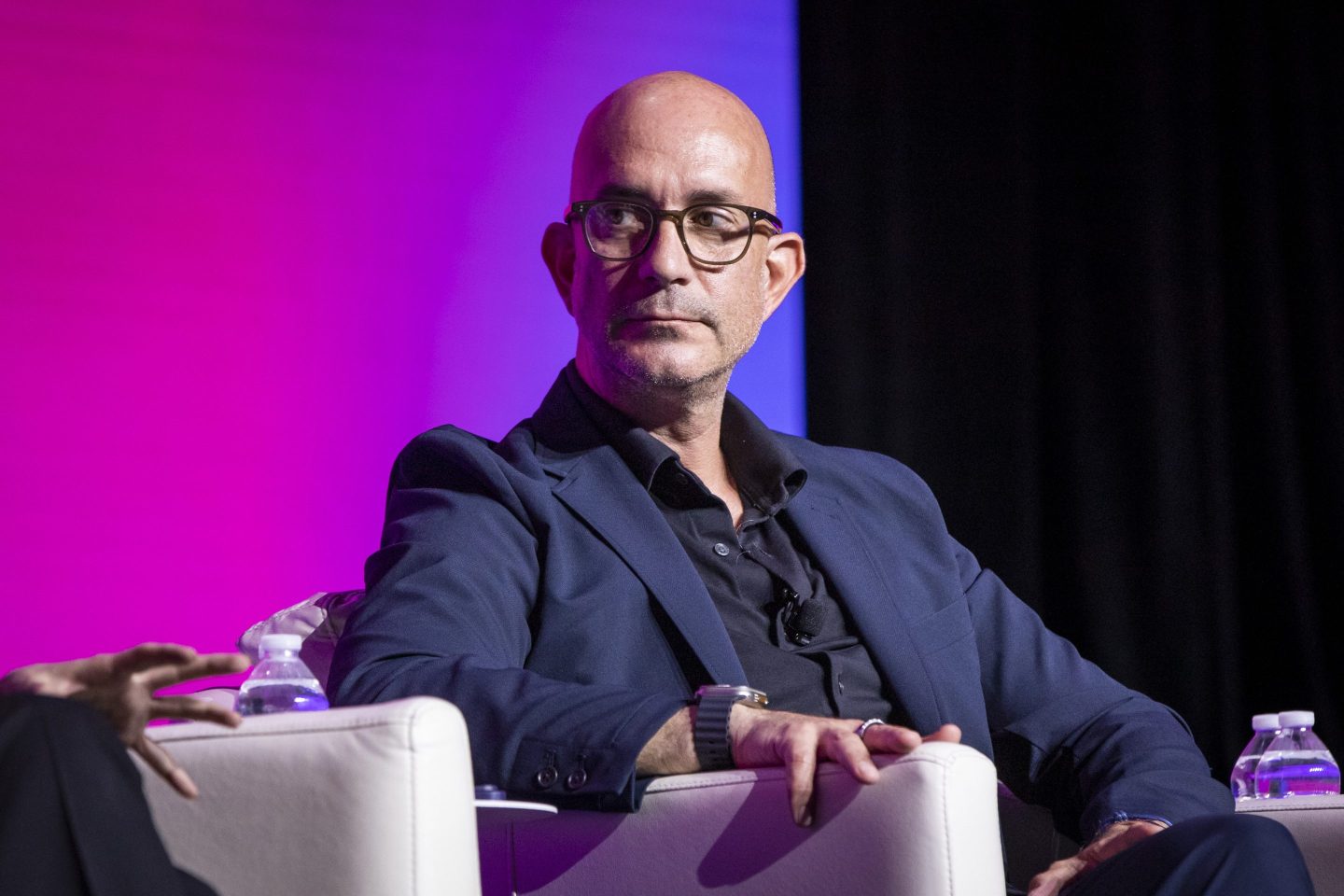

Carl Fritjofsson, who has run Stockholm, Sweden-based Creandum’s San Francisco office since 2016, says the timeline for European founders to cross the pond is compressing at a pace he’s never seen.
“There is more demand in the U.S. today than there is in Europe,” he told Fortune. “Especially if you’re selling towards enterprises with some kind of AI-native product. That is pulling people to do the U.S. expansion faster than ever before.”
The pull factor is real: AI firms captured 61% of global venture capital in 2025—and 80% to 81% of total global venture capital in the first quarter of 2026. The overwhelming majority of that demand lives on American enterprise procurement budgets.
Receipts from Creandum’s own portfolio make the case. Lovable, the Swedish vibe-coding startup Creandum backed early, crossed $400 million in ARR in February—adding $100 million in a single month with 146 employees—and sits at a $6.6 billion valuation. The company’s growth is nearly entirely digital and borderless, a model Fritjofsson describes as “bottoms-up from day one”—no boots on the ground required, as U.S. users have flocked to the platform without a U.S. expansion plan.
But not every company gets to grow the way Lovable did. For enterprise-focused startups, “ready for the U.S.” still means putting a founder on a plane—and that’s where the playbook gets complicated. Fritjofsson acknowledged that the Trump administration’s visa friction is real, even if he’s not ready to call it a dealbreaker.
Last September, the administration imposed a $100,000 fee for new H-1B applications—a more than 6,500% cost increase. For founders, the practical workaround has been the O-1 visa, the “extraordinary ability” category that Fritjofsson describes as working pretty well. For the team members they want to bring along? The path is murkier.
Yet Fritjofsson’s read is that the deregulatory tailwind for AI is outweighing the immigration headwind. “What Trump has done is also make the U.S. more AI-friendly when it comes to regulation,” he said. “The lessening friction on the commercial side has driven more demand than the additional friction on immigration has slowed it.”
His take appears to track with the data: European venture funding reached $58 billion in 2025, a modest 9% gain year-over-year, while U.S. companies captured 83% of global venture capital in Q1 2026 alone. The gravitational pull of American AI enterprise demand isn’t a narrative—it’s a funding gap. Europe’s structural challenge runs deeper than visa policy. A 2024 report by Interface found that European countries are “losing significant AI talent, both national and international,” to the U.S. One mapping of global AI professionals found Europe has roughly 30% more AI talent per capita than the U.S.—they just don’t always stay. Fritjofsson frames it as a two-way flow—many researchers eventually build back in Europe (like Cast AI)—but by later growth stages, 73% of European AI companies’ lead investors are American, which tells you where the capital conviction still lives.
Klarna’s U.S. story—which required rebuilding the product nearly from the ground up for the American market before U.S. revenue grew 58% year-over-year—is the old playbook. Lovable hitting $400 million ARR without a traditional expansion strategy, is the new one.
And so it seems the question every European founder should be asking right now isn’t when to go to the U.S. It’s whether AI has already made the question obsolete.
See you tomorrow,
Lily Mae Lazarus
X:@LilyMaeLazarus
Email:lily.lazarus@fortune.com
Submit a deal for the Term Sheet newsletter here.
Joey Abrams curated the deals section of today’s newsletter.Subscribe here.
VENTURE DEALS
- Dust, a Paris, France-based human-AI agent collaboration platform, raised $40 million in Series B funding. Abstract and Sequoia led the round and were joined by Snowflake and Datadog.
- equipifi, a Scottsdale, Ariz.-based company that helps banks and credit unions offer buy-now-pay-later services in their digital banking offerings, raised $34 million in Series B funding. Left Lane Capital led the round and was joined by existing investors.
- Wirestock, a San Francisco-based platform that provides image and video datasets for AI model training, raised $23 million in Series A funding. Nava Ventures led the round and was joined by SBVP, Formula VC, I2BF Global Ventures, and others.
- Arkeus, a Port Melbourne, Australia-based defense technology company, raised $18 million in Series A funding. QIC Ventures led the round and was joined by others.
- Onramp, a Dallas, Texas-based bitcoin-centric financial services company, raised $12.5 million in Series A funding. Early Riders led the round and was joined by angel investors.
EXITS
- H.I.G. Capital acquired International Aerospace Coatings, an Irvine, Calif.-based aviation services provider, from Tiger Infrastructure Partners.
- NTT DATA agreed to acquire WinWire Holdings, a Santa Clara, Calif.-based agentic AI firm, from Sverica Capital Management. Financial terms were not disclosed.
IPOS
- ERock, a Houston, Texas-based energy company, filed to go public on the New York Stock Exchange. The company posted $191 million in sales for the year ending March 31.