
• Home
  • Latest
  • Fortune 500
  • Finance
  • Tech
  • Leadership
  • Lifestyle
  • Rankings
  • Multimedia

Exclusive

An hour in the Oval Office with President Trump Fortune Editor-in-Chief: Alyson Shontell sat down with President Trump in the Oval Office for an hour. Tariffs, Intel, AI, Boeing, Iran—and the question every CEO eventually has to answer: who's next?

An hour in the Oval Office with President Trump Fortune Editor-in-Chief: Alyson Shontell sat down with President Trump in the Oval Office for an hour. Tariffs, Intel, AI, Boeing, Iran—and the question every CEO eventually has to answer: who's next?

An hour in the Oval Office with President Trump Fortune Editor-in-Chief: Alyson Shontell sat down with President Trump in the Oval Office for an hour. Tariffs, Intel, AI, Boeing, Iran—and the question every CEO eventually has to answer: who's next?

An hour in the Oval Office with President Trump Fortune Editor-in-Chief: Alyson Shontell sat down with President Trump in the Oval Office for an hour. Tariffs, Intel, AI, Boeing, Iran—and the question every CEO eventually has to answer: who's next?

An hour in the Oval Office with President Trump Fortune Editor-in-Chief: Alyson Shontell sat down with President Trump in the Oval Office for an hour. Tariffs, Intel, AI, Boeing, Iran—and the question every CEO eventually has to answer: who's next?

An hour in the Oval Office with President Trump Fortune Editor-in-Chief: Alyson Shontell sat down with President Trump in the Oval Office for an hour. Tariffs, Intel, AI, Boeing, Iran—and the question every CEO eventually has to answer: who's next?

An hour in the Oval Office with President Trump Fortune Editor-in-Chief: Alyson Shontell sat down with President Trump in the Oval Office for an hour. Tariffs, Intel, AI, Boeing, Iran—and the question every CEO eventually has to answer: who's next?

An hour in the Oval Office with President Trump Fortune Editor-in-Chief: Alyson Shontell sat down with President Trump in the Oval Office for an hour. Tariffs, Intel, AI, Boeing, Iran—and the question every CEO eventually has to answer: who's next?

An hour in the Oval Office with President Trump Fortune Editor-in-Chief: Alyson Shontell sat down with President Trump in the Oval Office for an hour. Tariffs, Intel, AI, Boeing, Iran—and the question every CEO eventually has to answer: who's next?

An hour in the Oval Office with President Trump Fortune Editor-in-Chief: Alyson Shontell sat down with President Trump in the Oval Office for an hour. Tariffs, Intel, AI, Boeing, Iran—and the question every CEO eventually has to answer: who's next?

Future of WorkJobs

Goldman Sachs: The U.S. labor market is healthier now than when ChatGPT launched. Yes, really

Nick Lichtenberg
By
Nick Lichtenberg
Nick Lichtenberg
Business Editor
Down Arrow Button Icon
Nick Lichtenberg
By
Nick Lichtenberg
Nick Lichtenberg
Business Editor
Down Arrow Button Icon
May 19, 2026, 1:51 PM ET
traffic
It's been a jobs traffic jam for the last four years.Getty Images

You know the deal: AI is the villain, the thing that all the college kids are booing at commencement speech, the bringer of destruction to the labor market. Since the launch of ChatGPT in late 2022, the anxiety has mounted along with the predictions of the demise of white-collar work.

Recommended Video

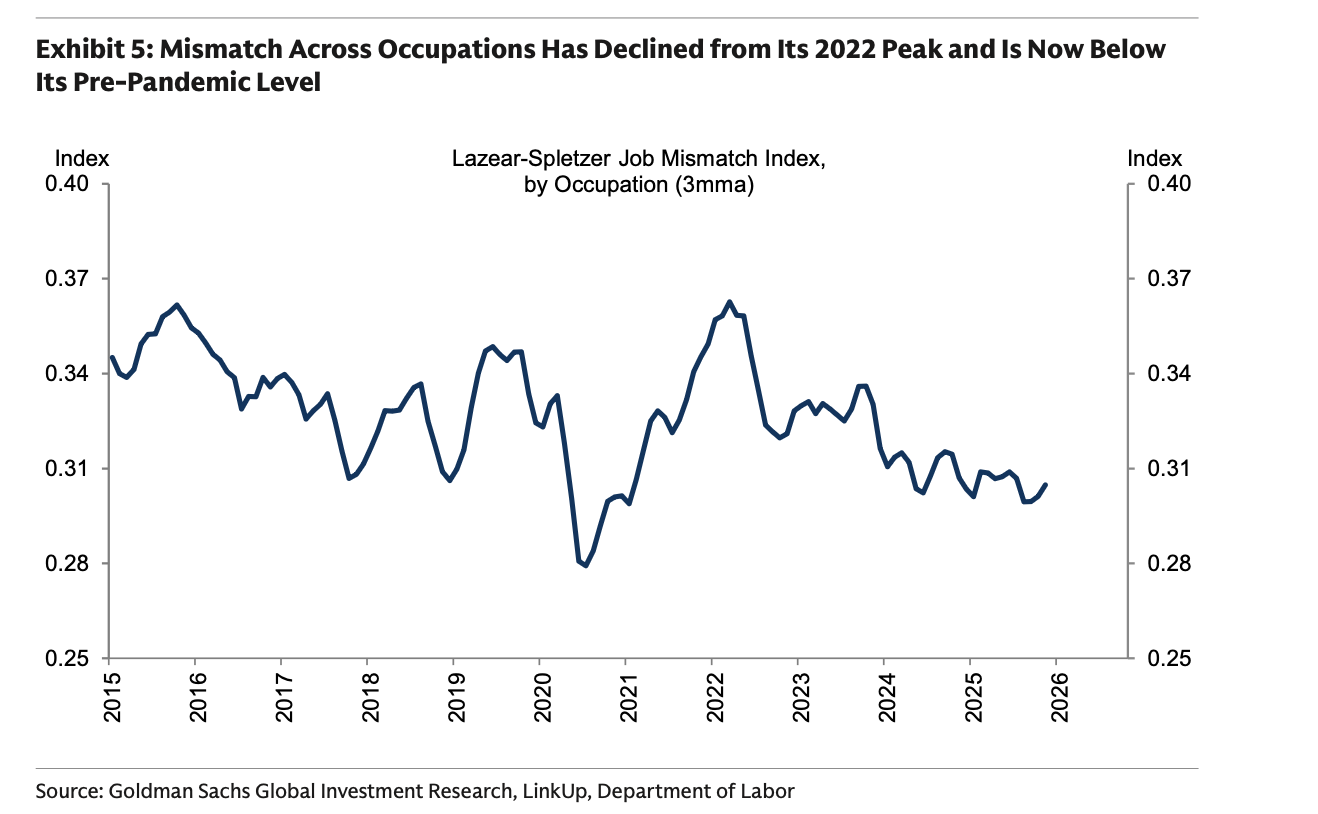
But nearly four years later, Goldman Sachs economists have a surprising update. The mismatch between workers and available jobs—a key barometer of labor market stress—has actually improved since that moment, falling below its pre-pandemic level. The traffic jam, in other words, is clearing.

The reason, paradoxically, is AI itself.

A tale of two studies

The Goldman finding doesn’t go unchallenged. Economists at the New York Fed published their own analysis the same day, concluding that overall AI exposure shows little link to declining job postings—and the drop in postings for high-exposure roles actually predated ChatGPT entirely. The two camps aren’t so much contradicting each other as standing at different points on the same highway, describing what kind of snarl they see.

Goldman separates AI that replaces workers from AI that assists them, whereas the NY Fed treats exposure as a single, aggregate measure. Goldman is looking at which specific lanes are emptying and why. The NY Fed is measuring overall congestion, and finding it no worse than before.

That methodological choice drives very different conclusions about whether the labor market is moving freely or quietly rerouting in ways that will bottleneck further ahead.

In a research note published Thursday, Goldman Sachs economists Elsie Peng and Ronnie Walker argued the distinction matters enormously—and that it explains why blunter analyses keep missing the signal.

“Our occupation-level mismatch index has declined from its 2022 peak and is now slightly below its pre-pandemic level,” they wrote, before offering a warning about what comes next.
How the jam formed—and how it cleared

To understand how AI could improve a labor market measure it was supposed to wreck, it helps to understand what “mismatch” actually means. The Goldman economists use a version of the Lazear-Spletzer mismatch index, which captures the share of job seekers who would need to be reallocated across occupations to equalize labor market tightness. When that number is high, it means the people looking for work aren’t aligned with where the openings are—structurally inefficient, and bad for workers and employers alike.

Think of mismatch as the labor market’s equivalent of a traffic jam: not too few cars or too few roads, but the wrong cars on the wrong roads. In 2022, that jam was historic: Nurses couldn’t be found in hospitals that needed them, while tech company offices sat half-empty with more applicants than desks. ChatGPT arrived on the scene when the post-pandemic labor market was exceptionally distorted: Some sectors were desperately short of workers; others had far too many applicants.

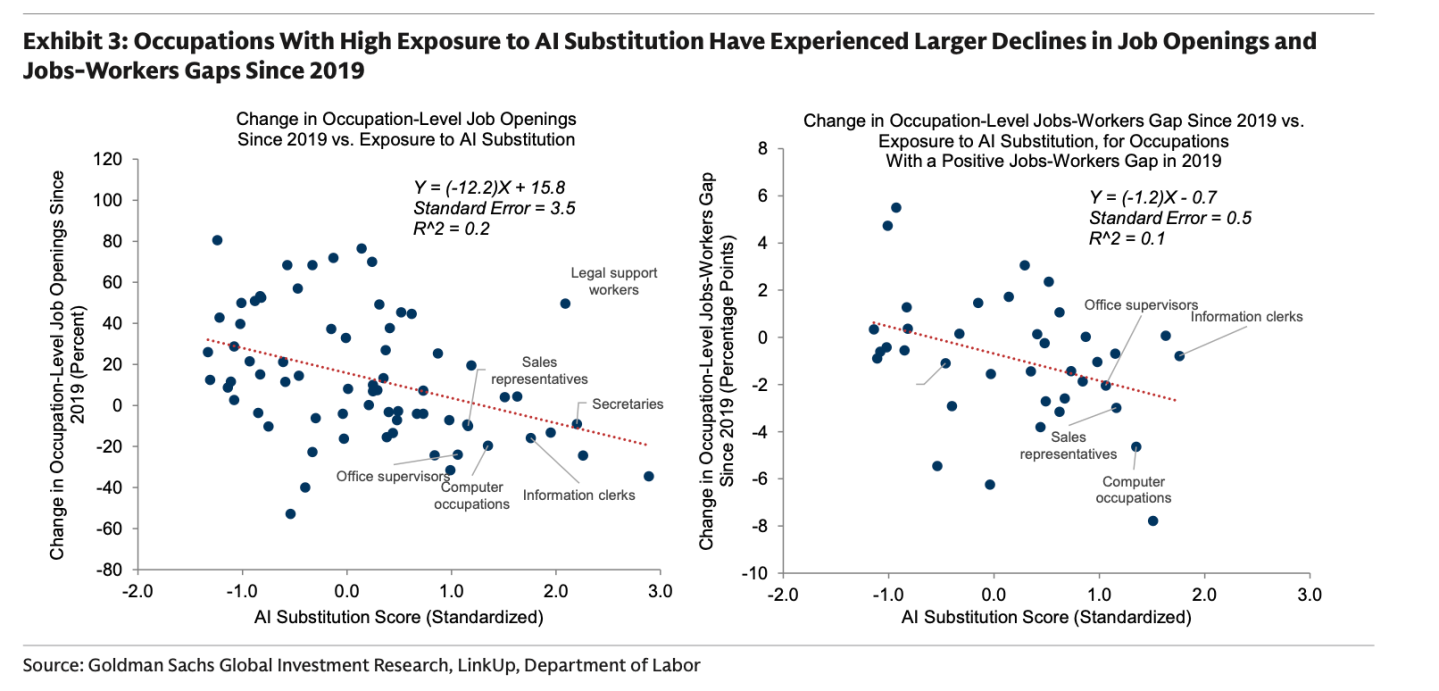
The occupations most exposed to AI substitution, where most core tasks can be readily automated, like information clerks, secretaries, and sales representatives, were already experiencing some of the worst labor shortages at the time, according to Peng and Walker. When AI began reducing job openings in those fields, it didn’t create new unemployment so much as it helped close an existing gap between demand and supply.

“The first stage of AI deployment has been fortuitously timed,” Peng and Walker wrote, “because it coincided with a labor shortage in the most AI-exposed occupations.”

The effect is sharpest for computer and information workers, sales representatives, and office supervisors—roles that used to serve as the default landing spots for college graduates entering the workforce. Peng and Walker have a prediction for what’s coming next: “The next stage of deployment will likely require more adaptation by the workforce.”

Where the jobs went as traffic rerouted

The composition of U.S. job openings has shifted significantly since 2019.  Traffic is building in the physical-presence lanes—health care, food preparation, maintenance—while draining fast from the office lanes AI has most aggressively entered. Roughly 300,000 more openings in the former; 450,000 fewer in the latter, compared to 2019.

Goldman’s statistical analysis puts numbers on the shift: a one-standard-deviation increase in an occupation’s exposure to AI substitution is associated with 12% fewer job openings relative to that occupation’s 2019 average. The effect is sharpest for computer and information workers, sales representatives, and office supervisors.
The catch

Goldman is not arguing AI’s workforce disruption is overblown. If anything, the firm’s note reads as a warning dressed up as reassurance.

The favorable mismatch trend reflects a specific, unlikely set of circumstances: AI happened to arrive when the occupations it most threatened were already struggling to fill seats. That created an accidental cushion. The next stage of AI deployment—broader, deeper, touching occupations that weren’t already in surplus — will not come with the same built-in buffer.

For younger workers and career changers, that adaptation window may already be narrowing. The jobs gaining openings—health care, food preparation, physical maintenance—are harder to enter without credentials or physical presence. The jobs losing openings are the ones that once served as accessible entry points for college graduates: office roles, sales positions, tech-adjacent support jobs.

The lanes filling up with openings—bedside nursing, line cooking, HVAC repair—require bodies in rooms, credentials, and years of training to enter. The lanes draining of openings are the ones you used to be able to enter with a laptop and a college degree. For a generation that was told to work smart, not hard, the detour ahead is longer than any mismatch index can fully capture.

For this story, Fortune journalists used generative AI as a research tool. An editor verified the accuracy of the information before publishing.


At the Fortune Workplace Innovation Summit, Fortune 500 leaders will convene to explore the defining questions shaping the workforce of the future—delivering bold ideas, powerful connections, and actionable insights for building resilient organizations for the decade ahead. Join Fortune May 19–20 in Atlanta. Register now.
About the Author
Nick Lichtenberg
By Nick LichtenbergBusiness Editor
LinkedIn icon

Nick Lichtenberg is business editor and was formerly Fortune's executive editor of global news.

See full bioRight Arrow Button Icon

Latest in Future of Work

Finance
Lorem ipsum dolor sit amet, consectetur adipiscing elit, sed do eiusmod tempor incididunt ut labore et dolore magna aliqua. Ut enim ad minim veniam
By Fortune Editors
October 20, 2025
Finance
Lorem ipsum dolor sit amet, consectetur adipiscing elit, sed do eiusmod tempor incididunt ut labore et dolore magna aliqua. Ut enim ad minim veniam
By Fortune Editors
October 20, 2025
Finance
Lorem ipsum dolor sit amet, consectetur adipiscing elit, sed do eiusmod tempor incididunt ut labore et dolore magna aliqua. Ut enim ad minim veniam
By Fortune Editors
October 20, 2025
Finance
Lorem ipsum dolor sit amet, consectetur adipiscing elit, sed do eiusmod tempor incididunt ut labore et dolore magna aliqua. Ut enim ad minim veniam
By Fortune Editors
October 20, 2025
Finance
Lorem ipsum dolor sit amet, consectetur adipiscing elit, sed do eiusmod tempor incididunt ut labore et dolore magna aliqua. Ut enim ad minim veniam
By Fortune Editors
October 20, 2025
Finance
Lorem ipsum dolor sit amet, consectetur adipiscing elit, sed do eiusmod tempor incididunt ut labore et dolore magna aliqua. Ut enim ad minim veniam
By Fortune Editors
October 20, 2025

Most Popular

Finance
Lorem ipsum dolor sit amet, consectetur adipiscing elit, sed do eiusmod tempor incididunt ut labore et dolore magna aliqua. Ut enim ad minim veniam
By Fortune Editors
October 20, 2025
Finance
Lorem ipsum dolor sit amet, consectetur adipiscing elit, sed do eiusmod tempor incididunt ut labore et dolore magna aliqua. Ut enim ad minim veniam
By Fortune Editors
October 20, 2025
Finance
Lorem ipsum dolor sit amet, consectetur adipiscing elit, sed do eiusmod tempor incididunt ut labore et dolore magna aliqua. Ut enim ad minim veniam
By Fortune Editors
October 20, 2025
Finance
Lorem ipsum dolor sit amet, consectetur adipiscing elit, sed do eiusmod tempor incididunt ut labore et dolore magna aliqua. Ut enim ad minim veniam
By Fortune Editors
October 20, 2025
Finance
Lorem ipsum dolor sit amet, consectetur adipiscing elit, sed do eiusmod tempor incididunt ut labore et dolore magna aliqua. Ut enim ad minim veniam
By Fortune Editors
October 20, 2025
Finance
Lorem ipsum dolor sit amet, consectetur adipiscing elit, sed do eiusmod tempor incididunt ut labore et dolore magna aliqua. Ut enim ad minim veniam
By Fortune Editors
October 20, 2025
Fortune Secondary Logo
Rankings
  • 100 Best Companies
  • Fortune 500
  • Global 500
  • Fortune 500 Europe
  • Most Powerful Women
  • World's Most Admired Companies
  • See All Rankings
  • Lists Calendar
Sections
  • Finance
  • Fortune Crypto
  • Features
  • Leadership
  • Health
  • Commentary
  • Success
  • Retail
  • Mpw
  • Tech
  • Lifestyle
  • CEO Initiative
  • Asia
  • Politics
  • Conferences
  • Europe
  • Newsletters
  • Personal Finance
  • Environment
  • Magazine
  • Education
Customer Support
  • Frequently Asked Questions
  • Customer Service Portal
  • Privacy Policy
  • Terms Of Use
  • Single Issues For Purchase
  • International Print
Commercial Services
  • Advertising
  • Fortune Brand Studio
  • Fortune Analytics
  • Fortune Conferences
  • Business Development
  • Group Subscriptions
About Us
  • About Us
  • Press Center
  • Work At Fortune
  • Terms And Conditions
  • Site Map
  • About Us
  • Press Center
  • Work At Fortune
  • Terms And Conditions
  • Site Map
  • Facebook icon
  • Twitter icon
  • LinkedIn icon
  • Instagram icon
  • Pinterest icon

Latest in Future of Work

david hassell
Future of WorkFortune Workplace Innovation
CEO of AI-powered performance review firm says annual evaluations weren’t designed for the AI era: ‘The practice just hasn’t kept up’
By Jake AngeloMay 19, 2026
3 minutes ago
Santora gestures towards himself
Future of WorkGen Z
WeWork and Upwork CEOs confirm the Gen Z hiring nightmare is real—but it’s nothing new
By Jacqueline MunisMay 19, 2026
32 minutes ago
traffic
Future of WorkJobs
Goldman Sachs: The U.S. labor market is healthier now than when ChatGPT launched. Yes, really
By Nick LichtenbergMay 19, 2026
1 hour ago
Jeff Bezos wearing a cowboy hat and goggles
SuccessCareers
Will the future of work for Gen Z include space? Tech leaders predict space work and travel could be just a decade away
By Preston ForeMay 19, 2026
6 hours ago
young worker at desk
AIGen Z
Gen Z is over-relying on AI at work—and it could cost them their careers
By Jake AngeloMay 19, 2026
7 hours ago
reorgs
CommentaryRestructuring
We studied 6,000 executives and found the real reason 70% of transformations fail
By Julia Dhar, Kristy R. Ellmer and Philip JamesonMay 19, 2026
9 hours ago

Most Popular

While Trump insisted the Iran war would end ‘soon,’ an account in his name was buying millions in oil, defense and gold
Economy
While Trump insisted the Iran war would end ‘soon,’ an account in his name was buying millions in oil, defense and gold
By Eva RoytburgMay 18, 2026
1 day ago
The Bezos family just donated $100 million to help achieve one of Mayor Zohran Mamdani’s top campaign promises
Politics
The Bezos family just donated $100 million to help achieve one of Mayor Zohran Mamdani’s top campaign promises
By Jake AngeloMay 12, 2026
7 days ago
Current price of oil as of May 18, 2026
Personal Finance
Current price of oil as of May 18, 2026
By Joseph HostetlerMay 18, 2026
1 day ago
Current price of silver as of Monday, May 18, 2026
Personal Finance
Current price of silver as of Monday, May 18, 2026
By Joseph HostetlerMay 18, 2026
1 day ago
EXCLUSIVE: An hour in the Oval Office with the CEO-in-Chief, President Trump
Politics
EXCLUSIVE: An hour in the Oval Office with the CEO-in-Chief, President Trump
By Alyson ShontellMay 18, 2026
1 day ago
Spirit Airlines apologizes to all the Americans who can't afford any summer vacation flights as it shuts down
Travel & Leisure
Spirit Airlines apologizes to all the Americans who can't afford any summer vacation flights as it shuts down
By Rio Yamat and The Associated PressMay 18, 2026
1 day ago

© 2026 Fortune Media IP Limited. All Rights Reserved. Use of this site constitutes acceptance of our Terms of Use and Privacy Policy | CA Notice at Collection and Privacy Notice | Do Not Sell/Share My Personal Information
FORTUNE is a trademark of Fortune Media IP Limited, registered in the U.S. and other countries. FORTUNE may receive compensation for some links to products and services on this website. Offers may be subject to change without notice.