
Artificial intelligence has inspired visions of a near-utopian future: cures for cancer, breakthroughs in space, and even a world where money matters less. But the people who will experience that future the most may also be the ones most harmed by it now.
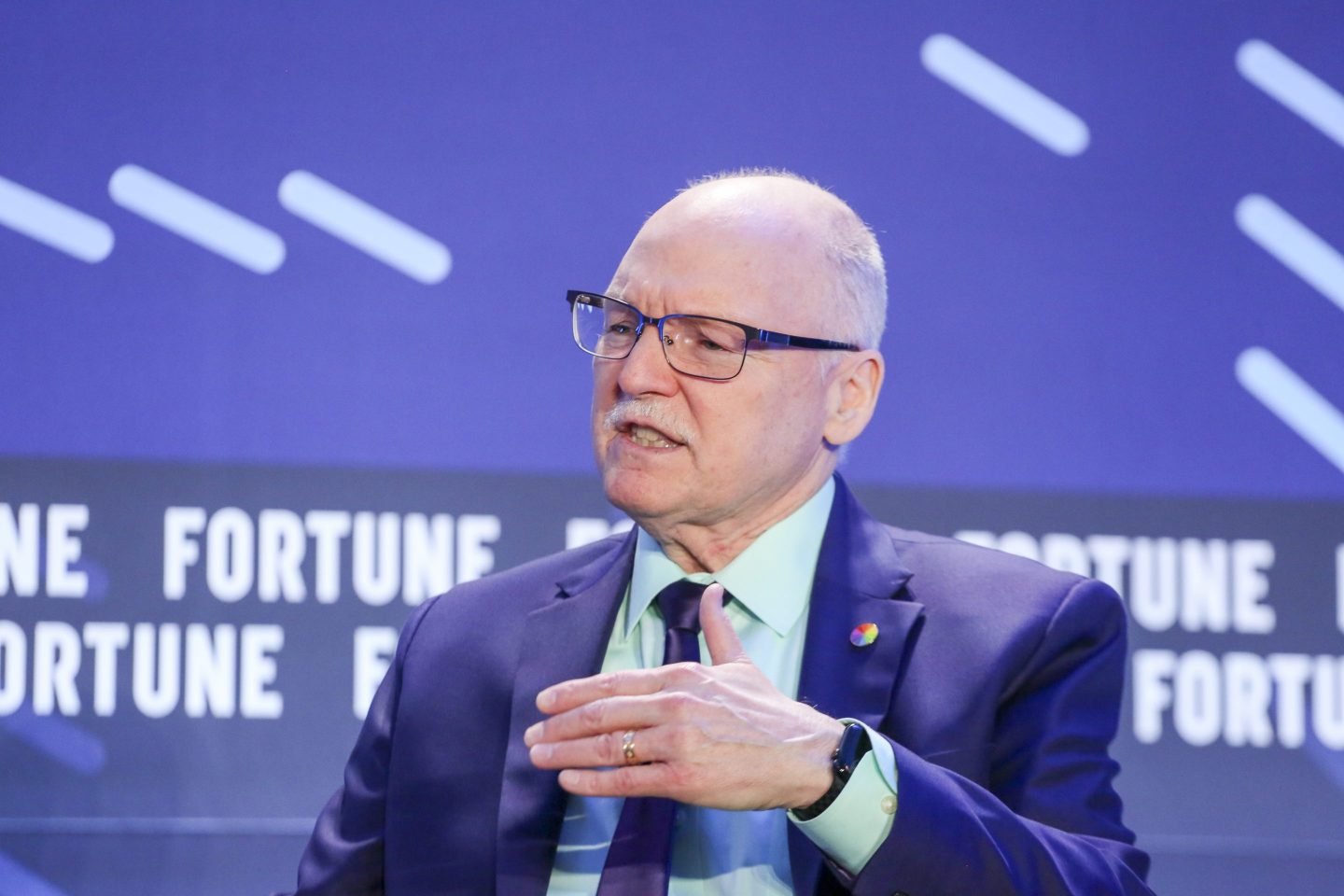
Speaking at Fortune’s Workplace Innovation Summit on Wednesday, Jeff DeGraff—clinical professor of management and organizations at the University of Michigan’s Ross School of Business—admitted young people are increasingly driving the newest forms of innovation—often outside traditional corporate structures.
“Look to young people, they’re creating federations of meaning, they’re trying to cure river blindness in these loose affiliations, they’re creating walkways for animals,” he told Fortune C-Suite and Leadership Editor Ruth Umoh. “They’re doing things outside the traditional industrial structure.”
Yet despite their desires to transform the world toward a bright future, DeGraff said society has failed to adequately prepare young people for the AI transition.
“We’ve sort of given the short end of the stick,” he added in the panel titled What High-Innovation Teams Do Differently. One of the most glaring examples, he said, is how companies are deploying AI: primarily for efficiency.
“That’s going to eliminate a lot of opening jobs,” DeGraff said. “It’s going to eliminate a lot of that first staircase for young people, which is concerning.”
Rather than fueling breakthrough innovation with young people, he added that much of today’s corporate world has been focused on doing things “better, cheaper, faster.”
DeGraff’s warnings come as many early-career workers are already facing a cooling labor market. According to the latest data analysis from the Federal Reserve Bank of New York, 5.6% of recent college graduates aged 22 to 27 are unemployed, compared with 4.2% across all workers. Moreover, data from early-career hiring platform Handshake found that job postings are down 2% as compared to last year—and down 12% from pre-pandemic levels.
Gen Z need to follow the innovation to find success, business professors say
But not all hope is lost for Gen Z job seekers. Instead, young people might have to think about the companies that are eager to foster innovation—and take advantage of their digital-native skillset.
“I think there’s a lot of innovation theater that goes on,” DeGraff added. “In a lot of the larger corporations, what happens is that they let more boundary-based organizations—smaller organizations that cannot compete on scope or scale to do the innovation—and they acquire them, so that’s usually part of the basic problem until they run into an inflection event that requires them to change.”
In other words, while big companies may lack innovation cultures, startups often provide the creative environment young workers need to develop their skills.
Once they land at those innovative companies, however, young workers will need to stand out. In the same panel, Sheena Iyengar, the S.T. Lee Professor of Business at Columbia Business School, offered insight into how to be a successful innovator. It starts, she said, with a better problem-solving approach.
“As Einstein put it, ‘If I had an hour to save the planet, I’d spend the first 55 minutes thinking about the problem, and the last five about the solution,’” she said. “Most people get to solutions way too fast.”
Iyengar emphasized understanding critical questions like, “What is that pain point? Why does that pain point exist? What are going to be the barriers?”
Solutions, however, need to be genuinely innovative. Iyengar joked about the marketplace now offering over 100 different shades of white paint as an example of meaningless differentiation.
“Let’s face it, all of us have tons of ideas, and with ChatGPT, you can have a lot more ideas and that any given idea is worth less than maybe a penny today,” Iyengar said.
“But the key has to be generating more meaningful options. Yes, you want more choice, but you don’t want them to be minor variations of each other. They should be meaningfully different, and I think that’s true, whether you’re looking at the marketplace or whether you’re looking at your organization.”