Good morning. On Fortune’s radar today:
- Iran is taking a toll on market outlook
- AI revolution poses more of a status risk than job threat
- Goldman Sachs on Warsh’s balance sheet plan
- Hybrid hangover on transit figures
- How to build an AI film that debuts at Cannes
THE MARKETS
- S&P 500 futures are up 0.2%.
- In Europe, the Stoxx 600 is up 0.5% in early trading and the U.K.’s FTSE 100 is up 0.4% before lunch.
- Asia: South Korea’s KOSPI is up 0.4%. Japan’s Nikkei 225 is up 2.68%. India’s Nifty 50 is up 0.36%. China’s CSI 300 is up 1.3%.
- Brent crude is at $105 a barrel this morning.
- Bitcoin is down to $77,256.
Taking a toll
There’s more head-scratching to be done in the U.S.-Iran negotiations, with reports now emerging that the Iranian regime may seek to place tolls on travel through the Strait of Hormuz—yet another obstacle to navigate in the bid to normalize global oil supply lines.
Though President Trump has been adamant about the need for the Strait to reopen as soon as possible, he’s not keen on oil suppliers having to pay for passage, which was previously free.
“We want it open, we want it free, we don’t want tolls,” Trump told reporters last night. “It’s international—it’s an international waterway—they’re not charging tolls.”
“Investors have little more than sentiment when assessing risks around the Iran war,” UBS’s Paul Donovan told clients this morning. “Trying to assess Iran’s position using little more than semi-official news statements and viral Lego-style videos does not create precise analysis."
ONE BIG THING
AI’s real threat? Status loss
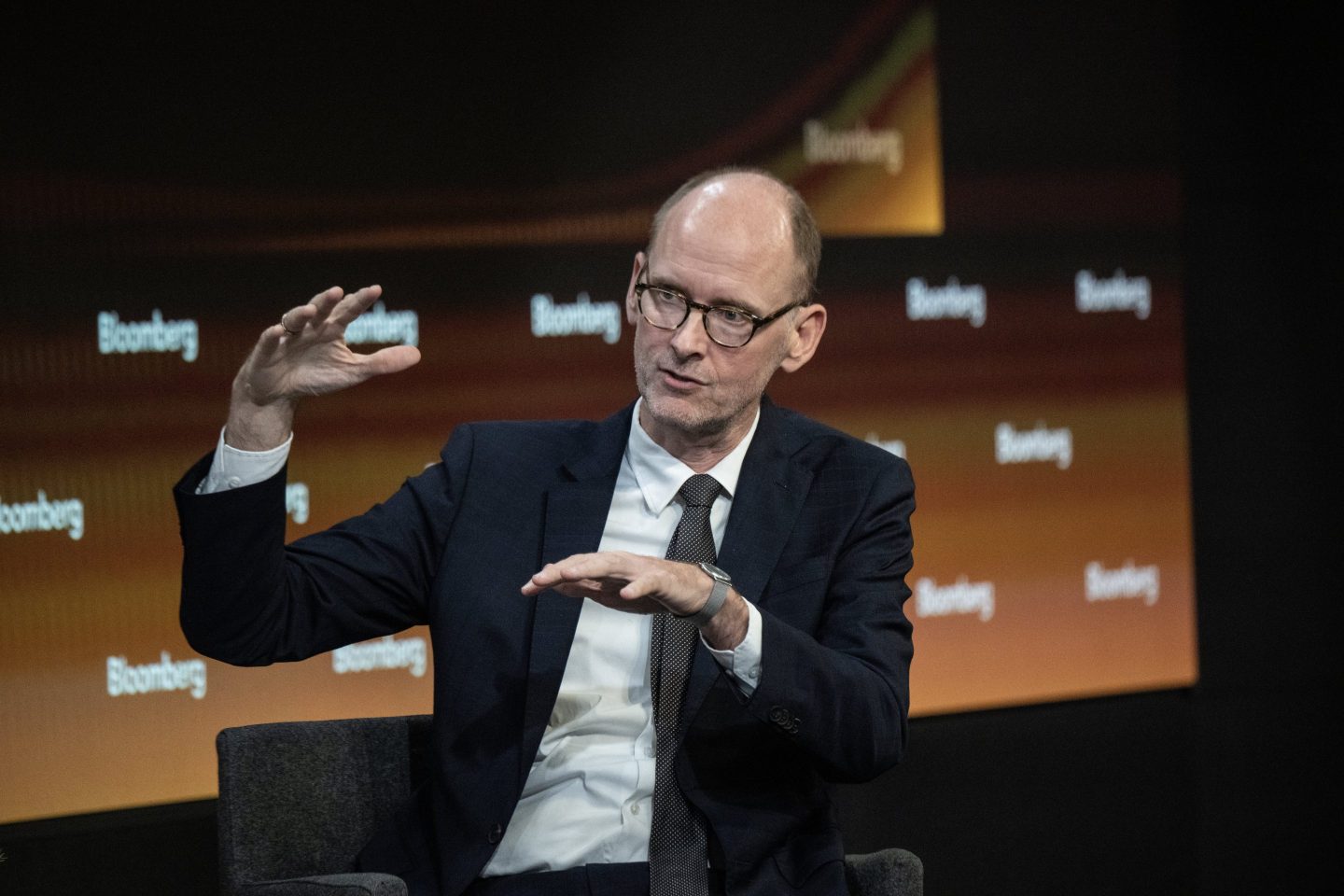
Backstage at the Sana AI summit at the New York Public Library on Thursday, Fortune’s Nick Lichtenberg spoke with top economist Tyler Cowen.
The George Mason University economist and Bloomberg columnist offers an alternative perspective on the job apocalypse AI is predicted to bring. The uncomfortable part for society when it comes to the emerging technology isn’t the loss of jobs, it’s the redistribution of status, he believes.
Cowen argues the biggest losers in the AI transition may not be blue-collar workers, but elite professionals: The Manhattan lawyers, strategy consultants, and finance partners who spent decades mastering a set of elite credentials and playing by the rules. “Those are actually the people who might lose,” he said. “The people who will win are the people who are best at taking initiative, figuring out how AI works, figuring out how agents work, doing something different,” including, Cowen suggested, workers in the developing world and immigrants who never had access to those rules in the first place.
Status loss, he argues, hits harder than income loss—especially for a professional class that has built its identity around intellectual mastery and institutional prestige.
FEDERAL RESERVE
Warsh’s plans for the balance sheet
With Kevin Warsh’s first Federal Open Market Committee (FOMC) meeting fast approaching, Goldman Sachs has been mulling one of the longer-term suggestions the incoming central bank chairman has made.
Warsh has long opined that the Fed’s balance sheet is too large and is causing market distortions, meaning it doesn’t function as well as it should. It’s a huge task to reduce the balance sheet, with ramifications for the Treasury and the bond market—both of which Warsh will be mindful to handle with care.
Goldman’s William Marshall wrote in a note seen by Fortune that he doesn’t expect much action in the short term: “We expect only modest expansion in the Fed's balance sheet until early 2027, after which we anticipate a return to a more trend-like growth of $300 billion per year to keep reserves steady around 11% of bank assets.
“While there are downside risks to this baseline, just keeping the balance sheet stable would likely see reserves steadily decline at a modest pace in outright terms and more swiftly as a share of bank assets.”
MORE FROM FORTUNE
- Inside the fraud-ripe feeding frenzy to snag Anthropic shares while the company remains private - by Allie Garfinkle
- Founder of Ms. Anti Work says her ‘lazy girl job’ allowed her to only work a few hours a day—and she built her media company on the side - by Emma Burleigh
- You wouldn’t put your entire 401(k) in one stock. Why are you doing it with your credit card points? - by Catherina Gioino
- Europe is considering price caps to control inflation. CEOs are shaking their heads in despair - by Kamal Ahmed
CHART OF THE DAY
Hybrid hangover
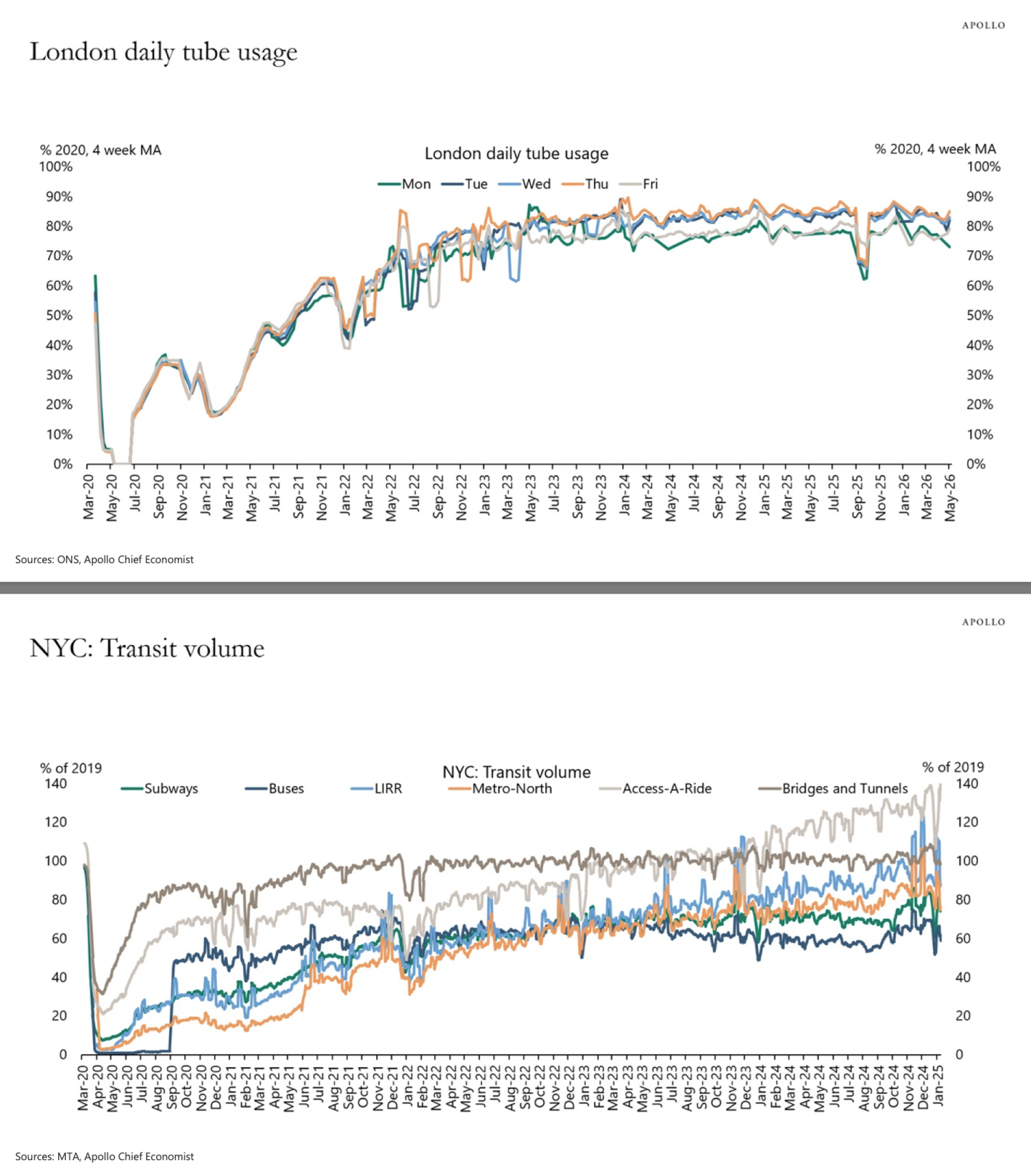
Hybrid work has cast a "permanent shadow” on transit services, writes Torsten Slok at Apollo. Rider levels on NYC public transport and the London tube have stabilized at around 80% of pre-pandemic levels.
This is actually ahead of the office occupancy average charted by Kastle Systems, which provides security services to 2,600 buildings in 138 U.S. cities. According to Kastle’s office occupancy barometer, the average occupancy rate of the top 10 cities in the United States is around 55%.
NUMBER OF THE DAY
3,000
‘Hell Grind,’ an AI-generated action-adventure film, premiered at Cannes this week. Of the $500,000 budget assigned to create the 95-minute feature, $400,000 went toward compute costs to generate the content, per the WSJ.
The film is the result of two weeks of work by San Francisco startup Higgsfield AI, which created the movie to demonstrate its technologies to Hollywood producers.
With every character, setting and prop generated by AI, the team had to be specific with their instructions: Each prompt, on average, was around 3,000 words long.
THE FRONT PAGES TODAY
- ‘Fast entry’ SpaceX, OpenAI and Anthropic IPOs to ignite Wall St trading frenzy - FT
- California’s Governor Signs A.I. Order Aimed at Protecting Workers - NYT
- Trump’s Envoy Gets Chilly Reception on First Trip to Greenland - WSJ
- U.S., Iran signal peace progress — but remain at odds over enriched uranium, Strait of Hormuz tolls - CNBC
ONE MORE THING
Cut hopes fading
Fed cuts are pretty much off the table, according to CME’s FedWatch barometer. Per the index, investors are pricing in a 97.2% chance of a hold at Warsh’s first Federal Open Market Committee (FOMC) meeting in a few weeks’ time.
Earlier this week, we mentioned Thierry Wizman at Macquarie’s note about Fed hawks, arguing Fed officials would need to sound unequivocally hawkish if the bond market is going to trust that the central bank is taking inflation seriously, following a bond market selloff.
Come the end of the week, “that's started to happen,” wrote Wizman in another note seen by Fortune—referencing remarks made by Anna Paulson at the Philly Fed. But Wizman adds: “To help stabilize bond yields, other Fed officials will need to follow with hawkish remarks in the next few weeks.”
There will be no newsletter on Monday because of the holiday. Enjoy the long weekend, and thanks for reading!