
Henry Luce, who founded Fortune in 1929 and its sister publication Life seven years later, used the pages of the latter in February 1941 to issue one of the most consequential editorial arguments in American journalism. He called it “The American Century.”
The promise of a “more abundant life,” Luce wrote, of “adequate production for all mankind,” is characteristically an American promise. The United States, he wrote, had both the power and the obligation to shape the coming era in its image—to export its prosperity, its institutions, and its economic model to a world that would be better for receiving them.
The pyramid he was implicitly describing—with American wealth at its apex, American workers as the global benchmark for middle-class life, and the developing world arrayed at the base, slowly, unevenly ascending—held its shape longer than almost anyone predicted. Being poor in America meant, by global standards, something closer to middling. A widely cited statistic by economists at Columbia and the Federal Reserve Bank of New York found that as recently as 2009, the poorest Americans sat near the 70th percentile of global income distribution, meaning a family below the U.S. poverty line was, by the world’s reckoning, solidly average. The American floor was that high.
This pyramid is not holding its shape any longer. And what is replacing it is something far more ambiguous—a geometry of genuine progress and radical instability that Luce’s framework cannot contain.
The diamond takes shape
The pyramid’s base never vanished, but its proportional weight in the global distribution has measurably contracted. The World Data Lab reported in 2025 the global consumer class now dominates worldwide for the first time, driven by industrialization across Asia, Latin America, and parts of sub-Saharan Africa. The Brookings Institution projects the global middle class will reach 5.3 billion by 2030—two-thirds of them in Asia, compared to a fraction of that in North America—the most dramatic geographic rebalancing of economic mass in recorded history.
The American Century has been inherited by the Asian middle class.
The middle, however, has done something harder to read. It has not collapsed, as the hollowing-out thesis of the 1990s predicted. But it has fractured. What was once a relatively undifferentiated broad middle class has stratified into tiers that no longer share the same economic logic: the asset-owning professional class, the high-earning-but-not-rich-yet (HENRY) younger worker, the service-economy backbone that earns more than its parents but owns less of the country with every passing decade. The diamond’s widest point has shifted upward—toward the upper-middle, the professional managerial class, the dual-income homeowner—leaving a longer, thinner stem below it than the shape suggests.
The numbers behind the shape
The UBS Global Wealth Report 2026, released Tuesday—the most comprehensive annual accounting of personal wealth across 56 markets, representing more than 92% of global wealth—puts precise numbers on the shape Luce’s century built and what it has become. Global personal wealth rose 10.8% in 2025, the fastest pace since 2017 and more than twice as fast as 2023 and 2024. Nearly 1 million new millionaires were minted. The proportion of adults worldwide holding less than $10,000 in wealth fell from nearly 75% in 2000 to just over 41% today. The base of the pyramid has genuinely contracted.
But the same report identifies what it calls “a fly in the ointment”: Median wealth—the wealth of the person sitting precisely in the middle of the distribution—actually declined in most of the 56 markets UBS tracks, even as the headline average surged.
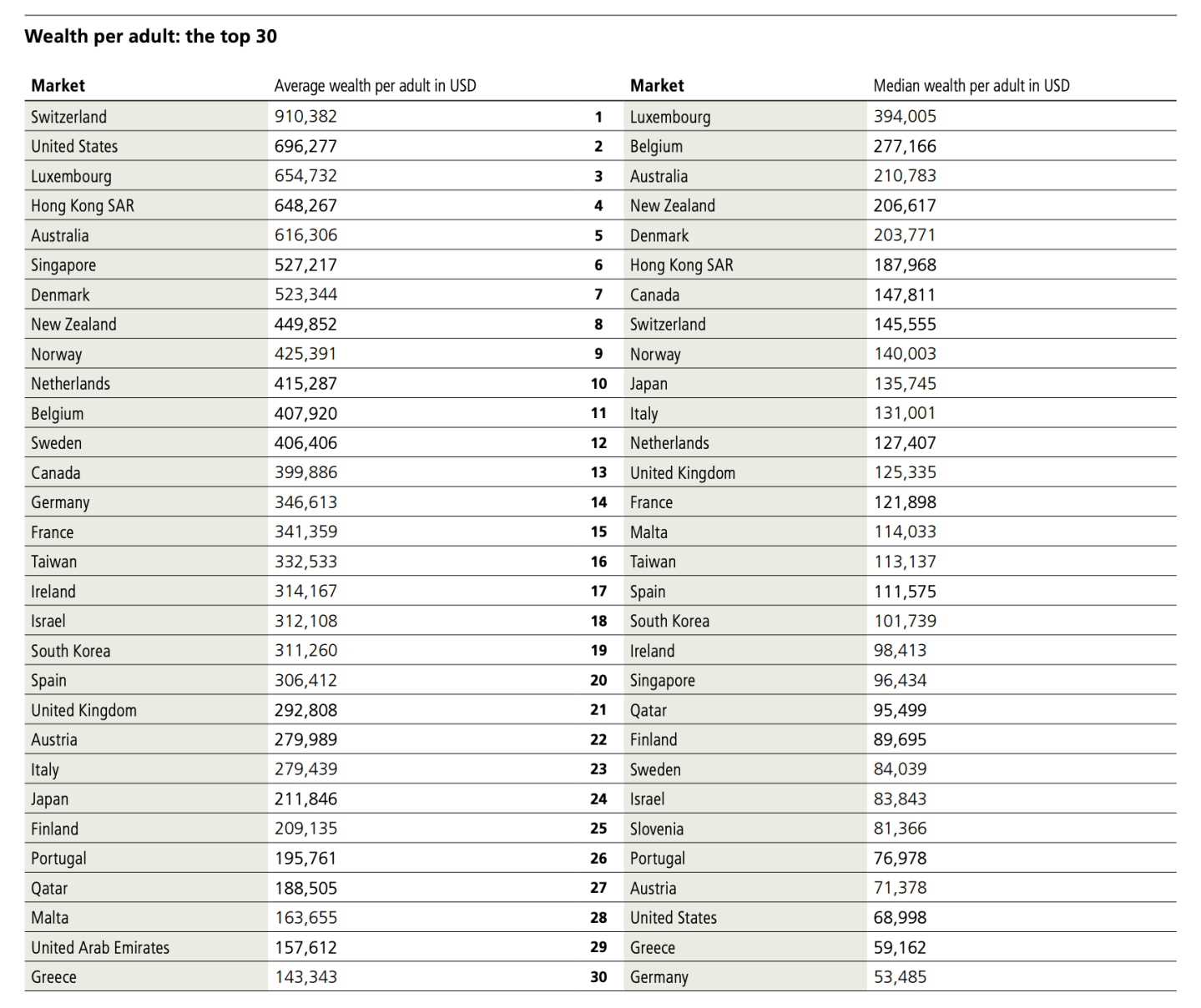
Nowhere is that gap more legible than in the U.S. The UBS data ranks America second in the world by average wealth per adult—$696,277, behind only Switzerland—and 28th by median, at $68,998. The so-called “Gini coefficient,” a common measure of inequality developed over 100 years ago by an Italian economist, for the United States is the sixth worst in the world at 0.77, behind only the UAE, Russia, South Africa, Brazil, and Saudi Arabia. The American floor is high on earnings and surprisingly hollow on ownership.
The spinning top
Then there is the apex.
The top of a diamond is meant to be a point—a narrow convergence. What the data now shows is something different: a concentration of wealth so extreme, and cycling through assets so rapidly, that it no longer behaves like a stable structural feature of the economy. It spins.
The UBS report documents this with unusual precision. The cohort it calls the “elder siblings” of last year’s big wealth trend: the “everyday millionaires” with between $5 million and $100 million in wealth. The elder siblings grew at double-digit rates in several key markets in both headcount and total assets in 2025. Since 2000, their collective wealth has compounded in real terms at 8.7% annually, more than double the 4% rate for everyday millionaires and many times the rate for median households. In mainland China, the $50 million–$100 million cohort has been compounding at nearly 31% annually since 2000.
The World Inequality Report 2026 found just 56,000 ultra-wealthy individuals—the top 0.001% — now control more wealth than the poorest 4 billion people on Earth combined, with their share of global wealth nearly doubling since 1995. That is a very skinny point on the spinning top: a mass of capital at the apex that is no longer accumulating in the traditional sense of building and holding, but rotating—between asset classes, between jurisdictions, between private and public markets—at a speed that outruns taxation, regulation, and, increasingly, measurement.
UBS chief economist Paul Donovan argues in the 2026 report the broadening of the midpoint of the diamond is a more significant trend than the skinny point up top, but acknowledges “wealth inequality is becoming more visible under the glare of the social media spotlight.” He adds governments are likely to seek to mobilize wealth to lower the cost of debt finance.
Donovan told Fortune that it is widely accepted that the U.S. has a less equal distribution of income and wealth than most other advanced economies. “There is a concentration of equity wealth into the very highest wealth and income cohorts, which means that periods of strong equity performance (as just witnessed) will widen the gap between the two.”
This large global middle class—increasingly made up of asset-owning, professionally credentialed workers—generates a political economy of stakeholding rather than solidarity. The fat part of the diamond owns index funds and 401(k)s, has a mortgage and a retirement account—something to protect. Its economic interests have more in common with the spinning top above it than with the base below.
One concern is whether this starts to break down, Donovan told Fortune. “Rising house price to income ratios have prevented younger people from participating in housing as early as they would wish,” he acknowledged, and many have responded by holding more financial assets (even in very low-risk holdings like bonds and cash) to save more money for a deposit. “However, if buying a house is beyond the reach of a younger person (and real estate ownership is only likely through inheritance), behaviour shifts,” Donovan warned, sometimes the desire to save disappearing entirely. “You can go back to Japan in the 1990s to see this for instance. In this case the younger generation may choose to consume, or they may chose to ‘gamble’ or speculate rather than to invest in a conventional way.”
But Donovan said this dynamic — the decline of the American century as the global middle class rises — shouldn’t lead to an exodus of wealth, saying that wealth movement tends to be “greatly exaggerated.” The number of “nomadic wealthy, and their relative economic importance,” he said, is relatively small, noting that most people have a variety of local ties including social, familial, linguistic, and cultural – “treatment of wealth is only one factor.” Once people do become nomadic, though, they are likely to stay that way. “If those other ties have been severed, they are not normally reestablished in the new location.”
[This report has been updated with additional comments from UBS Chief Economist Paul Donovan.]