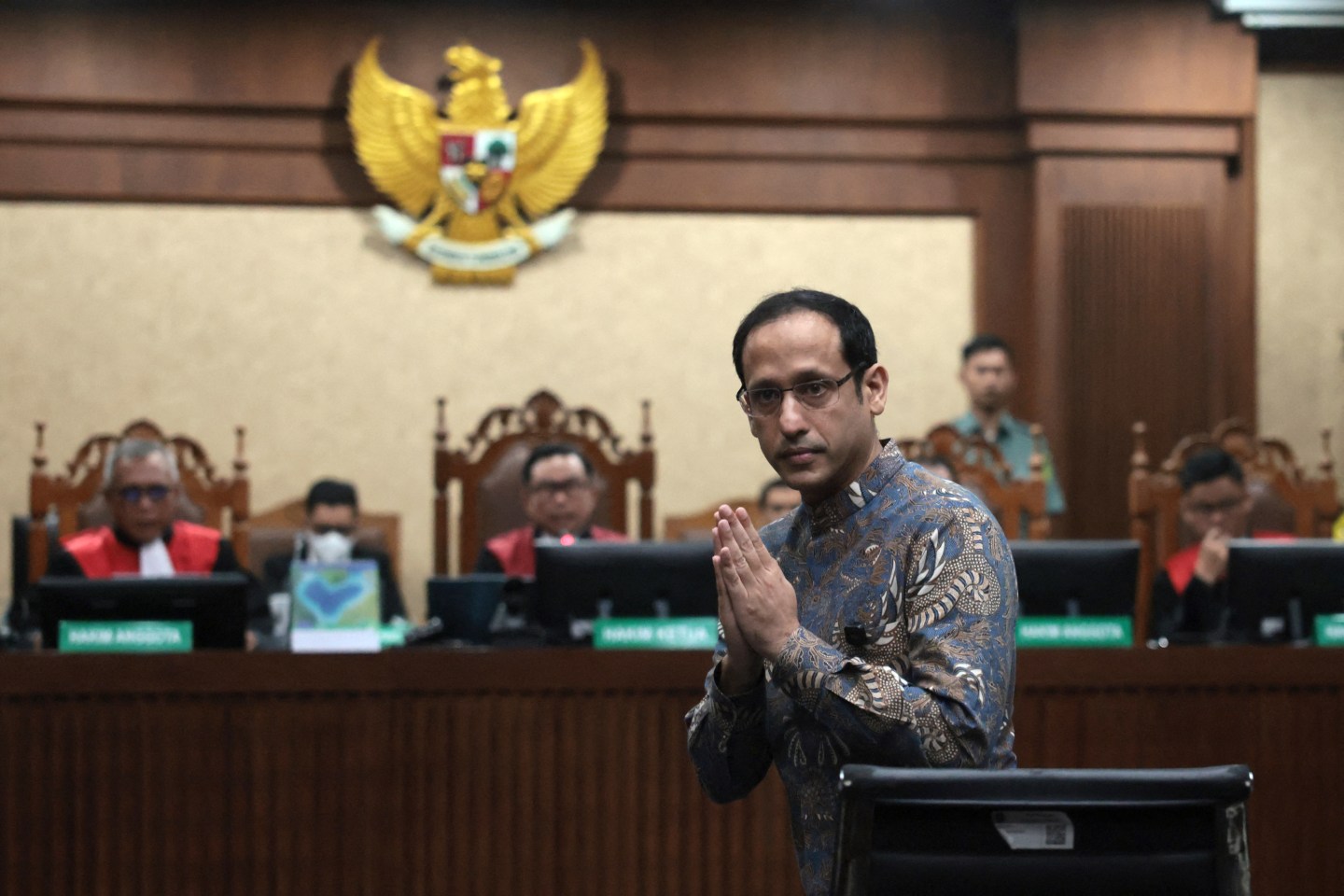
Former Indonesian Education Minister and Gojek co-founder Nadiem Makarim was found guilty of corruption over a pandemic-era procurement of Chromebooks for schools, a ruling likely to add to investor concerns about how Southeast Asia’s largest economy distinguishes graft from disputed policy and business decisions.
In a split decision, the Corruption Court at the Central Jakarta District Court on Tuesday sentenced Makarim to 10 years in prison, lower than the 18 years sought by prosecutors.
Judges, reading from parts of a more than 1,100-page decision, said they found Makarim guilty of a subsidiary charge related to abuse of authority, but that prosecutors had failed to prove a more serious primary charge related to self-enrichment.
They ordered Makarim to pay a 1 billion rupiah fine and 809.5 billion rupiah ($45.2 million) in restitution, or face an additional five years in prison. Prosecutors had sought about 5.7 trillion rupiah.
Makarim, 41, was charged in relation to a decision to purchase more than a million Chromebooks and device-management software for schools from 2020 to 2022. Prosecutors accused him of overpaying for laptops and software, ignoring internal evaluations, and favoring Chromebooks because of Google’s investment in his former company, while alleging he received a benefit valued at about 809 billion rupiah.
Makarim denied all charges, arguing that the prices paid were below market and that the internal evaluations were outdated and at odds with the urgent demands of schooling during the Covid-19 pandemic. His lawyers also argued the alleged gain reflected standard pre-IPO administrative restructuring and never flowed to him personally.
Google was not charged in the case.
Makarim was greeted ahead of the hearing by dozens of supporters, many of them Gojek drivers wearing the company’s signature green jackets. The Harvard Business School graduate wiped away tears as supporters offered prayers, embraced him and shook his hand. Some sang in Indonesian: “Free Nadiem now.”
Inside the courthouse, Makarim, dressed in a batik shirt, sat before the panel of judges for more than four hours as they read out their decision. Shortly after the verdict, he told media and supporters that he didn’t have funds to pay the financial penalties and thus was facing 15 years in prison.
“I no longer know what words to say,” he said. “Everyone says there was no element of corruption in this. I no longer know whom to turn to for help.”
He said he would appeal the ruling.
Prosecutor Corneles Geeb Paulus Heydemans said judges found that Makarim had abused his authority and caused losses to the state.
The case has been viewed as a test of legal certainty in Indonesia, where a series of recent graft rulings have raised questions over whether disputed policy choices and business risks can later be treated as criminal acts.
Former executives of state-backed venture capital firms recently were sentenced over failed investments in agritech startup TaniHub, a case critics say criminalized standard market risk. Also contentious was last year’s jailing of former Trade Minister Thomas Lembong over sugar import permits a decade ago despite no evidence of personal financial gain. He was ultimately released after President Prabowo Subianto granted abolition.
Wijayanto Samirin, an economist and lecturer at Paramadina University, said the penalties handed to Makarim are “far more reasonable” than the prosecutors’ demands, “although many people had hoped for an even lighter sentence or full acquittal.”
“This decision is likely to have an impact on investor appetite to invest in projects related to the public sector,” he said, adding that it also risks discouraging “many talented young people from pursuing careers in public service.”
Makarim, who left Gojek in 2019 to join the cabinet under then President Joko Widodo, has warned that the case could deter professionals from entering public service and spook investors worried about legal uncertainty in Indonesia.
In handing down the verdict, the judges said his actions ran counter to Indonesia’s anti-graft efforts and were carried out systematically, while noting as a mitigating factor that the former minister had no prior criminal conviction.
Associate Judge Andi Saputra, who offered the sole dissenting opinion in the decision and called for acquittal, said the case offered no proof of malicious intent, wrongdoing or any indication of a conflict of interest.
“Although there were meetings with Google officials, they were held at the ministry’s office and conducted openly and transparently,” he said. “The meetings cannot be seen as an initial indication of a conflict of interest.”