
I’m 42; Samuel Moyn is 54. When we talked about his new book, Gerontocracy in America, it felt less like an interview than a conversation between two people who’ve learned to live with the price of telling older, richer people something they don’t want to hear. Maybe Moyn was trying to give me advice when I asked him to describe what it’s like to write non-fiction that leaves a mark.
“I tend to write books that get a lot of blowback,” said the Yale law and history professor, clad in a navy-blue, school-branded T-shirt, zooming into the call from the wood-paneled head of college office in New Haven. He noted that a friend of his even told him he is always “antagonizing people,” but “this is on a different level.”
The fights have tended to be “smaller” and “more scholarly” than what he calls the oldest, richest class of citizens in the history of the world. “But I’m kind of a gadfly,” he shrugged. “That’s my career.”
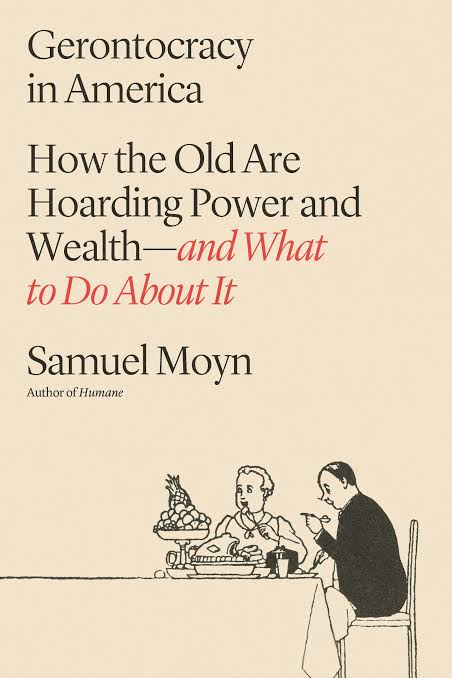
It’s because Moyn has written what may be one of the most polarizing political books of the year: an indictment of America’s quiet slide into generational inequality, in which older, disproportionately wealthy voters and homeowners shape the economy — and America’s democracy — to their advantage while insisting they’re really the ones who are under siege. His core argument is simple and backed with data: “the rich today are old, to an astonishing extent.”
As Moyn writes in his introduction, “an aging society is more set on preservation than on renovation,” and he suggests that we have “long been drifting into an unsuspected form of rule … a new kind of society that privileges many older Americans— to the detriment of all, including many senior citizens themselves.” This is what he calls “gerontocracy in America.”
“What I decided,” Moyn told me, with a slight smirk, “was that the cause which I deeply believe in, of intergenerational justice, had been taken over by folks who read Fortune magazine.” It’s a typically provocative statement from the man who was once, ironically, the Henry R. Luce professor at Yale, a seat named for Fortune‘s very own founder.
Boomers choking the economy—and why it hurts to hear it
In my inbox, the backlash to what I view as honest, data-backed generational reporting has been intense. After I reported several months ago on Steven Ruggles’ academic research likening the Baby Boomer generation to a “pig in the python” of American demography, I just had to follow up with a letters column because of the extraordinary responses.
“I apologize for not dying soon enough for you, so your generation can pick over my financial bones,” one wrote to me. Another posed an absurd rhetorical question: “Are you suggesting putting boomers on ice floes or turning them into Soylent green?” Many older readers read accusation between the lines and responded as if I’d blamed them personally for an objectively true situation of stagnant wages, high home prices, and soaring national debt and entitlements.
Social psychologists call this “symbolic threat”: the sense that another group is attacking your values and identity, even when the argument is about material facts. The more I focused on data—wealth by age, housing shares, bottlenecks in promotion—the more some boomers told me they felt confused, angry, sad, and insecure, and lashed out at me (“whiny”) as if I was blaming them personally for every problem in the economy.
Moyn has watched the same dynamic play out at a much higher volume. He told me he’d “gotten a lot of rage” and discovered an unlikely outlet for it: LinkedIn. “I had not known that LinkedIn was really a site where there were a lot of just like, senior citizens, you know, spewing out hatred,” he said. The intensity was such that he’s since stayed off it entirely. “It’s been extraordinary.”
The site is full of what Moyn called “senior advocates,” and he argued that they are, for the most part, “not willing to talk objectively” about the reality of gerontocracy. He even revealed darkly that he’s facing organized opposition — a first for this particular gadfly. “I haven’t in my career had whole campaigns organized against me, which has happened with this book in certain ways.”
A friend offered a theory: “Sam, you’re taking on the most powerful group in world history.” Moyn’s response: “It’s kind of true. It’s like a David-and-Goliath situation. But, you know, David can lose.”
The richest old people in history—and the denial that follows
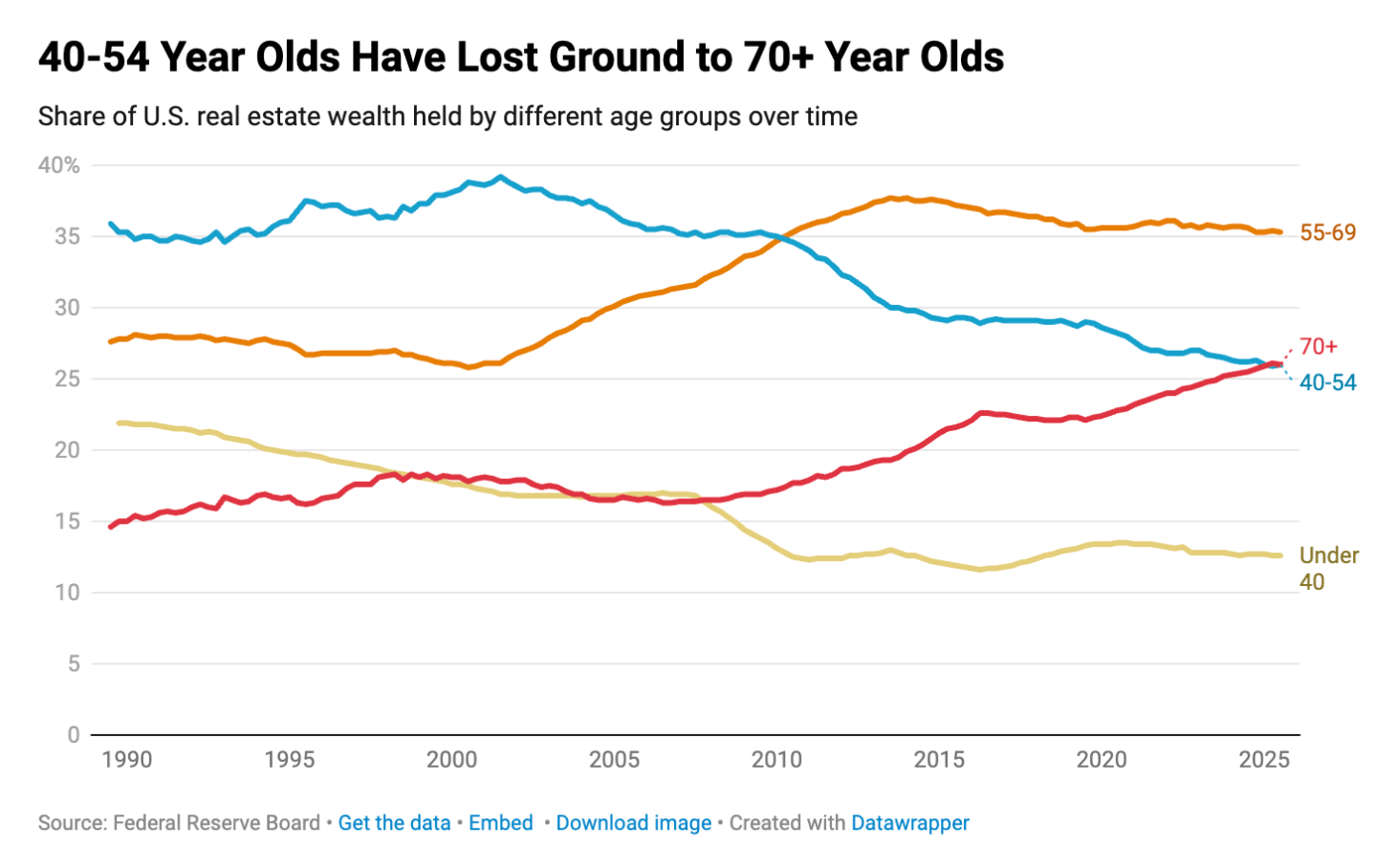
The scale of America’s age skew is staggering. Visa recently estimated that Boomers hold more than half of American wealth — about $93 trillion in assets (with Federal Reserve data putting all household net worth at $174 trillion). In terms of real estate, Americans 70 and older hold 26%, more than prime-earning adults aged 40 to 54 for the first time ever, Redfin calculated in March.
Moyn’s book noted that “aging Americans control the biggest bank accounts and stock portfolios… In our time, the old rich have pulled away from everyone else,” with households headed by people older than 65 boosting their median net worth by roughly 42% in the early 2000s while the wealth of families of adults 18 to 34 fell by a whopping 68%. If America is an oligarchy, he writes, it’s also an “oldigarchy.”
What surprises Moyn is how many people rebel against the hard truth of numbers. He has a simple rebuttal for those who say America isn’t a gerontocracy: “We have a branch of government literally named after old men,” he said, citing an etymological finding from his book: “Senate. Council of Elders.” (Technically, it derives from the Latin word senatus, which is rooted in senex, meaning “old man” or “elder.”) I reported in May that Boomers make up 43% of Congress and hold 61% of Senate seats, a remarkable display of gerontocracy in action.
“My goal was not to be popular,” Moyn said, “but to start a conversation,” and he feels he’s done that by identifying a new kind of reverse ageism that people don’t want to admit. “If I say there’s something called gerontocracy, I get gerontocracy denialism because people think, well, older people have always been the most oppressed.” His answer: scoreboard. “Plus, if you are older, there’s every incentive to claim the posture of victim.”
Meritocracy traps and senior citizens homes
For Moyn, the gerontocracy story started close to home, when he became a Yale Law professor in his 40s and was stunned by how unproductive his old colleagues were. As he notes in his book, Yale Law School’s “golden age for intellectual breakthroughs and practical influence alike” was in the 1930s, when the average age of regular faculty was just under 43 years, a figure that remained roughly the same through the 1980s. By the 2010s, though, he found that it had leaped to almost 57, something he calls “the graying of the professoriate.”
Moyn told me bluntly that “certain of my colleagues … were overstaying their welcome,” and he noted in his book that the 1930s had only one professor over 65 and none over 70, but Yale’s faculty started skewing older when mandatory retirement was lifted. The same age ranges in the faculty have since grown to 33% and 15% of faculty, respectively, he calculated. “It was just sad to watch them hang on,” he said of his older colleagues,” and I resolved myself not to let that happen to me.” He added that his book is part of a tradition he wants to keep alive. “We’re supposed to be free thinkers and challenge conventional pieties.”
Moyn smiled when I compared his new book to The Meritocracy Trap by his colleague Daniel Markovits, a similarly impassioned tome about a fraying social contract. Markovits’ insight was that nobody was a winner in the 21st-century U.S. economy, not even the winners, as the promise of opportunity through hard work has become a treadmill that has exhausted strivers and entrenched incumbents.
“He’s one of my best friends,” Moyn said, adding that Markovits had a “big impact” on Gerontocracy, beyond serving as a key inspiration; he even uses the phrase “gerontocracy trap” in his book, a deliberate echo. Where Markovits mapped how meritocratic competition grinds down the highly educated, Moyn maps who benefits most once the grinding is done—older elites who sit atop law schools, newsrooms, and corporate hierarchies, often long past their intellectual prime.
In the corporate sector (and certain newsrooms), I’ve heard versions of the same story. Millennial managers have told me they feel stuck, watching a layer of older executives who won’t move on and a restless entry-level desperate for support. The “lump of labor fallacy” is real in the aggregate, Moyn allows, but anyone who’s ever felt their progress blocked knows, deep in their bones, that it isn’t true in particular.
Moyn said he’s been having an active debate with friends in the Yale economics department about this: “they’re right in some domains and sectors and not others.” That’s why he suggested in the book going sector by sector through the economy and seeing where it’s, well, lumpy. In fields such as academia and journalism, the old cliché that you have to wait for someone to die to get the job you want isn’t entirely a joke. “There are a lot of people waiting for jobs further up the apex. And those also are finite.”
We talked about how this plays out within families, too. In wealthy clans, adult children often wait until their 40s or 50s to inherit a house or portfolio, long past the ideal time to deploy that capital. That dynamic is at the heart of HBO’s Succession, which Moyn calls “a parable of America.” “We have this syndrome even within wealthy families of folks waiting around on their parents to inherit them,” he told me. “It’s so late. It’s the wrong time in life for people to come into their house or their wealth.” The series struck a nerve, he thinks, because it speaks to something many people have lived—“being reduced to, in a sense, being infantilized by the old.”
Old voters, young cynics
The issue that Moyn keeps returning to — and that has provoked the most criticism — is political. “It’s not okay that older people monopolize elections,” Moyn said, “especially boring elections.” In his book, he labels the AARP the “best‑funded advocacy group in world history.”
Moyn told me that his book is even a victim of a similar dynamic. “I thought there would be more youthful enthusiasm for the book,” he said, “but of course, [the] youth don’t read books.” His college-age daughters anticipated this, he said, adding that they may help him adapt it to some kind of TikTok series. “They’ve said they would do that eventually … But you know, all you can hope is an author is the facts and the views kind of percolate. And, you know, hopefully they’ll percolate into social media.”
Moyn said much of the criticism has been about his proposed solutions and that he was deliberately provocative with some of them—inflating the weight of younger people’s votes, even expropriating some older wealth. His more conventional proposals, he pointed out, are similarly outlandish in today’s climate: just raising taxes.
Moyn told me he sees Gen Z’s political posture as “passive and resigned,” beaten down by the intense power and wealth held by the oldest members of their society. Old people ignore this and embrace denialism at their peril, he added. “I think young people are alienated from democracy, and that could lead them to move to the far right; it could lead them to move to the far left, but they’re not voting.”
Gen Z sees a political agenda shaped by older voters’ shorter-term concerns and concludes that the game is rigged. He invoked the (millennial-coded) John Mayer song “Waiting on the World to Change.” The real message of the song, in Moyn’s reading, is a younger generation’s reply to accusations of passivity: you’re making us wait, so why wouldn’t we stand at a distance to your handiwork and just wait for you to die? “That’s literally what’s happening in America,” he said. “I think they’re largely resigned; they see that the issues that politicians and older voters prioritize are not their issues.” The younger generation, he added, “just don’t feel our political system is up to the challenge of what they’ll be living through. And I think they’re right.”