JPMorgan Chase CEO Jamie Dimon warned that the U.S. has fallen dangerously behind on shipbuilding, creating a massive shortage of skilled workers—and a lucrative opportunity for young Americans looking for AI-proof, high-paying jobs.
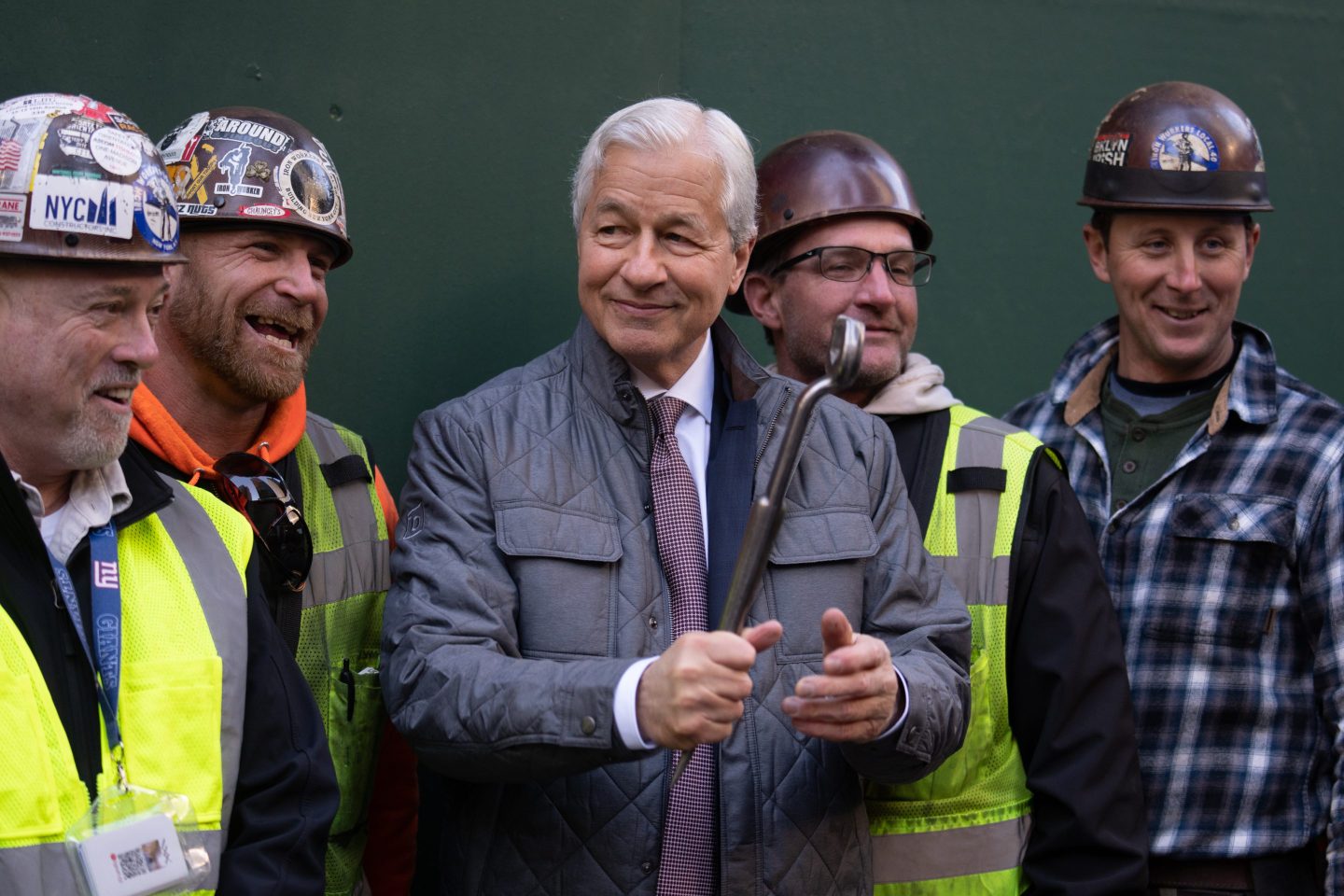
“We need 300,000 electricians, welders, etc. to build ships in the next five or 10 years,” Dimon told CNBC on Tuesday, speaking from the Philadelphia Navy Yard.
Unlike many traditional white-collar career paths, skilled trades apprenticeships often pay workers while they train—putting them on a path to six-figure salaries without taking on college debt.
“It fits what we call the American dream: getting kids skills or all workers’ skills that they have jobs that could pay 80-, 90-, $100,000 a year after you know a year or two of training. This lifts up America. It helps build the defense industry,” Dimon added.
The Philadelphia Navy Yard alone currently employs about 16,000 workers, but Dimon said that workforce could double over the next five years as domestic shipbuilding ramps up.
To help fuel that growth, JPMorgan announced a $24 million investment through loans and philanthropic grants to support a new submarine manufacturing and assembly facility expected to create 450 permanent jobs. The funding will also expand workforce training and apprenticeship programs for “thousands” of prospective welders, electricals, pipefitters, and other skilled trades workers needed at the Navy Yard.
The U.S. can’t catch South Korea without more skilled workers
Joining Dimon was Pennsylvania Sen. David McCormick—husband of Meta president Dina Powell McCormick—who argued that while artificial intelligence has fueled fears about the future of white-collar work, demand for skilled trades has never been stronger.
“If you’re an experienced welder or electrician, we can’t get enough of you,” he said. “We have to have [a] workforce that meets this incredible demand.”
But Philadelphia embodies the uphill battle the industry faces. The yard was purchased by Hanwha, a South Korean ship manufacturer, in 2024 for $100 million and currently only delivers one to one-and-a-half ships per year. In South Korea, ships are delivered “basically one a week,” according to the CEO of Hanwha Philly Shipyard, David Kim. The apprenticeship can also accommodate only about 20 trainees at a time, compared with roughly 400 simultaneously at Hanwha’s facilities in South Korea.
Workforce struggles extend well beyond Pennsylvania.
In the Hampton Roads region of Virginia, there is an estimated shortage of 10,000 shipyard workers, which is expected to grow to 40,000 by 2030, reported WHRO.
At Huntington Ingalls Industries—an American shipbuilding company that operates major yards in Newport News, Virginia and Pascagoula, Mississippi—over $110 million is invested annually in workforce development. And according to CEO Chris Kastner, it’s becoming a growing priority.
“We hired over 1,600 shipbuilders in the first quarter,” Kastner said during HII’s 2026 Q1 earnings call in May. “We also graduated nearly 200 apprentices from our apprentice schools this year, and our apprentice schools are now at full enrollment. I’m confident that as our workforce continues to stabilize, our workforce will become more proficient.”
Meta, Lowe’s and BlackRock are investing hundreds of millions into the skilled trades—and presenting Gen Z with opportunity
Shipbuilding is just one sector eager for skilled workers. But as demand surges in construction, including energy projects, AI data centers and semiconductor facilities, many companies are now pouring hundreds of millions of dollars into training the next generation of electricians, plumbers, machinists, and more.
Earlier this year, Lowe’s announced a $250 million commitment to help train 250,000 skilled trade workers in fields like plumbing, carpentry, and electrical work over the next decade. Investment firm BlackRock similarly put up $100 million in an effort to train 50,000 workers over the next five years.
Meta also entered the effort in June, with the launch of a $115 million training program called America’s Workforce Academy. The effort seeks to specifically train data center technicians, and after completing the 5-week program, a job is guaranteed on one of Meta’s sites.
“America needs hundreds of thousands of skilled tradespeople—electricians, mechanics, fiber technicians, and more—and this program creates clear, accessible pathways into those careers,” Rachel Peterson, Meta’s vice president of data centers, said at the time.
The stakes go beyond one individual company or sector. By 2030, an estimated 2.1 million skilled trades jobs could go unfilled, according to an analysis of U.S. Department of Education data by JLL. And the economic losses could reach $1 trillion annually.
For Gen Z entering an economy reshaped by AI, the shortages present an unusual opportunity: stable, high-paying work that can’t easily be automated. And as Dimon put it, give young people hope that the American Dream might be back in their grasp.