• Home
  • Latest
  • Fortune 500
  • Finance
  • Tech
  • Leadership
  • Lifestyle
  • Rankings
  • Multimedia

Exclusive

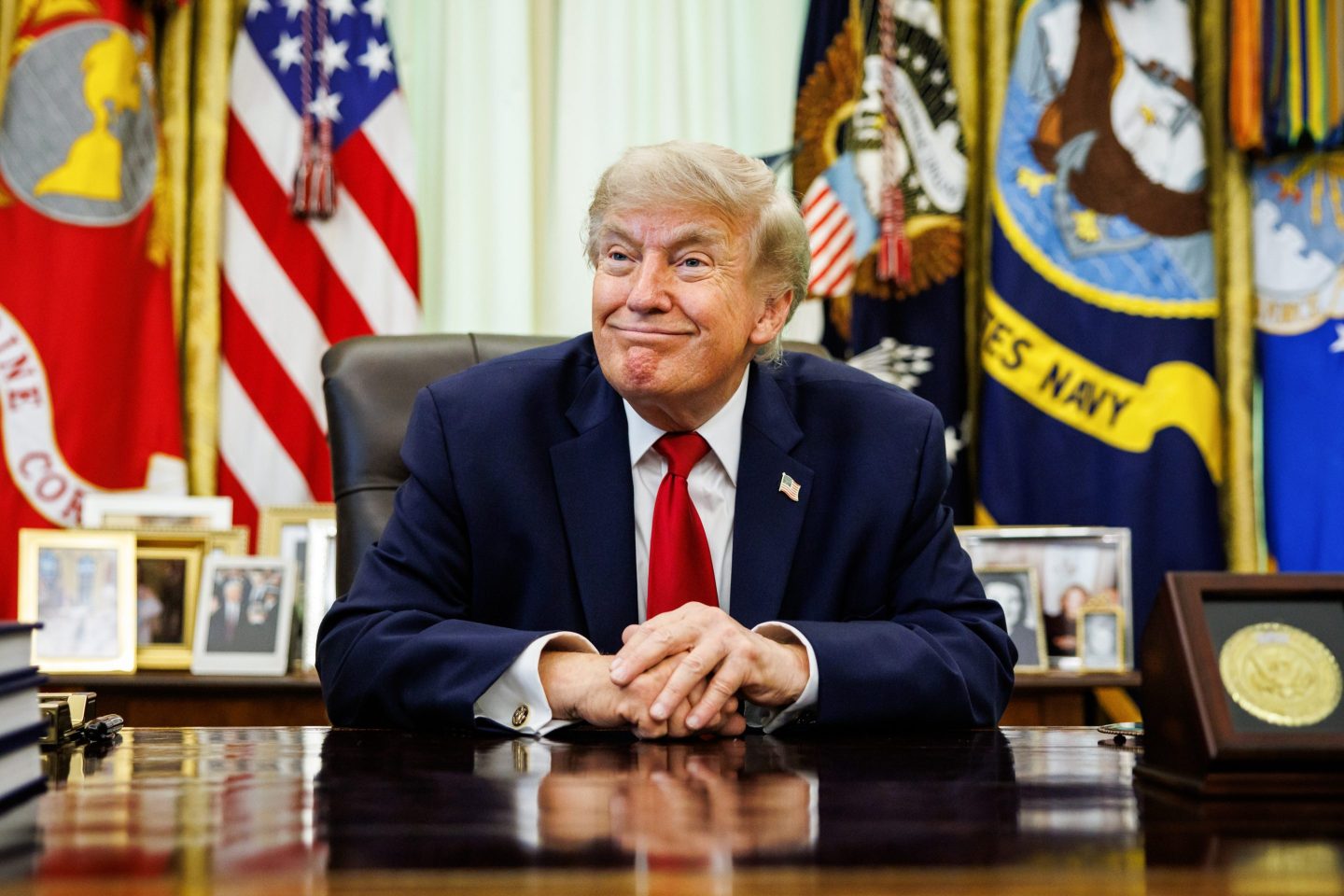
An hour in the Oval Office with President Trump.

An hour in the Oval Office with President Trump.

An hour in the Oval Office with President Trump.

An hour in the Oval Office with President Trump.

An hour in the Oval Office with President Trump.

An hour in the Oval Office with President Trump.

An hour in the Oval Office with President Trump.

An hour in the Oval Office with President Trump.

An hour in the Oval Office with President Trump.

An hour in the Oval Office with President Trump.

Techdeepfakes

Facebook says it’s made a big leap forward in detecting deepfakes

Jeremy Kahn
By
Jeremy Kahn
Jeremy Kahn
Editor, AI
Down Arrow Button Icon
Jeremy Kahn
By
Jeremy Kahn
Jeremy Kahn
Editor, AI
Down Arrow Button Icon
June 16, 2021, 12:00 PM ET

This is the web version of Eye on A.I., Fortune’s weekly newsletter covering artificial intelligence and business. To get it delivered weekly to your in-box, sign up here.

Researchers at Facebook and Michigan State University say they have made a leap forward in detecting deepfakes, the realistic-looking images created by artificial intelligence that many fear could be used in disinformation campaigns.

Social media companies, including Facebook, as well as academic researchers, have been trying for several years to find ways to automatically spot deepfakes. But the fake photos and videos are often extremely difficult for humans to detect, although trained digital forensics experts can frequently spot them by meticulously inspecting the images for subtle anomalies.

For many researchers the obvious solution has been to use A.I. itself to catch these A.I.-generated fakes. But to date, reliable deepfake-spotting software has remained elusive. In a contest Facebook ran in 2020 to find the best deepfake detector, the winning software was accurate less than two-thirds of the time.

But now, in a blog post and a paper posted online, the research team from Facebook and Michigan State say they have created a system that, at 70% accuracy on a key benchmark test, is significantly better than any previous system that ingested whole still images or video frames for examination. The system was also only 1% less accurate than the best previous method overall. But that earlier top-performing system examined images pixel by pixel, instead of frame by frame. As a result, it consumed far more computer power than the system Facebook and Michigan State scientists created.

Critically, unlike many rival deepfake detectors, the researchers said, their approach should be able to uncover deepfakes created using methods its detection algorithm has never even encountered before in its training.

The method the scientists used to build their detector is somewhat counterintuitive. Rather than asking an algorithm to simply determine whether an image is real or a deepfake, they essentially assume the image is a deepfake and ask their algorithm to reverse engineer key aspects of the A.I. software used to create it. For instance, the algorithm must predict the number of layers in the neural network (a kind of machine-learning system loosely based on the human brain) that was used to create the image. It also looks at how these layers are arranged and at the mathematical formula that the A.I. creating the image used to optimize what it produced.

By learning to make accurate predictions about the technology used, the software can essentially create a “fingerprint” of that system. Once the algorithm knows this fingerprint, another piece of software layered on top of that algorithm’s output can try to match the fingerprint to the fingerprints of other videos or images. In this way, the software can attribute a deepfake to a particular known method for generating them, or, at the very least, tell researchers that a deepfake of, say, Tom Cruise, and another of Meryl Streep were likely created using the same software, even if it has never seen a deepfake made with that software before.

This is not that dissimilar from how the FBI once used subtle differences in how different mechanical typewriters render text to determine which brand and model of typewriter was used to compose a ransom note.

What’s more, a certain fingerprint will allow the system to predict that the video is, in fact, not a deepfake at all, but genuine.

Tal Hassner, a Facebook researcher who worked on the project, says that, at first, he doubted it would be possible to teach an A.I. system to make accurate predictions about the inner workings of the technology used to create an image just by examining the image itself. “It wasn’t apparent to me why this would work,” Hassner says. “But it turns out, to my personal surprise that, yeah, you can say something about the design of the model used to create this image just by looking at the image.”

Hassner says the research took inspiration from prior work by a Michigan State computer scientist who collaborated on the project, Xiaoming Liu. Liu had studied the subtle differences between images taken with different brands and kinds of digital cameras. He built machine-learning systems that could analyze images and determine, with a high degree of accuracy, the type of camera used to take that particular picture.

The Facebook scientist said that for the moment the deepfake detector and analyzer the team built is purely a research project, with no immediate plans to use the system across the company’s social media platforms to detect potential deepfakes. He said he was interested in seeing how the system performed against images or videos where only part of the image is created using a deepfake and the rest is real, or where there has been extensive postproduction work applied to the deepfake using more traditional digital video editing technology.

But in the past, these kinds of innovations have often found their way into Facebook’s production systems in relatively short order. The company has not revealed whether it currently uses automated software to try to detect deepfakes uploaded to either Facebook or Instagram.

Microsoft unveiled a commercial deepfake detection tool in September last year, which it calls Video Authenticator, that analyzes video frame by frame and provides a score of how confident the software is that the frame is either genuine or A.I.-generated. The company made the tool available to organizations monitoring the 2020 U.S. elections, including media outlets and political campaigns. Microsoft said the tool had a “high degree of accuracy” but has not disclosed exact figures on how well it has performed against benchmark tests.


Subscribe to Fortune Daily to get essential business stories straight to your inbox each morning.
About the Author
Jeremy Kahn
By Jeremy KahnEditor, AI
LinkedIn iconTwitter icon

Jeremy Kahn is the AI editor at Fortune, spearheading the publication's coverage of artificial intelligence. He also co-authors Eye on AI, Fortune’s flagship AI newsletter.

See full bioRight Arrow Button Icon

Latest in Tech

Finance
Lorem ipsum dolor sit amet, consectetur adipiscing elit, sed do eiusmod tempor incididunt ut labore et dolore magna aliqua. Ut enim ad minim veniam
By Fortune Editors
October 20, 2025
Finance
Lorem ipsum dolor sit amet, consectetur adipiscing elit, sed do eiusmod tempor incididunt ut labore et dolore magna aliqua. Ut enim ad minim veniam
By Fortune Editors
October 20, 2025
Finance
Lorem ipsum dolor sit amet, consectetur adipiscing elit, sed do eiusmod tempor incididunt ut labore et dolore magna aliqua. Ut enim ad minim veniam
By Fortune Editors
October 20, 2025
Finance
Lorem ipsum dolor sit amet, consectetur adipiscing elit, sed do eiusmod tempor incididunt ut labore et dolore magna aliqua. Ut enim ad minim veniam
By Fortune Editors
October 20, 2025
Finance
Lorem ipsum dolor sit amet, consectetur adipiscing elit, sed do eiusmod tempor incididunt ut labore et dolore magna aliqua. Ut enim ad minim veniam
By Fortune Editors
October 20, 2025
Finance
Lorem ipsum dolor sit amet, consectetur adipiscing elit, sed do eiusmod tempor incididunt ut labore et dolore magna aliqua. Ut enim ad minim veniam
By Fortune Editors
October 20, 2025

Most Popular

Finance
Lorem ipsum dolor sit amet, consectetur adipiscing elit, sed do eiusmod tempor incididunt ut labore et dolore magna aliqua. Ut enim ad minim veniam
By Fortune Editors
October 20, 2025
Finance
Lorem ipsum dolor sit amet, consectetur adipiscing elit, sed do eiusmod tempor incididunt ut labore et dolore magna aliqua. Ut enim ad minim veniam
By Fortune Editors
October 20, 2025
Finance
Lorem ipsum dolor sit amet, consectetur adipiscing elit, sed do eiusmod tempor incididunt ut labore et dolore magna aliqua. Ut enim ad minim veniam
By Fortune Editors
October 20, 2025
Finance
Lorem ipsum dolor sit amet, consectetur adipiscing elit, sed do eiusmod tempor incididunt ut labore et dolore magna aliqua. Ut enim ad minim veniam
By Fortune Editors
October 20, 2025
Finance
Lorem ipsum dolor sit amet, consectetur adipiscing elit, sed do eiusmod tempor incididunt ut labore et dolore magna aliqua. Ut enim ad minim veniam
By Fortune Editors
October 20, 2025
Finance
Lorem ipsum dolor sit amet, consectetur adipiscing elit, sed do eiusmod tempor incididunt ut labore et dolore magna aliqua. Ut enim ad minim veniam
By Fortune Editors
October 20, 2025
Fortune Secondary Logo
Rankings
  • 100 Best Companies
  • Fortune 500
  • Global 500
  • Fortune 500 Europe
  • Most Powerful Women
  • World's Most Admired Companies
  • See All Rankings
  • Lists Calendar
Sections
  • Finance
  • Fortune Crypto
  • Features
  • Leadership
  • Health
  • Commentary
  • Success
  • Retail
  • Mpw
  • Tech
  • Lifestyle
  • CEO Initiative
  • Asia
  • Politics
  • Conferences
  • Europe
  • Newsletters
  • Personal Finance
  • Environment
  • Magazine
  • Education
Customer Support
  • Frequently Asked Questions
  • Customer Service Portal
  • Privacy Policy
  • Terms Of Use
  • Single Issues For Purchase
  • International Print
Commercial Services
  • Advertising
  • Fortune Brand Studio
  • Fortune Analytics
  • Fortune Conferences
  • Business Development
  • Group Subscriptions
About Us
  • About Us
  • Press Center
  • Work At Fortune
  • Terms And Conditions
  • Site Map
  • About Us
  • Press Center
  • Work At Fortune
  • Terms And Conditions
  • Site Map
  • Facebook icon
  • Twitter icon
  • LinkedIn icon
  • Instagram icon
  • Pinterest icon

Latest in Tech

haidt
AIGen Z
A record number of 18-year-olds are set to graduate into an economy designed against them
By Nick LichtenbergMay 18, 2026
1 hour ago
A panel on Gen Z workers sit alongside Fortune's Kristin Stoller at the Fortune Workplace Innovation Summit.
NewslettersFortune Workplace Innovation
AI in the workplace is stumbling. Fortune’s Workplace Innovation Summit will dive in to why
By Kristin StollerMay 18, 2026
2 hours ago
charlie
CommentarySoftware
Anaplan CEO: AI isn’t eating software. It’s sorting it
By Charlie GottdienerMay 18, 2026
3 hours ago
Carl Fritjofsson smiles in a blue t-shirt
Startups & VentureTerm Sheet
The AI boom is pulling Europe’s hottest startups to the U.S.—whether they planned to move or not
By Lily Mae LazarusMay 18, 2026
4 hours ago
SpaceX COO Gwynne Shotwell in Barcelona, Spain on March 2, 2026. (Photo: Angel Garcia/Bloomberg/Getty Images)
NewslettersFortune Tech
What to expect from a SpaceX IPO
By Andrew NuscaMay 18, 2026
5 hours ago
How a mom-and-pop car wash chain went from sticky notes to AI-powered operations that are upleveling every part of the company
AIAutomation
How a mom-and-pop car wash chain went from sticky notes to AI-powered operations that are upleveling every part of the company
By Sage LazzaroMay 18, 2026
6 hours ago

Most Popular

Microsoft AI chief gives it 18 months—for all white-collar work to be automated by AI
AI
Microsoft AI chief gives it 18 months—for all white-collar work to be automated by AI
By Jake AngeloMay 16, 2026
2 days ago
The top foreign holders of U.S. debt may soon dump Treasury bonds and bring their money back home, potentially spiking borrowing costs
Economy
The top foreign holders of U.S. debt may soon dump Treasury bonds and bring their money back home, potentially spiking borrowing costs
By Jason MaMay 17, 2026
21 hours ago
The Bezos family just donated $100 million to help achieve one of Mayor Zohran Mamdani’s top campaign promises
Politics
The Bezos family just donated $100 million to help achieve one of Mayor Zohran Mamdani’s top campaign promises
By Jake AngeloMay 12, 2026
6 days ago
'No one was coming to save me': How Reese Witherspoon built a $900 million company from a problem Hollywood wouldn't fix
Success
'No one was coming to save me': How Reese Witherspoon built a $900 million company from a problem Hollywood wouldn't fix
By Sydney LakeMay 17, 2026
1 day ago
SpaceX heads into a record-shattering IPO with the 'deepest moat that exists today' as investors vow to 'never bet against Elon'
Innovation
SpaceX heads into a record-shattering IPO with the 'deepest moat that exists today' as investors vow to 'never bet against Elon'
By Jason MaMay 16, 2026
2 days ago
Gen X is the most indebted generation in America. Their employers can fix that
Commentary
Gen X is the most indebted generation in America. Their employers can fix that
By Mary MorelandMay 17, 2026
1 day ago

© 2026 Fortune Media IP Limited. All Rights Reserved. Use of this site constitutes acceptance of our Terms of Use and Privacy Policy | CA Notice at Collection and Privacy Notice | Do Not Sell/Share My Personal Information
FORTUNE is a trademark of Fortune Media IP Limited, registered in the U.S. and other countries. FORTUNE may receive compensation for some links to products and services on this website. Offers may be subject to change without notice.