
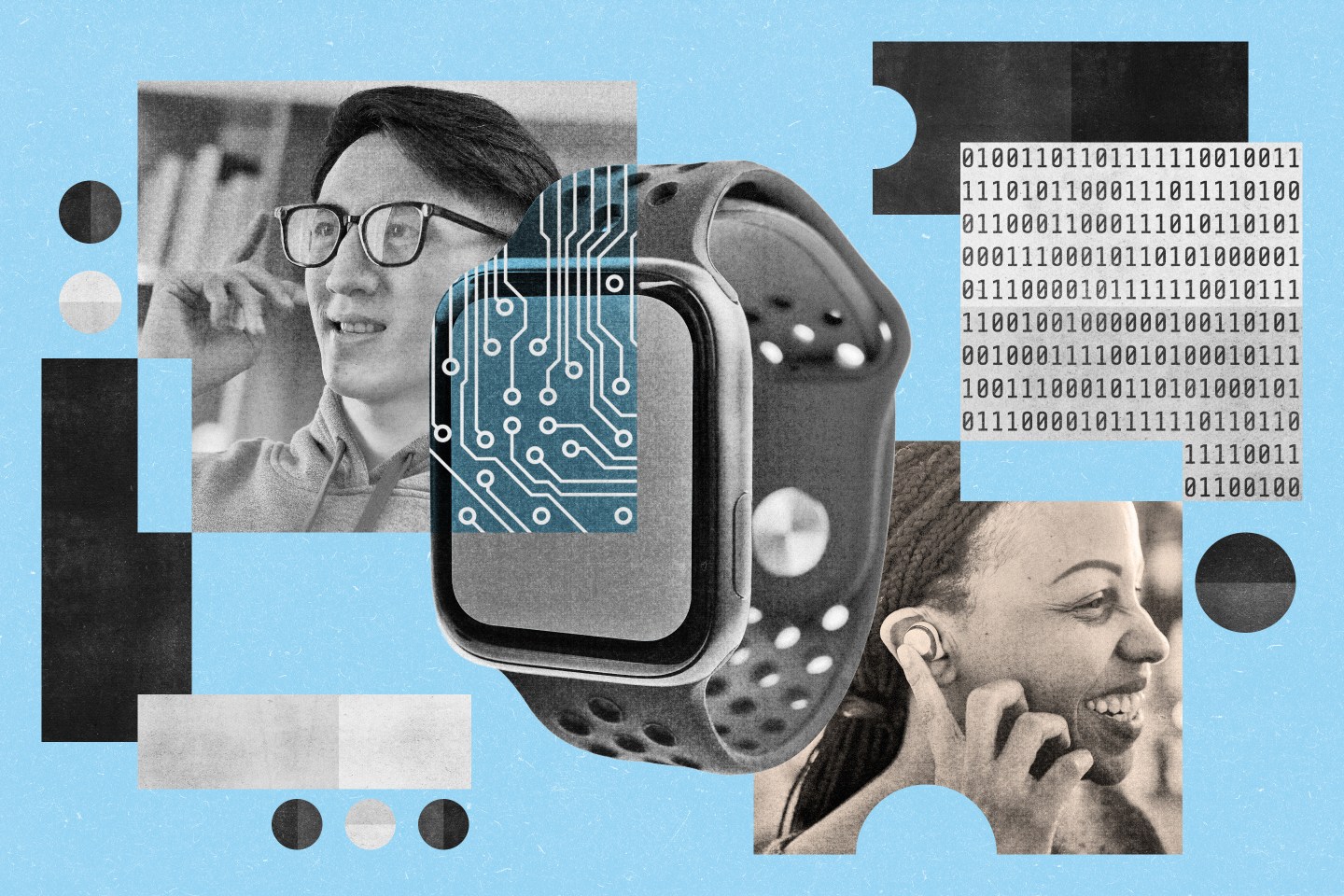
Within the next 10 years, our phones will no longer be our primary personal device. That’s pretty universally agreed upon in Silicon Valley among tech executives, including those at Apple, the major winner of the smartphone era.
That’s because computers and phones weren’t made for AI. Our devices were made to be responsive to our prompts, not to anticipate our needs. In the AI era, this will flip, and a consumer device will prevail that can see, hear, and learn in real time—becoming a proactive, hyper-personalized guide through life. This will be made possible by AI agents, which will increasingly be able to learn, sense, and react to a constant stream of real-time data, and by the shift to next-generation 6G wireless networks.
The gadgets best suited for this new reality are still in the evolutionary phase, with the various tech industry titans all seeking to advance their vision. Google and Meta are developing smart glasses with cameras that can listen and observe. OpenAI has acquired legendary iPhone designer Jony Ive’s hardware startup, io, for $6.5 billion to develop a family of AI-powered consumer devices.
The person with perhaps the best insight into what will replace our handheld obsession is Cristiano Amon, CEO of Qualcomm.
You may not know what Qualcomm does, but you almost certainly interact with its products on a daily basis. Depending on which car you drive, which computer you use, or what phone you have, there’s a high chance Qualcomm’s chips are inside it. Roughly 5 billion devices globally are powered by Qualcomm chips. The company, which ranks No. 117 on the Fortune 500, has partnerships with virtually every major tech player building the AI devices of the future except Apple—from Meta to OpenAI.
I recently sat down with Amon at Qualcomm’s Sorrento Valley, Calif., campus to discuss the 6G future and the devices that will define it, for my podcast, Fortune 500: Titans and Disruptors of Industry. Here are the key lightly edited excerpts.
What is 6G, exactly?
Every even-number generation of wireless is huge: 2G was huge; 4G was huge; 6G is going to be huge for that reason alone. But beyond the number, it’s one of the biggest transitions we’re going to see in wireless—and it’s going to be way beyond how we think about wireless connectivity. It’s also going to be how AI is going to be part of the networks.
If you look at how telecom started, you had a dial tone to call somebody. Today, it’s very, very different—you have a very high-capacity data network where you do things like stream TV on demand. It’s way beyond calling somebody. I think that type of transition is also going to happen when we go to 6G.
Why AI agents require new kinds of personal devices:
We talk about agents a lot. With agents, we are going to see a new class of AI devices. Glasses, for example, are very natural—because if they understand what we say, what we hear, and what we see, glasses are very close to all those senses. They sit near your eyes, your ears, your mouth—it’s going to be very important context for agents to do things for you. So one of the features of 6G is, I need to have a network that everything I see can get streamed to the cloud at high performance and speed. All of us are going to be walking cameras.
How much longer will we have smartphones as our primary device?
This year will be the year of agents. You’ll start to see more form factors of things people wear. By 2027, 2028, you’ll start to see workload shift [from phones to AI agent devices]. In the next five years, it’s very possible those devices will be in the hundreds of millions, heading toward a billion [agentic AI devices].
What the future personal AI device will look like:
I am bullish on glasses. Humans are very comfortable with glasses. You turn your head, that’s where the camera is going to see what your eyes are seeing. They’re very close to your ear and very close to your mouth. You’re going to read something and the camera can read it. So glasses, I think, will be the primary form factor.
There are some secret form factors that I cannot tell you about. We’re working with pretty much all of them, from OpenAI to Meta. You have different things that people wear—glasses is the easiest one to understand, but also jewelry, pins, and pendants.
For example, you’ll be walking around with glasses, and you’re going to see something you really like. You’ll say, “I’d like to buy this. How much is it on Amazon?” Or, “Can you render how I’m going to look with this on?” It’s going to be a different kind of low-friction experience, and workloads are going to start to shift. Certain things you’re going to do with an agent.
Which company is best positioned to be the Apple of AI devices?
With wearables, you have a mix of fashion and technology. Eyewear companies, for example, can become technology companies—and their valuations are going to expand, because you’re still going to be buying a fashion device.
Would you believe a consumer electronics company will make one pair of glasses that everyone wears? Or will people pick the brand they want? You’re going to see more things that we wear becoming smart, and it’s going to create a new set of players. One thing I can tell you with precision is that in every new generation of wireless, the players change as the industry changes. So I think we’re going to see that again.
AI devices will be more horizontal with less concentration, because not everybody wears the same clothes or the same glasses. The key thing is going to be the control point. Where it used to be the operating system and the app store, that’s now going to be agents. There will be new classes of devices that you’re going to use with your agent of choice.
This is also going to further separate who should be the custodians of all this personal data. Who are the trusted companies, and who are not?
Is society ready for always-streaming AI devices?
I am not one of those that think AI is going to be better than humans. I look at AI as a very powerful tool. [Like all technology] it can be misused. But it’s going to be probably as big of a change as when the internet arrived—and we survived that.
The question of trust, and which companies deserve access to the trove of data that the 6G era will generate, will be the battleground for the next decade. The future winner won’t just be the one with the best product. It will be the one consumers and enterprises trust to let into the most intimate parts of their daily lives, ultimately replacing the device they can’t imagine living without today.
Read more about how artificial intelligence is changing the way businesses operate, compete, and succeed in Fortune’s Special Digital Issue: The AI Economy.