Friday marked one of the biggest days in stock market history as SpaceX, the most hotly anticipated stock market debut ever, blew past expectations in its first day of trading. Elon Musk’s rocket, satellite, and AI empire made its long-awaited debut on both the Nasdaq Global Select Market and Nasdaq Texas under the ticker SPCX, capping a 24-year run as the most valuable, and most scrutinized, private company in the world. SpaceX opened at just above $150 a share (up 11.11% from the $135 IPO price) just after 11:46AM. Trading turnover exceeded $11.4 billion at open.
The valuation surged Musk’s net worth above $1 trillion and SpaceX’s valuation to more than twice that—with the company’s market cap reaching $2.1 trillion.
The official trading start was delayed due to intense order matching activity, in which investors who refreshed brokerage accounts on Friday morning saw that SPCX was public, but there were no trades.
At noon Friday, the stock was hovering between $162 and $165. By 1PM, it soared to $175, up nearly 30% from its target price, before settling at above $169. An hour later, SpaceX traded more than 360 million shares, 10 times the total volume that 2026’s second-largest IPO, Cerebras, posted in its first day of trading.
Thirty minutes before market close, the stock remained steady at just over $162, and more than 172 million shares were traded on Nasdaq alone, taking over a record previously held by Nokia, which became the second-most active stock on the exchange.
SpaceX closed at $161.11, marking its historic first day of public trading on the Nasdaq with a surge of nearly 20%.
By midafternoon, SpaceX’s merch store began selling eight new items to honor their IPO. They include a $45 tote bag and a $15 sticker reading the SPCX ticker, as well as two separate t-shirts reading “The future is public.”
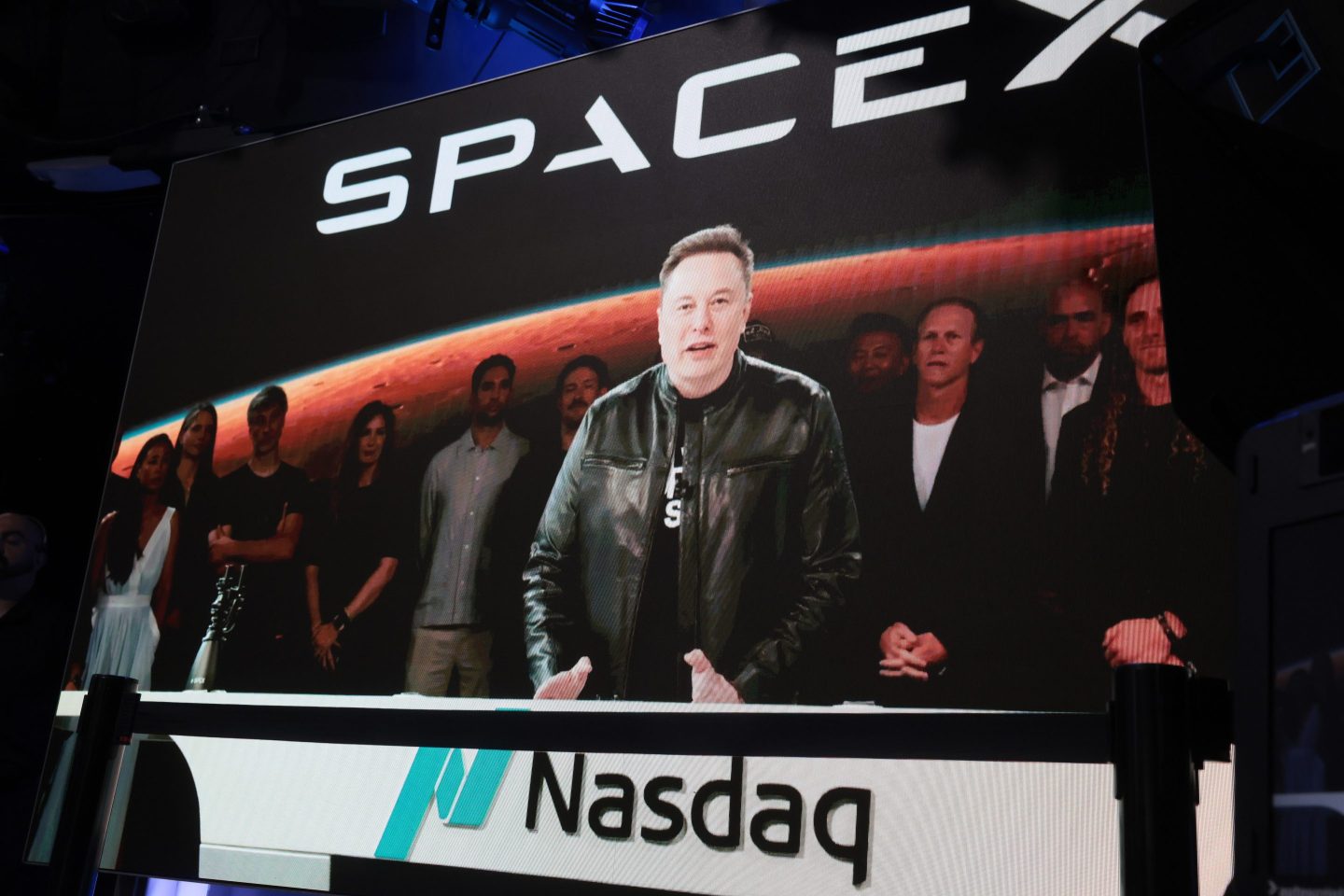
Musk addresses SpaceX employees at Nasdaq before debut
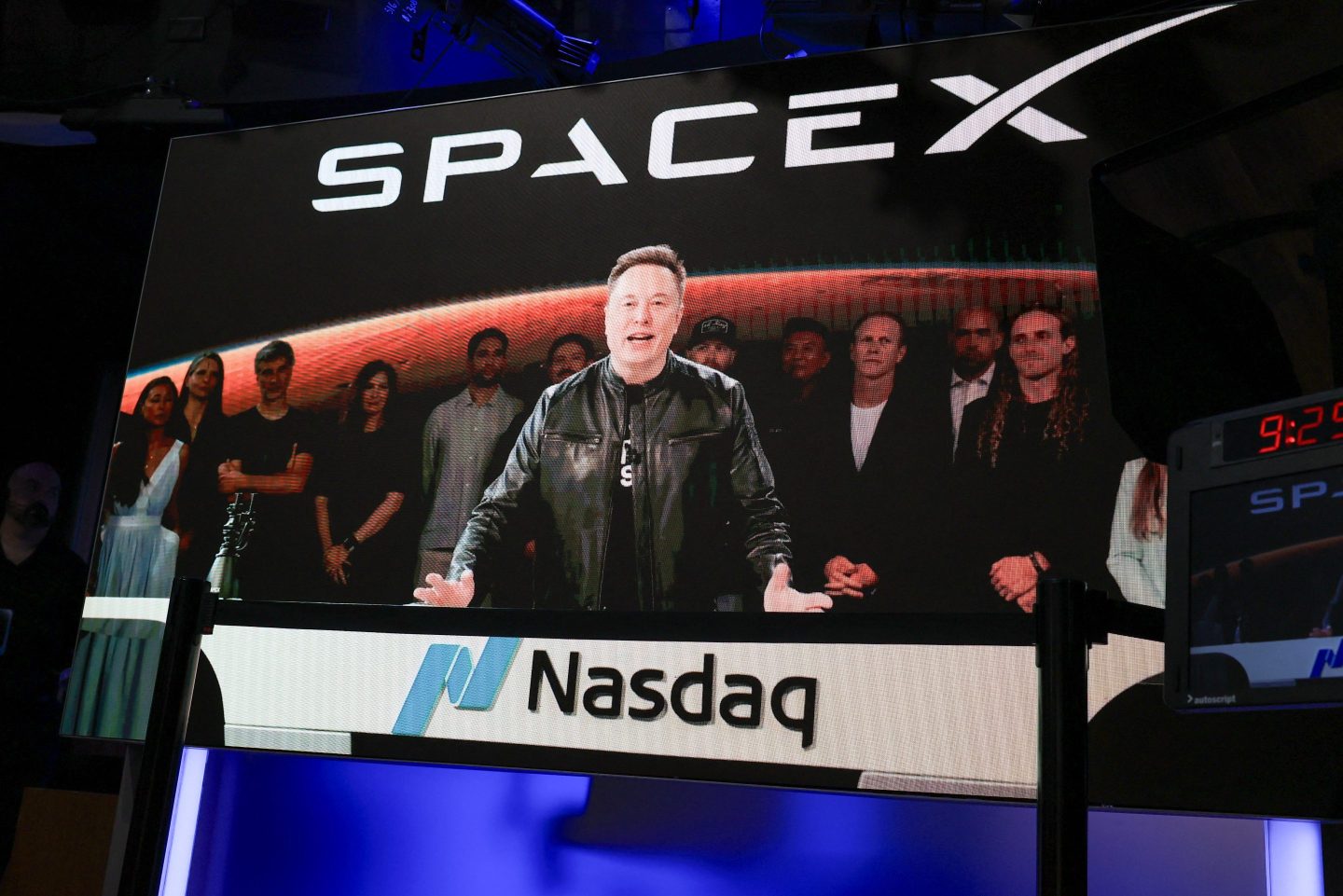
Ahead of the debut, the rocket, satellite and AI company’s CEO Elon Musk addressed Nasdaq in Texas, reiterating the company’s extraterrestrial goals. “SpaceX wants to be able to take you to the moon,” Musk said. “I am confident at this point that with the incredible team that we have here at SpaceX, that we will do that for you.”
He told the crowd of SpaceX employees at Nasdaq’s Starbase, Texas location that at first, he didn’t have high hopes for the company that today, could potentially make him the world’s first trillionaire. “I gave SpaceX less than a 10% chance of succeeding at all.”
Still, he said, after more than two decades of prototypes, failed launches and eventual success that has culminated in the Falcon 9 Block 5—the world’s most reliable rocket—Musk said that his initial out-of-this-world fascination still remains at the company.
“That’s what SpaceX is all about, is take science fiction and create an exciting, inspiring future for everyone,” Musk said. “We want to be able to take anyone who wants to go to the moon, anyone who wants to go to Mars… not just a few astronauts, I mean, you, literally you.”
“There are always problems on Earth,” he concluded, moments before Elton John’s ‘Rocket Man’ started playing. “But there also have to be things that get you excited about the future, that make you glad to wake up in the morning, because you can’t wait to see what happens next.”
At New York’s Nasdaq, SpaceX CEO Gwynne Shotwell rang the opening bell, with SpaceX employees wearing green shoes in a nod to the IPO’s “greenshoe” overallotment option. Fortune’s Shawn Tully explained how this mechanism allows underwriters to sell additional shares in an IPO to ensure stability while responding to the increase in investor demand.
Speaking at the Times Square ceremony after ringing the opening bell, Shotwell said, “Today, we make history again, and we have a history of making history. We’re about 22,000 strong, and thanks go to all of you for hanging in there, for keeping a straight spine as the doubters doubt, to achieve historic things every day.”
The offering priced Thursday afternoon—which was announced in a free-writing prospectus filed with the SEC just after 3 p.m. ET, while markets were still open—was at $135 a share for 555.6 million shares, raising the $75 billion the company targeted and valuing it at $1.77 trillion. Underwriters hold a 30-day option to purchase up to 83.3 million additional shares, which would lift the total raise to $86.25 billion.
That valuation makes it the largest IPO in stock market history: the raise is nearly triple the previous record, set when Saudi Aramco collected $25.6 billion on Riyadh’s exchange in December 2019 at a $1.71 trillion valuation. (One caveat for the record books: in inflation-adjusted terms, Aramco raised the equivalent of $33.2 billion at a $2.21 trillion valuation—so by that measure, the Saudi oil giant’s crown isn’t fully relinquished.) The offering covers only about 4% of SpaceX’s roughly 13.08 billion shares outstanding, making the company worth more today than Tesla was the day it became the world’s most valuable automaker.
The $1.77 trillion price tag instantly makes SpaceX the sixth-most valuable company in the U.S. and seventh-most valuable worldwide, ahead of Meta and Tesla—despite posting a $4.9 billion net loss in 2025 on $18.7 billion in revenue, the vast majority of it from Starlink. At the IPO price, investors are paying roughly 94 times trailing revenue for a company whose combined entity with xAI has racked up an accumulated deficit of $41.3 billion.
And unlike most newly public companies, SpaceX won’t have to wait long for index money to find it. Don’t look for it in the S&P 500: the benchmark requires sustained profitability, which SpaceX doesn’t have. But under a Nasdaq rule change that took effect in May, megacap debuts can join the Nasdaq-100 in as little as 15 trading days rather than the usual three months, and FTSE Russell and other index providers have agreed to fast-track inclusion as well—meaning trillions of dollars in passive retirement and pension money could soon hold SpaceX whether savers chose it or not.
How people are reacting to the debut
Sen. Bernie Sanders, a long time vocal opponent of the billionaire class who has sometimes publicly shared some words with the SpaceX founder, called it an “absurdity” for the world’s first trillionaire to pay the same in taxes as someone who makes less than $200,000 a year.
“Today, Elon Musk, a trillionaire, pays the same amount into Social Security as someone making $184,500,” the Vermont senator said on X, owned by Musk. “If we end that absurdity and lift the cap on taxable income, we can make Social Security solvent for 75 years and expand benefits by $2,400. My Social Security bill does that.”
Sanders’ colleague Sen. Elizabeth Warren also expressed concern with Musk’s wealth.
“Elon Musk just became the world’s first trillionaire,” Warren wrote on X. “The typical American household would have to work more than 11 MILLION years to make Elon Musk’s level of wealth.”
Fortune’s Eva Roytburg was on scene outside Nasdaq before the stock opened on Friday, where supporters of Musk and the company were spotted wearing astronaut costumes and discussing their potential ownership of the stock. A few blocks away, about two dozen protesters were outside the JP Morgan Chase headquarters chanting “shame, shame, shame” at Musk’s new trillionaire status.
“The same man who cut children’s cancer research is now a trillionaire,” read another post from the Democratic party.
New York City Mayor Zohran Mamdani used Musk’s new decimal place to bring it back to one of his campaign promises. “Reason #1,000,000,000,000 why we should tax the rich,” the Democratic-socialist mayor posted on X.
On the other side of the aisle, President Donald Trump’s son Eric reposted a Kalshi post that read: “JUST IN: SpaceX is now worth more than Canada.” In his repost, Eric Trump wrote: “LOL… This is amazing.”
A16Z general partner Katherine Boyle on X repeated a line from Musk’s address to employees and added “Only in America. Congratulations to @elonmusk @SpaceX. This is the American Dream.”
The road to Wall Street
After more than a decade of fueling fanfare over the possible public offering of his company, Musk would often dangle a possible IPO just to dismiss it almost immediately afterwards. For the most part of the last 14 years, a SpaceX IPO became a running joke among investors: Musk would repeatedly promise a public offering at a later date, just for that date to arrive and for Musk to call those claims speculative at best. In 2012, he told Bloomberg there was “a good chance that SpaceX goes public next year.” A few years later, he said the company would only go public after the Mars Colonial Transporter, the precursor to Starship, began shuttling humans to Mars.
In 2019, he told SpaceX employees in an email it would “make sense to take Starlink public in about three years or so,” and in 2020, he promised again an IPO, “but only several years in the future when revenue growth is smooth and predictable. Public market does not like erratic cash flow.” Musk was still playing defense in 2024, after SpaceX ran a $112-a-share insider tender that valued the company at roughly $210 billion (up from $180 billion in a tender just months earlier). He pointed to the litigation over his Tesla pay package as a reason SpaceX should remain private, posting that “the legal load and pressure for short-term results for a public company are very high.”
It may be that very rationale that changed his mind when reports of yet another will-he-or-won’t-he with regard to a SpaceX IPO resurfaced last year. The rise of orbital AI compute, coupled with Starship’s maturation to the point where demands for capital would dwarf whatever private markets would be able to cleanly supply, could be the reason why Musk finally chose to file an S-1 on April Fools’.
The public S-1 dropped on May 20, and the subsequent road show launched on June 4, a week earlier than expected as the SEC completed its review ahead of schedule. The roadshow—where a company’s executives and underwriters pitch their stock offering to institutional investors—drew $250 billion in orders and was underwritten by a 21-bank syndicate, led by Goldman Sachs and with Morgan Stanley, Bank of America, Citigroup and JPMorgan rounding out the top five.
There’s one big concern hanging over the debut: Starship, the vehicle at the center of SpaceX’s most ambitious projections, is currently grounded while the FAA conducts a mishap investigation into its most recent test flight.
An unconventional man whose ideas are out of this world
Musk founded SpaceX in 2002 as a means to answer what many children eventually grow out of the habit of asking: what’s out there on the red planet? Now, the IPO could make the man with extraterrestrial sights the first trillionaire in history.
Using $100 million of his PayPal proceeds, Musk visited Russia three times to buy refurbished Intercontinental Ballistic Missiles (ICBMs) for a Mars greenhouse stunt. Upon his return, he realized rocket materials accounted for roughly 2% of a typical launch cost, and he decided to build some himself. Throughout the years, he launched several liquid-fueled rockets—some fell, and some fell flat—and would eventually call for data centers and even communes on Mars.
However, the 300-plus-page IPO prospectus itself claims a total addressable market of $28.5 trillion, a figure the company calls the largest in human history, even as it acknowledges the speculative and “improbable” nature of its Mars timeline.
The IPO is as unconventional as the man behind it. Usually, most companies set a price range and let the book-building process find the clearing price. In this case, SpaceX simply told investors what the stock would cost, fixing $135 a share before the roadshow even began, and making Thursday night’s pricing a formality. It also reserved roughly 30% of shares for retail investors, about three times the typical allocation for an offering of this size.
As a result, it’s close to four times oversubscribed: investors placed more than $250 billion in orders, roughly three and a half to four times the shares on offer, meaning many buyers will receive a fraction of what they requested, or nothing at all. Post-offering, Musk will retain control through a multi-class share structure that, according to a letter from New York’s state and city comptrollers and the head of CalPERS, gives him as much as 85% of voting power despite owning about 42% of the equity. As the pension officials put it, removing the company’s most powerful officer would, as a mathematical matter, require his own vote, making him effectively unfireable without his consent.
Morningstar, the market’s most prominent bear, pegs SpaceX’s fair value at $780 billion, or roughly 55% below the IPO valuation. It argued that neither a rapidly reusable Starship nor commercially competitive orbital data centers has been demonstrated, and that retail investors will likely find better entry points after listing.
History is written by the victors
The hype surrounding SpaceX’s debut left analysts wondering ahead of Friday whether the stock could possibly live up to it. Historically, among the largest public offerings on record, the odds of a company posting negative returns in its first three months are roughly a coin flip.
Take Saudi Aramco, the previous record holder: it rose 10% on its first day in December 2019, briefly pushing its valuation to about $1.88 trillion and past Apple as the world’s most valuable listed company. Within months, amid the oil crash and COVID selloff, it had fallen below its offer price.
You can blame oil markets for that one, but the tech-growth story powering SpaceX is the same one that plagued Facebook’s May 2012 debut. The social network fell nearly 50% in its first three months and traded below its $38 offer price for more than a year before becoming one of the best-performing mega-cap IPOs ever. Internationally, SoftBank Corp dropped 14.5% on its first day in Tokyo in December 2018 and spent years below its offer price.
Other companies thrived in the months following their IPO, and even eked out a path to secure strong market domination during some of the economy’s worst years. Six months before Lehman Brothers collapsed, Visa raised $17.9 billion in March 2008 and thrived through the Great Recession. The largest U.S. IPO previously belonged to Alibaba, which raised $21.8 billion in 2014 and earned the company a $231 billion market cap at listing.
SpaceX is the first of a hotly anticipated “IPO summer.” Anthropic filed its confidential S-1 on June 1; OpenAI followed a week later, targeting a September debut at an $852 billion valuation. If both land before year’s end, 2026 will close as the year public markets finally had to price artificial general intelligence.